24-Hour Urine Collection: Complete Guide
Learn how to properly collect a 24-hour urine sample for accurate kidney health assessment.
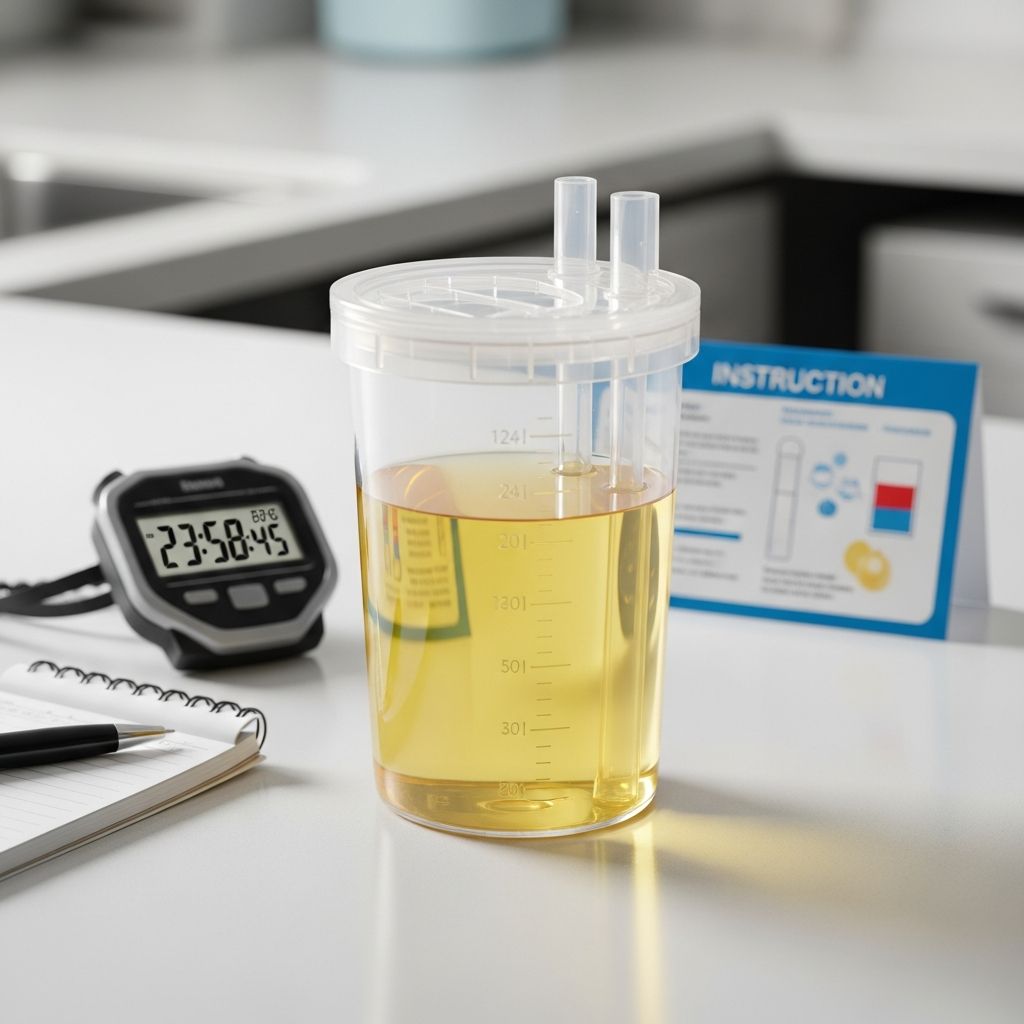
Understanding the 24-Hour Urine Collection Test
A 24-hour urine collection is an important diagnostic test that measures the components of your urine over a full day to assess your kidney function and overall health. This test requires you to collect all of your urine in a special container provided by your healthcare provider over a continuous 24-hour period. The collected sample provides valuable information about how your kidneys are filtering waste products and maintaining proper chemical balance in your body.
Healthcare providers order this test to evaluate kidney function, detect protein in urine, identify causes of kidney stones, and diagnose various metabolic disorders. Unlike a routine urinalysis that examines a single sample, the 24-hour collection provides a comprehensive measurement of substances excreted by your kidneys throughout an entire day, making it far more informative for assessing your overall renal health.
Why Your Doctor Orders a 24-Hour Urine Collection
Your healthcare provider may recommend a 24-hour urine collection for several important clinical reasons. This test helps evaluate kidney function by measuring creatinine clearance, which indicates how effectively your kidneys are filtering waste from your blood. The test can also detect abnormal levels of protein, calcium, glucose, and other substances in your urine that may indicate kidney disease or other metabolic conditions.
Specific conditions that warrant this test include suspected kidney disease, recurrent kidney stones, high blood pressure, diabetes, certain cancers, and various metabolic disorders. The test is particularly valuable for patients with a family history of kidney disease or those experiencing symptoms such as swelling, fatigue, or changes in urination patterns. Additionally, healthcare providers use this test to monitor the effectiveness of treatment plans and to establish baseline measurements for ongoing patient care.
Preparing for Your 24-Hour Urine Collection
Proper preparation is essential for obtaining accurate test results. Before beginning your collection, contact your healthcare provider to clarify any specific instructions or restrictions that may apply to your particular situation. Different types of 24-hour urine tests may have varying requirements regarding diet and medications.
Dietary and Medication Considerations:
- Ask your provider which foods and beverages you should avoid during the collection period
- Inform your provider about all medications and supplements you are taking
- Do not stop taking any medications without explicit approval from your healthcare provider
- Clarify whether you should maintain your normal diet or follow specific dietary restrictions
- Determine if you need to limit fluid intake or can drink normally
Most patients are advised to maintain their normal diet and fluid intake during the collection period unless their healthcare provider specifies otherwise. This ensures that the test results accurately reflect your typical daily kidney function. However, certain tests may require dietary modifications, such as limiting sodium intake or avoiding foods high in calcium or oxalate. Always follow your provider’s specific instructions carefully, as improper preparation can lead to inaccurate results.
Step-by-Step Collection Procedure
Understanding the correct collection procedure is critical for obtaining a valid sample. Following these steps precisely ensures that your sample accurately represents your full 24-hour urine output.
Related Stories



Starting Your Collection:
- Select a convenient day when you will be home and able to collect all urine samples
- Upon waking in the morning, urinate into the toilet as you normally would and flush
- Note the exact time you emptied your bladder—this is your official start time
- Write the start date and time on your collection container label
- Your bladder is now empty and ready to begin the 24-hour collection period
During the 24-Hour Collection Period:
- Collect every drop of urine passed during the next 24 hours
- Each time you urinate, collect the specimen in a clean, dry container first
- Carefully pour the urine into your labeled collection bottle without spilling
- If you have a bowel movement, collect urine separately to avoid contamination
- Keep the collection container closed, cool, and protected from light between collections
- Store the container in a safe location away from children and pets
Completing Your Collection:
- On the morning of day two, exactly 24 hours after starting, urinate into the collection container
- The timing should be precise—within 5 to 10 minutes of your original start time
- Add this final specimen to the bottle to complete your 24-hour collection
- Record the exact end date and time on your collection container label
- Ensure the container cap is firmly sealed
- Place the sealed container in the provided protective bag
Important Collection Guidelines
Accuracy depends on following specific guidelines throughout the collection process. The volume of urine you collect is less important than ensuring you capture every drop passed during the 24-hour period. Test results are calculated based on the total urine output over 24 hours, so any missed specimens will compromise the accuracy of your results.
Key Points to Remember:
- Never urinate directly into the collection container—always use an intermediate clean container first
- Do not discard any urine during the 24-hour collection period
- If you accidentally miss a specimen or contaminate the collection, abandon the attempt and restart on another day
- If you expect to produce more than five liters of urine, request additional containers before starting
- Do not use containers other than those provided by your laboratory
- Keep the container refrigerated or in a cool location throughout the collection period
After Your Collection: Submitting Your Sample
Once you have completed your 24-hour collection, proper handling and timely submission are crucial for maintaining sample integrity. Transport your sample to the laboratory as soon as possible, ideally within 24 hours after finishing your collection. Keep the container cool during transport to prevent degradation of the specimen.
Verify that your collection container label includes all necessary information: your full name, date of birth, the clinic or healthcare provider that requested the test, and the precise start and end dates and times. Double-check that the container cap is firmly sealed to prevent leakage during transport, which would invalidate your sample and require repeating the entire collection process.
Most laboratories will process your urine test within a few days, though some specialized analyses may require additional time. Your healthcare provider will receive the detailed results and will discuss the findings with you at your follow-up appointment.
Understanding Your Test Results
Your 24-hour urine collection results provide specific measurements that help your healthcare provider evaluate your kidney function and overall health. Standard analyses typically measure urine volume, creatinine, protein, calcium, sodium, potassium, and other electrolytes. The specific components measured may vary depending on the reason your provider ordered the test.
Reference ranges are provided with your results to help your healthcare provider interpret whether your values fall within normal limits. Abnormal results may indicate kidney disease, electrolyte imbalances, risk factors for kidney stone formation, or other metabolic disorders. Your provider will explain what your specific results mean and discuss any necessary follow-up testing or treatment options.
Common Challenges and Solutions
Many patients find the 24-hour urine collection challenging due to its time-consuming nature and the need to remember to collect every specimen. Understanding common difficulties can help you prepare and overcome obstacles.
| Challenge | Solution |
|---|---|
| Forgetting to collect a specimen | Set phone reminders, use a checklist, or collect into a container you carry with you |
| Insufficient container space | Request additional containers before starting your collection |
| Spillage or contamination | Use a funnel for easier pouring and handle the container carefully during transport |
| Difficulty collecting from females | Request a collection hat or funnel to make collection easier and cleaner |
| Trouble remembering exact timing | Write your start time prominently on the container label and set an alarm for your end time |
Special Considerations for Different Populations
Children: Parents collecting urine from children should plan the collection on a day when the child will be home. Females can use a toilet hat, while males can use a urinal or collection device. Explaining the procedure in age-appropriate language helps children understand the importance of collecting every specimen.
Patients with Multiple Conditions: If different tests require different preservatives, you may need to collect urine into separate containers during different 24-hour periods. Your laboratory will provide specific instructions for multiple collections.
Patients with Mobility Issues: Contact your healthcare provider to discuss accommodations or alternative collection methods if you have mobility challenges that make standard collection difficult.
Frequently Asked Questions
Q: What if I accidentally miss collecting one urination during the 24 hours?
A: If you miss collecting a specimen, it is better to discard the entire collection and start over on another day rather than submit an incomplete sample. Partial collections produce inaccurate results that could affect important treatment decisions. Many people experience collection errors despite their best efforts, and repeating the test ensures reliable results.
Q: Can I collect my 24-hour urine sample over a weekend or while traveling?
A: Yes, you can collect your sample over any 24-hour period, including weekends. However, you should be home or in a location where you can safely and privately collect each specimen. Traveling during your collection period is not recommended because it makes proper collection difficult and increases the risk of spillage or contamination.
Q: Do I need to follow a special diet during my collection?
A: Unless your healthcare provider specifies dietary restrictions, maintain your normal diet and fluid intake during the collection period. This ensures your results accurately reflect your typical kidney function. Some tests may require specific dietary modifications, so always confirm with your provider.
Q: Should I refrigerate my collection container?
A: Yes, keep your collection container cool and protected from light throughout the 24-hour collection period. Refrigeration helps preserve the specimen and prevents degradation of the substances being measured. Ensure the container remains closed between collections.
Q: How long does it take to get my results?
A: Most routine 24-hour urine tests are processed within a few days. However, specialized analyses may require additional time. Your healthcare provider will notify you when your results are available and will discuss the findings with you.
Q: What if I cannot complete a full 24-hour collection?
A: Shorter collections, such as 8- or 12-hour periods, may be acceptable in some circumstances and can improve patient adherence. However, 24-hour collections are generally preferred because they account for daily variations in creatinine and solute excretion. Discuss alternative collection periods with your healthcare provider if a full 24-hour collection is not feasible.
References
- 24-Hour Urine Protein — MedlinePlus Medical Encyclopedia, U.S. National Library of Medicine. 2024. https://medlineplus.gov/ency/article/003622.htm
- 24-Hour Urine Collection and Analysis — StatPearls, National Center for Biotechnology Information. 2024. https://www.ncbi.nlm.nih.gov/books/NBK482482/
- 24-Hour Urine Test: What It Is, Purpose, Procedure & Results — Cleveland Clinic. 2024. https://my.clevelandclinic.org/health/diagnostics/24-hour-urine-test
- How to Collect a 24 Hour Urine Sample — Cambridge University Hospitals NHS Foundation Trust. 2024. https://www.cuh.nhs.uk/patient-information/how-to-collect-a-24-hour-urine-sample/
- 24-Hour Urine Sample Collection Instructions — UNC Health Rex. 2024. https://www.rexhealth.com/rh/care-treatment/lab-services/forms-instructions/24-hour-urine-sample/
Similar Articles








Read full bio of medha deb