4 Types of Knee Implants: Understanding Your Options
Explore the different types of knee implants available for joint replacement surgery and their benefits.
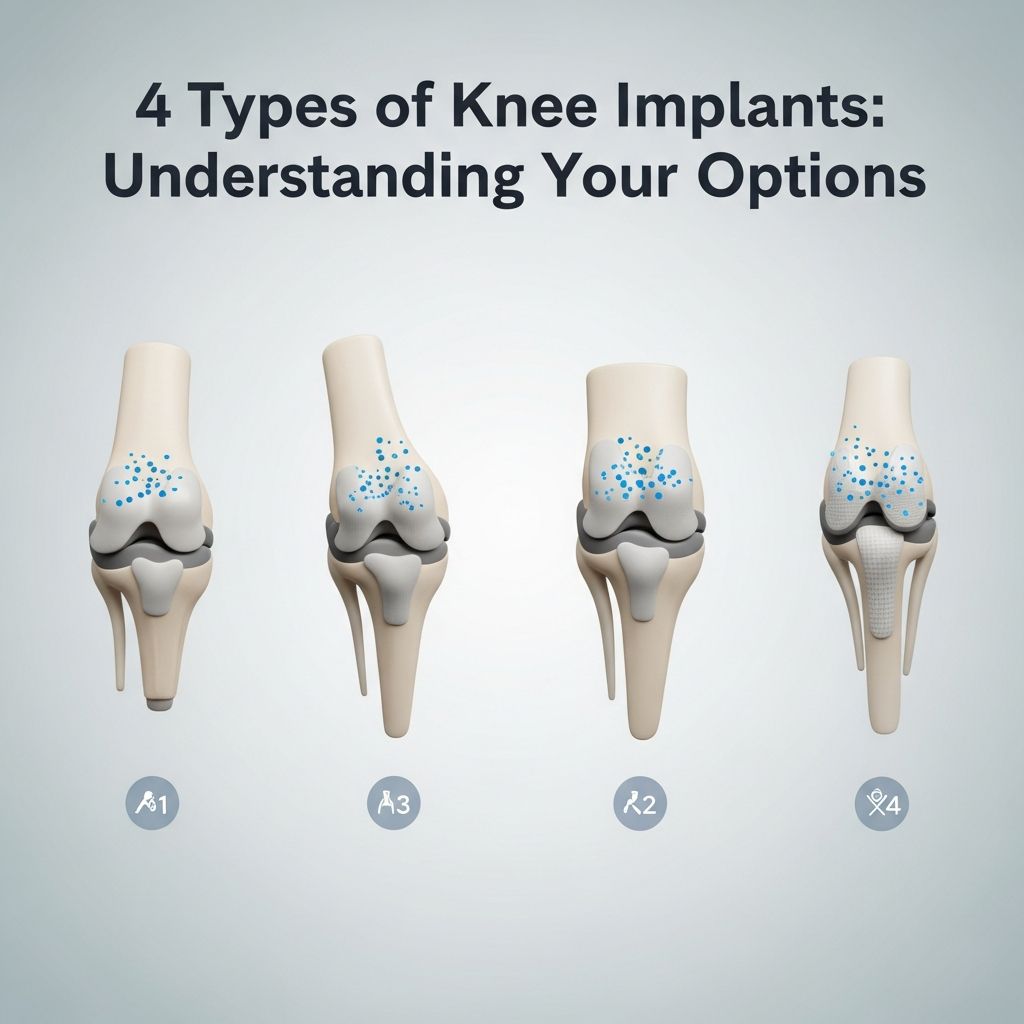
Understanding Knee Implants: A Comprehensive Guide to Your Options
Knee replacement surgery, also known as knee arthroplasty, is one of the most frequently performed orthopedic procedures in the United States, with more than 700,000 procedures conducted annually. When your knee joint becomes damaged due to osteoarthritis, rheumatoid arthritis, or injury, knee replacement may be recommended to restore function and reduce pain. The success of your knee replacement depends significantly on the type of implant selected for your specific condition. Understanding the different types of knee implants available can help you make an informed decision with your orthopedic surgeon.
What Are Knee Implants?
Knee implants, also known as prostheses or artificial joints, are sophisticated medical devices designed to replace damaged portions of your knee joint. These implants are typically composed of metal alloys, high-grade plastics, and sometimes ceramic materials. Modern knee replacement implants have been engineered to closely mimic the natural knee joint’s movement and function, allowing patients to resume many of their regular activities following recovery.
The durability of modern knee implants has significantly improved over the decades. Most knee implants will last for 20 years, and with proper care and maintenance, they may last even longer. If you maintain a healthy lifestyle, attend regular medical appointments, and avoid activities that accelerate wear and tear, your knee replacement could provide decades of reliable function.
The Four Main Types of Knee Implants
Knee implants vary based on their design, material composition, and the extent of joint replacement they provide. Below are the four primary types of knee implants available today:
1. Posterior Stabilized (PS) Implants
Posterior stabilized knee implants are among the most commonly used designs in total knee replacements. These implants feature a specialized design that includes a post on the tibial (shin bone) component and a corresponding cam on the femoral (thigh bone) component. This mechanical design helps to stabilize the knee joint and provides additional support when extending and bending the leg.
PS implants are particularly beneficial for patients who have lost the function of their posterior cruciate ligament (PCL), one of the major ligaments in the knee. The built-in stabilization mechanism allows patients to achieve excellent range of motion and improved functional outcomes. These implants have a proven track record of long-term durability and are suitable for patients with moderate to severe knee damage.
2. Cruciate-Retaining (CR) Implants
Cruciate-retaining knee implants represent an alternative approach to total knee replacement that preserves the patient’s natural posterior cruciate ligament. These implants are designed to work in harmony with your existing PCL, maintaining more of your natural knee anatomy during the replacement procedure.
The primary advantage of CR implants is that they preserve natural knee biomechanics and proprioception, which is your body’s ability to sense the position and movement of your knee. Many patients report improved knee sensation and a more natural feeling of movement with CR implants compared to other designs. However, these implants are not suitable for all patients, particularly those whose PCL has been damaged or is non-functional.
Related Stories



3. Medial Pivot Implants
Medial pivot knee implants are a specialized design that attempts to more closely replicate the natural motion of the knee joint. These implants feature a unique articulation pattern where the femur rotates around a fixed point on the tibia, similar to how a natural knee functions during normal movement.
This design can provide patients with a more natural knee motion pattern, potentially improving walking mechanics and reducing abnormal stress on the implant. Medial pivot implants are gaining popularity among surgeons and patients seeking a more physiologically accurate replacement option. They may be particularly beneficial for younger, more active patients who want to maintain a natural gait pattern.
4. Partial Knee Implants (Unicompartmental Replacements)
Partial knee implants, also referred to as unicompartmental knee replacements, are used when arthritis or damage is confined to only one compartment of the knee joint. The knee has three compartments: medial (inner), lateral (outer), and patellofemoral (under the kneecap). In some cases, only one of these compartments requires replacement.
Because a partial knee replacement is performed through a smaller incision, the surgery is quicker, the hospital stay is shorter, and patients can rehabilitate and return to normal activities faster compared to total knee replacement. Partial knee implants preserve more of your natural knee anatomy and may provide a more natural feel during movement. However, they are only applicable to a small number of patients whose damage is truly limited to a single compartment.
Comparing Knee Implant Types
| Implant Type | Coverage | Natural Ligament Preservation | Recovery Time | Longevity |
|---|---|---|---|---|
| Posterior Stabilized | Full knee joint | Does not preserve PCL | 6-12 weeks | 20+ years |
| Cruciate-Retaining | Full knee joint | Preserves PCL | 6-12 weeks | 20+ years |
| Medial Pivot | Full knee joint | Depends on design | 6-12 weeks | 20+ years |
| Partial (Unicompartmental) | One compartment | Preserves natural anatomy | 4-8 weeks | 15-20 years |
Materials Used in Knee Implants
The materials used in knee implant construction play a crucial role in their performance and longevity. Most modern knee implants consist of a combination of materials selected for their durability, biocompatibility, and wear resistance.
Metal Components: The femoral and tibial components are typically made from cobalt-chromium alloys or titanium alloys. These materials are chosen for their strength, corrosion resistance, and excellent biocompatibility with human tissue. Some advanced implants utilize innovative materials like OXINIUM, which is oxidized zirconium. This highly durable material has been lab tested to last significantly longer than conventional knee implant materials, providing extended implant lifespan.
Plastic Components: The articulating surface often uses ultra-high-molecular-weight polyethylene (UHMWPE), a durable plastic that provides excellent wear resistance. This material has been refined over decades to minimize wear particles that could cause implant loosening.
Ceramic Options: Some implants incorporate ceramic materials in specific components, offering alternative options for patients with specific allergies or preferences.
Choosing the Right Knee Implant for Your Needs
The selection of an appropriate knee implant should be a collaborative decision between you and your orthopedic surgeon. Several factors influence this choice, including:
Your Age and Activity Level: Younger, more active patients may benefit from implants designed to replicate natural knee motion, such as medial pivot designs. Older patients with lower activity levels might do well with proven PS or CR designs.
Your Knee Anatomy: Your surgeon will assess the condition of your ligaments, bone quality, and overall knee structure to determine which implant design is most suitable. If your posterior cruciate ligament is still functional, you may be a candidate for a CR implant.
Extent of Damage: If arthritis is limited to a single compartment of your knee, a partial knee implant may be appropriate. For multi-compartmental damage, a total knee replacement with an appropriate design will be necessary.
Your Health History: Any previous knee surgeries, implants, or complications will influence the implant selection. Your surgeon will take all of these factors into account when recommending the best option for your specific situation.
Advanced Surgical Techniques for Implant Placement
The success of knee implant surgery depends not only on choosing the right implant but also on precise surgical placement. Modern surgical techniques have revolutionized how implants are positioned for optimal outcomes. Robotics-assisted surgery, for instance, combines traditional surgical expertise with advanced technology to enhance accuracy. This approach uses handheld robotics to create customized 3D digital models of your knee and guide the surgical procedure with precision. The system sends precise information about your knee to the robotics-assisted handpiece more than 300 times per second, allowing surgeons to remove damaged surfaces, balance your joint, and position the implant with accuracy.
This advanced technology eliminates the need for invasive metal alignment rods or additional imaging like CT scans before surgery, reducing patient exposure to radiation while improving surgical outcomes.
Recovery and Long-Term Outcomes
Recovery time varies depending on the type of knee implant and the surgical technique used. Most patients can expect initial recovery to take 6 to 12 weeks for total knee replacements and 4 to 8 weeks for partial knee replacements. However, full functional recovery may take several months as you participate in physical therapy and gradually return to normal activities.
Physical therapy is a critical component of successful knee implant recovery. Working with a physical therapist helps restore strength, flexibility, and proper movement patterns, ultimately determining how well your new knee functions long-term.
It is important to note that while most modern knee implants last 20 years or more, revision surgery may eventually be necessary. Wear-and-tear, injury, or infection could require repair or replacement of the implant. Revision surgery typically takes longer to heal than primary replacement surgery because incisions are usually larger and the revision implants tend to be more invasive to install.
Frequently Asked Questions About Knee Implants
Q: How long do knee implants typically last?
A: Most modern knee implants are designed to last 20 years or longer. With proper care, regular medical checkups, and avoidance of activities that accelerate wear and tear, your implant may function well for several decades.
Q: Can I choose the type of knee implant I receive?
A: While you should discuss implant options with your surgeon, the final choice depends on your specific anatomy, the extent of knee damage, your age, activity level, and your surgeon’s professional recommendation. Your surgeon will guide you toward the most appropriate option for your situation.
Q: Will my knee implant set off metal detectors?
A: Most knee implants contain metal components that may be detected by metal detectors. Inform security personnel about your implant, and carry identification indicating you have an orthopedic implant.
Q: Can I participate in sports after knee implant surgery?
A: Many patients return to recreational activities and light sports after knee implant surgery. However, high-impact activities should be avoided as they can accelerate implant wear. Discuss activity recommendations with your surgeon.
Q: What is the difference between a total and partial knee replacement?
A: A total knee replacement replaces the entire knee joint, while a partial knee replacement replaces only the damaged compartment. Partial replacements are only suitable for patients with damage confined to a single knee compartment and offer faster recovery.
References
- Total Knee Replacement Surgery — AAD Lab (Arthritis and Arthroplasty Design Group), National Institutes of Health. 2024. https://www.aadlab.org/total-knee-replacement-surgery/
- Knee Replacement Surgery — Brigham and Women’s Hospital Department of Orthopaedic Surgery. 2024. https://www.brighamandwomens.org/orthopaedic-surgery/knee-replacement-surgery
- Revision Total Knee Replacement — Brigham and Women’s Hospital. 2024. https://www.brighamandwomens.org/orthopaedic-surgery/knee-replacement-surgery/knee-revision-surgery
- Center for Hip & Knee Replacement: Conditions & Treatment — Massachusetts General Hospital Department of Orthopaedics. 2024. https://www.massgeneral.org/orthopaedics/hip-knee/conditions-and-treatments
Similar Articles








Read full bio of Sneha Tete