5-Fluorouracil Cream: Comprehensive Guide To Use & Care
Comprehensive guide to 5-fluorouracil cream for treating actinic keratoses, Bowen's disease, and superficial basal cell carcinoma.
What is 5-fluorouracil cream?
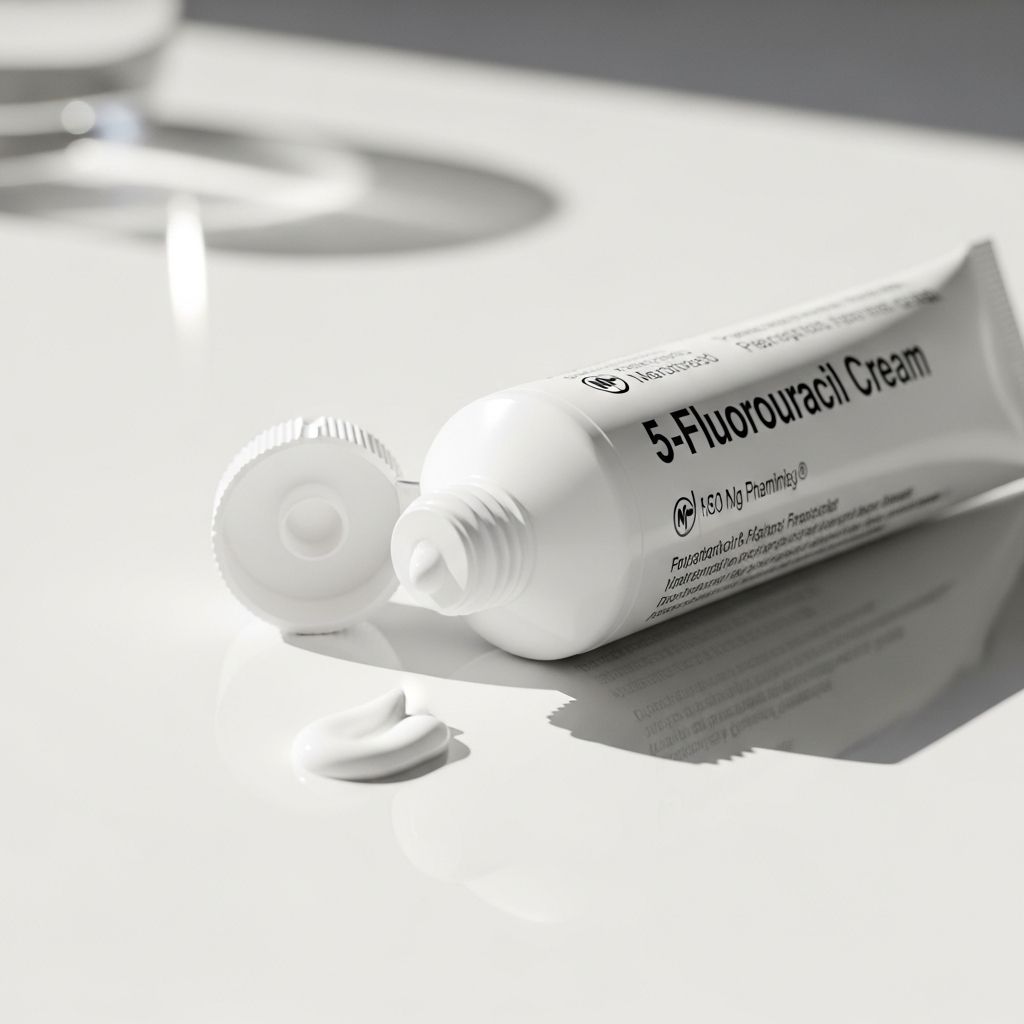
**5-Fluorouracil (5-FU) cream** is a topical chemotherapy agent used primarily in dermatology to treat pre-cancerous and superficial cancerous skin lesions. It belongs to the class of antimetabolites, which interfere with DNA synthesis in rapidly dividing cells, such as those in actinic keratoses and certain skin cancers. Available in strengths typically ranging from 0.5% to 5%, the 5% formulation is FDA-approved for multiple actinic (solar) keratoses and superficial basal cell carcinomas when surgery is impractical.
The cream targets abnormal skin cells caused by chronic sun exposure, destroying them selectively while sparing normal skin to some extent. It is prescription-only and commonly branded as Efudex, Carac, or Fluoroplex. Systemic absorption is minimal (less than 6% on normal skin, higher on diseased areas), making it suitable for localized treatment.
On this page
- What is 5-fluorouracil cream?
- What are the indications?
- How does it work?
- Pre-treatment
- What should I do before applying the cream?
- What happens during treatment?
- Side effects and complications
- Post-treatment care
- Follow-up
- Frequently Asked Questions
What are the indications for 5-fluorouracil cream?
5-FU cream is indicated for several sun-induced skin conditions:
- **Actinic keratoses (solar keratoses)**: Rough, scaly pre-cancerous lesions from UV exposure, applied twice daily for 2-4 weeks.
- **Bowen’s disease (squamous cell carcinoma in situ)**: Red, scaly patches that can progress to invasive cancer if untreated.
- **Superficial basal cell carcinoma**: Non-invasive skin cancer suitable for topical therapy when lesions are multiple or in difficult sites; 5% strength used twice daily for 3-6 weeks.
- **Off-label uses**: Viral warts, disseminated superficial actinic porokeratosis, keratoacanthomas, keloids, hypertrophic scars, and field cancerization to prevent squamous cell carcinoma in high-risk patients.
It is not suitable for invasive cancers or deep lesions requiring excision.
How does 5-fluorouracil cream work?
5-FU is converted intracellularly to fluorodeoxyuridine monophosphate (FdUMP), which inhibits thymidylate synthase, blocking DNA and RNA synthesis in proliferating cells. Sun-damaged atypical keratinocytes, which divide faster than normal cells, are selectively destroyed, leading to inflammation and eventual sloughing of treated areas. Clinical response peaks 1-2 weeks after treatment cessation as inflammation resolves.
Pre-treatment considerations
Before starting:
- Confirm diagnosis via biopsy if uncertain, especially for suspected basal cell carcinoma.
- Assess patient suitability: Avoid in pregnancy (category X), breastfeeding, DPD deficiency, or active skin infection.
- Protect untreated skin with broad-spectrum sunscreen (SPF 30+); sun avoidance is critical.
- Discuss expected reactions: Erythema, erosion, and pain are normal signs of efficacy.
How to apply 5-fluorouracil cream
Follow your dermatologist’s instructions precisely. General guidelines:
- Apply a
thin film
(pea-sized amount for small areas, 4 peas for full face) to clean, dry lesions and 2-3mm margin. - **Frequency**: Once or twice daily (night preferred for once-daily; morning/night for twice).
- **Duration**:
- Actinic keratoses/Bowen’s: 2-4 weeks (up to 6 weeks if needed).
- Superficial BCC: 3-6 weeks.
- Wash hands before/after; avoid eyes, mouth, nose, mucous membranes.
- Optionally cover with sterile gauze; avoid occlusive dressings.
| Condition | Strength | Frequency | Duration |
|---|---|---|---|
| Actinic keratosis | 5% | Twice daily | 2-4 weeks |
| Bowen’s disease | 5% | Once/twice daily | 4-6 weeks |
| Superficial BCC | 5% | Twice daily | 3-6 weeks |
What happens during treatment?
Related Stories



Treatment provokes a predictable
inflammatory response
peaking in weeks 2-4:- Week 1: Mild redness, itching.
- Week 2-3: Intense erythema, swelling, erosion, crusting, burning pain.
- Peak: Lesions become weepy, beefy-red; this indicates efficacy.
**Manage symptoms**:
- Moisturize with petroleum jelly or emollients.
- Paracetamol/ibuprofen for pain.
- Cool compresses; avoid picking crusts.
- If severe, pause treatment and consult doctor; may resume after soothing.
Continue full course unless intolerable; premature stopping reduces efficacy.
Side effects and complications
**Common (expected)**: Local irritation (92%), pain, pruritus, erythema, erosion, photosensitivity.
**Rare/Serious**:
- Allergic contact dermatitis.
- Bacterial superinfection (treat with antibiotics).
- Systemic: Rare nausea, leukopenia if large areas treated.
- Increased SCC risk if incomplete treatment.
Report fever, pus, excessive pain, or non-healing ulcers immediately.
Post-treatment care
- Continue emollients and sunscreen.
- Healing takes 2-4 weeks; new skin may be pink initially.
- Recurrence possible; monitor skin lifelong.
- Annual dermatology checks for high-risk patients.
Follow-up
Review 4-6 weeks post-treatment to assess response. Biopsy persistent lesions. 5-FU reduces future actinic keratoses by 75% at 1 year.
Frequently Asked Questions
Will 5-FU cream cure my skin condition?
It effectively clears treated lesions (75-90% for actinic keratoses), but new ones may develop with sun exposure. Not a permanent cure; prevention key.
At what time should I apply it?
Night for once-daily; morning/night for twice-daily to minimize sun exposure on treated skin.
What if the reaction is too severe?
Pause, soothe with petroleum jelly, cool compresses. Resume if possible or seek advice.
Can I use makeup or moisturizer?
Moisturizers yes after initial application dries; avoid makeup on eroded areas.
Is it safe in pregnancy?
No; category X. Avoid.
References
- Fluorouracil: Uses, Interactions, Mechanism of Action — DrugBank Online. 2024. https://go.drugbank.com/drugs/DB00544
- 5-Fluorouracil Cream Patient Information Leaflet — Skin Health Info (BAD Patient Hub). 2020-07-01. https://www.skinhealthinfo.org.uk/wp-content/uploads/2018/11/5-Fluorouracil-Cream-PIL-July-2020.pdf
- Fluorouracil — StatPearls [Internet]. NCBI Bookshelf. 2023-10-01. https://www.ncbi.nlm.nih.gov/books/NBK549808/
- Fluorouracil (topical route) — Mayo Clinic. 2024. https://www.mayoclinic.org/drugs-supplements/fluorouracil-topical-route/description/drg-20063877
- Fluorouracil Topical — MedlinePlus. 2024. https://medlineplus.gov/druginfo/meds/a605010.html
- HOW TO USE EFUDIX 5% CREAM (5-FU / Efudex) — YouTube (Doctor O’Donovan). 2023. https://www.youtube.com/watch?v=tbnjb8TeKnQ
- Fluorouracil (5-FU): How to Apply & Side Effects — Cleveland Clinic. 2024. https://my.clevelandclinic.org/health/drugs/19329-fluorouracil-5-fu-skin-cream-or-solution
Similar Articles








Read full bio of Sneha Tete