Abdominal Pain Causes: 9 Regions for Accurate Diagnosis
Understand abdomen anatomy, common pain causes, symptoms, and when to seek medical help for effective management.
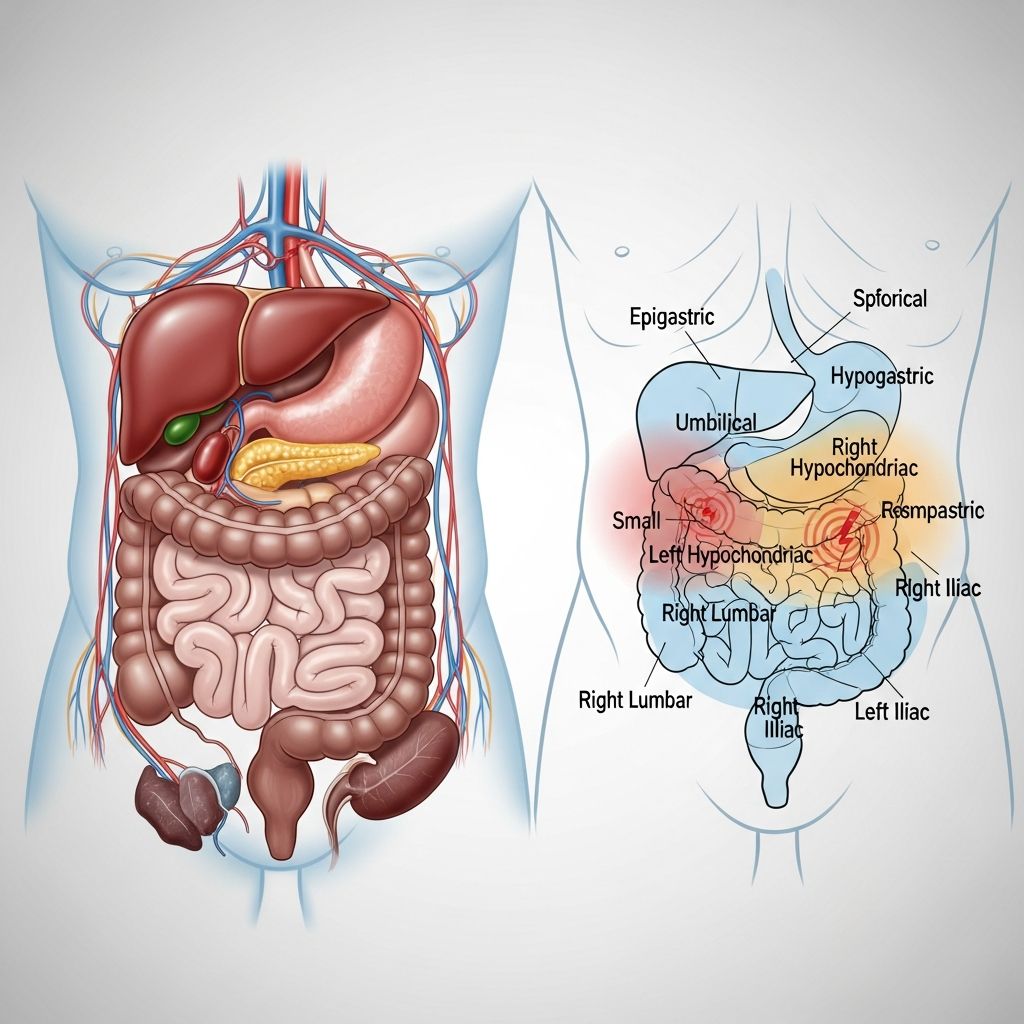
The abdomen is a complex region housing vital organs and serving as a common site for pain that can range from benign to life-threatening. Understanding its anatomy and pain mechanisms is crucial for accurate diagnosis and management in primary care settings.
What Is the Abdomen?
The
abdomen
refers to the part of the trunk between the thorax and pelvis, containing essential organs like the stomach, intestines, liver, kidneys, and reproductive organs. It is divided into nine regions—epigastric, umbilical, suprapubic, right/left hypochondriac, right/left lumbar, and right/left iliac—for precise localization of pain and pathology.This anatomical division aids clinicians in pinpointing potential sources: upper regions often relate to stomach or liver issues, while lower areas may involve intestines or pelvic organs. Pain location, though helpful, does not always correlate directly due to visceral or referred pain mechanisms.
Types of Abdominal Pain
Abdominal pain arises from various physiological mechanisms, broadly classified into visceral, parietal/somatic, and referred pain. Each type has distinct characteristics influencing diagnosis.
- Visceral pain: Originates from organ distension, ischemia, or inflammation; mediated by autonomic nerves; typically dull, poorly localized, and crampy.
- Parietal/somatic pain: From parietal peritoneum irritation; sharp, well-localized, worsened by movement or coughing due to segmental nerve mediation.
- Referred pain: Perceived away from the source via shared neural pathways; often dull with skin hyperalgesia, e.g., shoulder pain from diaphragmatic irritation.
Additional mechanisms include vascular issues like hemorrhage or torsion causing ischemia, as seen in ruptured aneurysms or ovarian cysts. Anterior cutaneous nerve entrapment syndrome, a frequent abdominal wall pain mimic, presents as localized tenderness worsening with muscle tensing (positive Carnett’s test).
Abdominal Pain Causes
Causes span gastrointestinal, genitourinary, gynecological, vascular, and metabolic origins. Most are benign, but 10-20% may indicate serious conditions like peritonitis or ectopic pregnancy requiring prompt intervention.
Common Gastrointestinal Causes
- Gastroenteritis: Viral or bacterial infection causing crampy pain, diarrhea, vomiting.
- Irritable bowel syndrome (IBS): Chronic functional disorder with bloating, altered bowel habits.
- Appendicitis: Starts periumbilical, migrates to right lower quadrant; rebound tenderness key.
- Diverticulitis: Inflammation of colonic pouches, typically left lower quadrant pain in elderly.
Genitourinary and Gynecological Causes
- Urinary tract infection (UTI): Dysuria, suprapubic pain, frequency.
- Kidney stones: Colicky flank pain radiating to groin.
- Ectopic pregnancy: Unilateral lower pain, vaginal bleeding; life-threatening rupture risk.
Serious and Vascular Causes
Life-threatening etiologies include aortic aneurysm rupture (severe back pain, hypotension), mesenteric ischemia (postprandial pain in elderly), and perforated viscus leading to peritonitis.
| Region | Common Pathologies |
|---|---|
| Epigastric | Gastritis, peptic ulcer, pancreatitis |
| Right Upper Quadrant | Cholecystitis, hepatitis |
| Umbilical | Early appendicitis, small bowel obstruction |
| Left Lower Quadrant | Diverticulitis, ovarian cyst |
This table summarizes region-specific pathologies, adapted from clinical guidelines.
Symptoms Accompanying Abdominal Pain
Pain rarely occurs alone; associated symptoms guide differentials. Fever suggests infection/inflammation; nausea/vomiting indicate obstruction or motility issues; bloody stools signal ischemia or ulcer bleed.
- Jaundice with right upper pain: Hepatobiliary disease.
- Dysuria/hematuria: UTI or stones.
- Altered mental status/hypotension: Sepsis or shock.
Related Stories



Abdominal Pain Diagnosis
Diagnosis hinges on history, examination, and selective investigations. Primary care approach emphasizes ruling out emergencies before reassurance.
History Taking
Key elements: Onset (sudden vs. gradual), location, radiation, quality (sharp/crampy), severity (1-10 scale), timing, aggravating/relieving factors, associated symptoms (SOCRATES mnemonic). Risk factors like age, comorbidities, medications queried.
Physical Examination
A systematic exam assesses general condition first: vital signs, appearance (e.g., still posture in peritonitis vs. writhing in colic).
- Inspection: Distension, scars, hernias.
- Auscultation: Bowel sounds (absent in ileus, hyperactive in early obstruction).
- Percussion: Tympany (gas), dullness (fluid/mass), rebound for peritonitis.
- Palpation: Light then deep; guarding/rigidity signals irritation. Rectal/pelvic exams mandatory for lower pain.
Carnett’s test differentiates wall from visceral pain.
Investigations
- Labs: CBC (leukocytosis), electrolytes, LFTs, amylase, pregnancy test, urinalysis.
- Imaging: Ultrasound for gallbladder/ectopic; CT for complex cases; plain X-ray for obstruction/perforation.

Treatment for Abdominal Pain
Treatment varies by cause: supportive for self-limiting (hydration, antispasmodics), antibiotics for infections, surgery for obstruction/appendicitis. Analgesia administered judiciously post-examination to avoid masking signs.
Red Flags Requiring Urgent Referral
- Severe pain unrelieved by OTC meds.
- Fever >101°F, persistent vomiting.
- Signs of peritonitis (involuntary guarding).
- Hypotension, shock, jaundice.
- Pregnancy with pain/bleeding.
Flowcharts for generalized vs. localized pain guide triage.
When to See a Doctor for Abdominal Pain
Seek immediate care for red flags; otherwise, consult if pain persists >48 hours, worsens, or accompanies weight loss/blood in stool. Primary care can manage 80% of cases.
Frequently Asked Questions (FAQs)
What causes sudden severe abdominal pain?
Sudden severe pain may indicate perforation, ectopic pregnancy, or stone; seek emergency care.
Is abdominal pain always serious?
No, most cases are benign like gas or IBS, but evaluation rules out dangers.
How is peritonitis diagnosed?
Via rebound tenderness, rigidity, absent bowel sounds; imaging confirms.
Can stress cause abdominal pain?
Yes, via functional disorders like IBS, but organic causes must be excluded.
What is referred abdominal pain?
Pain felt distant from source, e.g., heart attack mimicking upper abdominal pain.
References
- A primary care approach to abdominal pain in adults — PMC / National Library of Medicine. 2021-08-11. https://pmc.ncbi.nlm.nih.gov/articles/PMC8378095/
- Abdominal Pain – Clinical Methods — NCBI Bookshelf / National Center for Biotechnology Information. 1990. https://www.ncbi.nlm.nih.gov/books/NBK413/
- Approach to the Adult Patient with Acute Abdominal Pain — UpToDate / Wolters Kluwer. 2025-01 (last updated). https://www.uptodate.com/contents/approach-to-the-adult-patient-with-acute-abdominal-pain
- Abdominal Pain — American College of Gastroenterology. 2024-06-15. https://gi.org/topics/abdominal-pain/
- Acute Abdomen — Merck Manual Professional / Merck & Co. 2025-09. https://www.merckmanuals.com/professional/gastrointestinal-disorders/acute-abdomen/acute-abdomen
Similar Articles








Read full bio of medha deb