Abdominal Muscles: Anatomy, Function & Health
Comprehensive guide to abdominal muscle anatomy, function, and conditions affecting core stability.
Understanding Your Abdominal Muscles
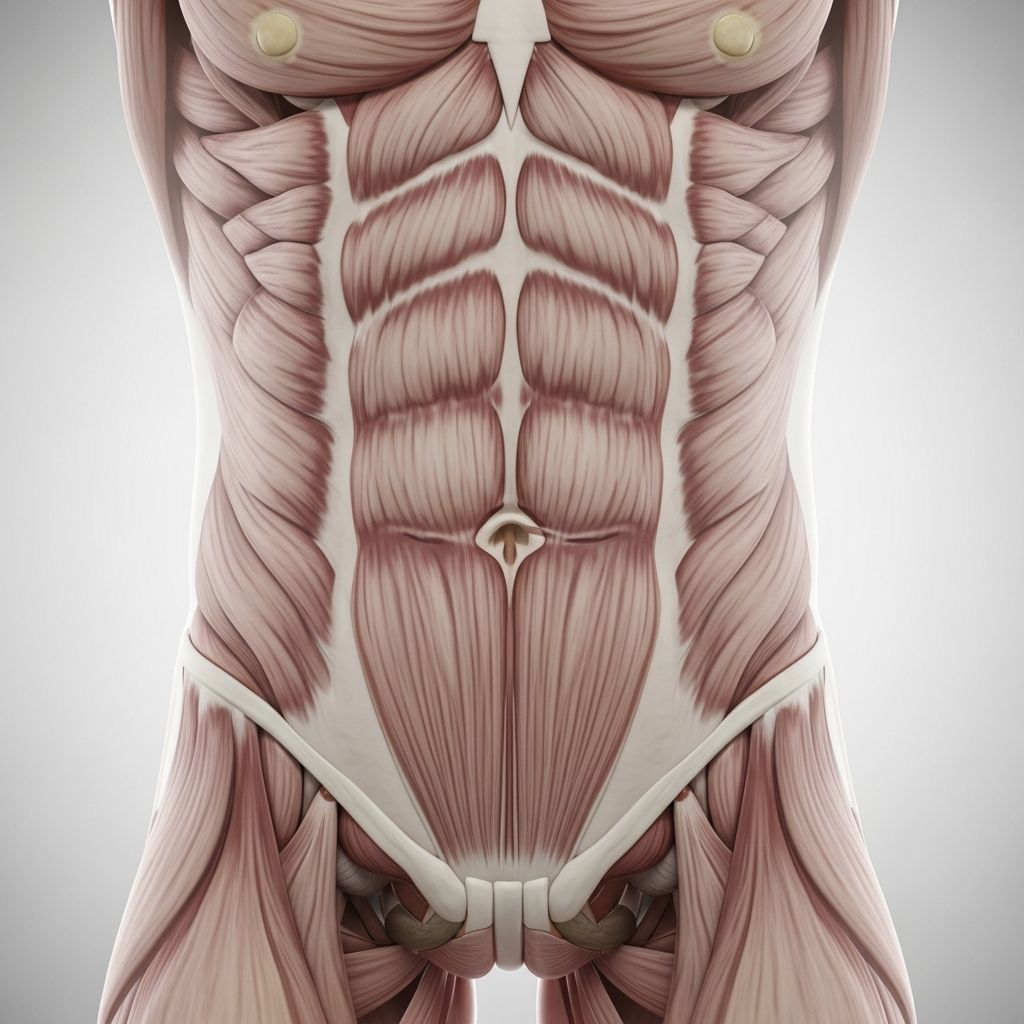
Your abdominal muscles are far more than just the visible “six-pack” you might see on athletes. These muscles form a complex system that supports your entire trunk, enables movement, holds your organs in place, and helps maintain internal pressure within your abdomen. The abdominal wall consists of skin, fascia, and multiple layers of muscle that work together to encase your abdominal cavity and viscera, providing both structural support and functional capability.
The abdominal region connects your thorax (chest) to your pelvis and is relatively deficient in skeletal support compared to other parts of your body. Unlike the rib cage that protects your thorax or the pelvic bones that support your lower body, your abdomen relies primarily on muscular support. This design allows for flexibility and the ability to accommodate dynamic changes in the volume of abdominal contents, such as after eating or during pregnancy.
The Four Main Abdominal Muscles
When people think of abdominal muscles, they typically refer to four primary muscle groups that form the visible muscular structure of the abdomen. Each of these muscles has distinct functions and contributes to overall core stability and movement.
Rectus Abdominis
The rectus abdominis is the most recognizable abdominal muscle and is commonly referred to as your “six-pack” when visible. This long, narrow muscle runs vertically down the front of your abdomen, stretching from the lower end of your sternum (breastbone) down to your pubic bone. It sits between the ribs and the pubis at the front of the pelvis and is divided into four discrete muscle segments by three tendinous intersections. When this muscle contracts, the characteristic bumps or bulges that create the “six-pack” appearance become visible, particularly in individuals with low body fat.
The primary function of the rectus abdominis is to flex the vertebral column, allowing you to bend forward at the waist. It’s a powerful flexor of the trunk and plays a crucial role in bringing your ribcage closer to your pelvis. This muscle is enclosed within the rectus sheath, which provides support and protection.
Transversus Abdominis
The transversus abdominis is the deepest of the anterolateral abdominal muscles and plays a critical role in core stability. Its fibers run transversely (horizontally) across your abdomen, similar to a corset wrapping around your trunk. This muscle arises from the fifth through tenth costal cartilages, the lumbar fascia, the iliac crest, and the lateral inguinal ligament.
The primary role of the transversus abdominis is to stabilize your trunk and maintain internal abdominal pressure. When you exhale, this muscle contracts to draw your abdominal wall inward. Together with the intrinsic back muscles, the transversus abdominis forms the core muscles that help keep your body stable and balanced while protecting your spine from excessive movement or injury.
External Oblique Muscles
The external oblique muscles are located on each side of your rectus abdominis and are the most superficial of the anterolateral abdominal wall muscles. These muscles have fibers that run diagonally from the lower ribs downward and inward toward the center of your abdomen. The external obliques arise from the fifth through twelfth ribs and run inferomedially.
Related Stories



The external oblique muscles allow your trunk to twist or rotate, but with an important twist: when the right external oblique muscle contracts, it rotates your body to the left, and vice versa. This contralateral rotation pattern means the muscles on one side of your body work to turn your trunk to the opposite side. The external obliques also contribute to lateral flexion of your spine and help you bend sideways.
Internal Oblique Muscles
The internal oblique muscles flank the rectus abdominis and are located just inside your hipbones, sitting beneath the external obliques. Their fibers run diagonally but in the opposite direction compared to the external obliques. This perpendicular fiber orientation allows for a more sophisticated control of trunk movement.
The internal obliques operate in the opposite manner to the external obliques. When you twist your trunk to the left, the left internal oblique muscle and the right external oblique muscle contract together in a coordinated fashion. This co-contraction pattern allows for smooth, controlled rotational movements of your spine. The internal obliques also assist with lateral flexion and contribute to maintaining core stability.
Extended Abdominal Muscle Structure
Beyond the four main abdominal muscles, the abdominal wall includes several other important muscles divided into anterolateral and posterior components.
Anterolateral Abdominal Wall Muscles
The anterolateral abdominal wall consists of two vertical muscles located on the midline and three flat muscles on the anterolateral side. In addition to the rectus abdominis, external oblique, internal oblique, and transversus abdominis already discussed, the anterolateral wall includes the pyramidalis muscle. The pyramidalis is a small, triangular muscle that runs vertically and parallel to the linea alba, arising from the pubic symphysis and crest and running superiorly to attach to the fifth through seventh costal cartilages.
These muscles are all connected by the linea alba, a thin band of connective tissue that runs down the front of your abdomen and serves as an attachment point where the aponeuroses (flat tendons) of these muscles fuse together in the midline. The linea alba separates the left and right sides of your rectus abdominis and is highly elastic, capable of expanding while maintaining the strength needed to support your abdominal muscles and stabilize your movements.
Posterior Abdominal Wall Muscles
The posterior abdominal wall includes muscles that support your spine and contribute to trunk movement. The quadratus lumborum is one of the deepest muscles of the posterior wall, originating from the iliolumbar ligament and iliac crest and running superomedially to insert into the twelfth rib and the first through fourth lumbar transverse processes. This muscle can cause lateral flexion and extension of the vertebral column and helps depress the rib cage.
The psoas major and psoas minor are long muscles that originate from the lumbar vertebrae and run through the pelvis. The iliacus muscle works closely with the psoas major to form the iliopsoas complex, which is responsible for flexing your hip. The diaphragm, particularly its posterior aspect, also functions as part of the posterior abdominal wall and plays a crucial role in respiration and core stability.
Muscle Actions and Core Stability
All abdominal muscles have different fiber orientations and work together across all three planes of movement. No single muscle works in isolation; instead, they function in harmony with others to control complex movements. The abdominal muscles work together to control the movement of your spine, pelvis, and overall trunk positioning.
The abdominal muscles contribute to multiple types of trunk movements, including flexion (bending forward), extension (bending backward), lateral flexion (bending sideways), and rotation (twisting). Simultaneous contraction of abdominal muscles can also facilitate the generation of intra-abdominal and intrathoracic pressure, which is critical for functions such as sneezing, coughing, vomiting, and defecating. This pressure generation is essential for maintaining core stability during physical activity and everyday movements.
Innervation and Blood Supply
The abdominal muscles receive their nerve supply primarily from the thoracolumbar region. Innervation of the anterolateral abdominal wall derives mainly from the T7-T12 intercostal nerves, which run a circumferential route anteriorly along with the neurovascular bundle between the layers of the internal oblique and transversus abdominis muscles. The posterior wall muscles, including the psoas major and quadratus lumborum, are supplied by branches from the lumbar plexus as it emerges from the spinal cord.
Blood supply to the abdominal muscles comes from various sources. The inferior epigastric artery, which branches from the external iliac artery near your groin, supplies blood to your abdominal muscles and has many branches that feed muscles and tissues in your abdomen and pelvis. The deep circumflex artery travels along the inner surface of the abdominal wall, running parallel to the inguinal ligament to supply the deep iliac fossa regions.
Common Causes of Abdominal Muscle Strain
Abdominal muscle strains can occur from various causes, ranging from minor to significant trauma. Common causes include:
– Overstretching the abdominal muscles beyond their normal range of motion- Overuse from repetitive activities or excessive training- Violent or poorly performed movements of the trunk- Improper technique during sports that require running, turning, and jumping- Lifting heavy objects with incorrect form- Laughing, coughing, or sneezing with sudden force- Sudden acceleration or deceleration movements
Functions of the Abdominal Muscles
Your abdominal muscles serve multiple vital functions beyond aesthetics. These functions include:
– Organ Support: The abdominal wall contains and provides a scaffold for the development and functioning of abdominal viscera, including your stomach, intestines, liver, and other organs.- Organ Protection: All layers of the abdominal wall contribute to physical protection of your organs by creating a muscular barrier against external trauma.- Trunk Movement: The abdominal muscles enable flexion, extension, lateral flexion, and rotation of your trunk, allowing for a wide range of body movements.- Core Stability: Working together with intrinsic back muscles, the abdominal muscles maintain trunk stability and balance, which is essential for posture and preventing injury.- Pressure Generation: These muscles help generate intra-abdominal pressure necessary for functions like breathing, coughing, and bowel movements.- Spine Protection: By providing stability and support, abdominal muscles protect your vertebral column from excessive movement or injury.
Frequently Asked Questions
Q: What is the linea alba and why is it important?
A: The linea alba is a thin band of connective tissue running down the front of your abdomen that separates the left and right sides of your rectus abdominis. It serves as an attachment point for other abdominal muscles and helps anchor and stabilize your torso. Weakness in the linea alba can lead to poor posture, pelvic pain, and back pain. The linea alba is highly elastic and capable of expanding, but it must also be able to stiffen and tighten to support your abdominal muscles and stabilize your movements.
Q: How do the external and internal obliques work together?
A: The external and internal obliques work in opposite patterns. When you want to twist your trunk to the left, the left internal oblique and right external oblique contract together. This contralateral co-contraction pattern allows for smooth, coordinated rotational movements. Both muscle groups also assist with lateral flexion of the spine and core stability.
Q: Why is the transversus abdominis called the deepest abdominal muscle?
A: The transversus abdominis is called the deepest abdominal muscle because it lies beneath the external and internal obliques and forms the innermost muscular layer of the anterolateral abdominal wall. Its horizontal fiber orientation allows it to act like a corset around your trunk, providing crucial stability and helping maintain intra-abdominal pressure.
Q: What causes the visible “six-pack” appearance?
A: The “six-pack” appearance results from the rectus abdominis muscle being divided into four distinct segments by three tendinous intersections. These are natural divisions in the muscle structure. The “bumps” become visible when someone has low enough body fat that the underlying muscle structure shows through. The tendinous intersections create the characteristic horizontal lines between the muscle segments.
Q: How do abdominal muscles protect the spine?
A: Abdominal muscles protect the spine by providing core stability and reducing excessive movement of the vertebral column. Together with intrinsic back muscles, they create a stable framework that supports your spine during movement and protects it from injury. Strong abdominal muscles help maintain proper posture and can reduce strain on spinal structures.
Q: Can weak abdominal muscles cause health problems?
A: Yes, weak abdominal muscles can lead to poor posture, reduced core stability, pelvic floor dysfunction, and back pain. Because the abdominal muscles work together with other core muscles to support your spine and maintain stability, weakness in these muscles can affect overall body function and increase injury risk during physical activity.
References
- Anatomy, Abdomen and Pelvis: Abdominal Wall — National Center for Biotechnology Information (NCBI/StatPearls). 2024. https://www.ncbi.nlm.nih.gov/books/NBK551649/
- Abdominal Muscles — Physiopedia. 2024. https://www.physio-pedia.com/Abdominal_Muscles
- Linea Alba (Abdomen): Function, Anatomy & Conditions — Cleveland Clinic. 2024. https://my.clevelandclinic.org/health/body/23483-linea-alba
- Inferior Epigastric Artery: Anatomy, Branches & Function — Cleveland Clinic. 2024. https://my.clevelandclinic.org/health/body/23945-inferior-epigastric-artery
- Pelvic Floor Muscles: Anatomy, Function & Conditions — Cleveland Clinic. 2024. https://my.clevelandclinic.org/health/body/22729-pelvic-floor-muscles
Similar Articles








Read full bio of Sneha Tete