Acanthoma Fissuratum: Symptoms, Diagnosis & Treatment Guide
Understanding acanthoma fissuratum: A benign skin condition from pressure by ill-fitting glasses, with key insights on causes, diagnosis, and treatment.
Introduction
Acanthoma fissuratum, also known as granuloma fissuratum or spectacle frame granuloma, is an uncommon benign dermatological condition characterized by localized skin thickening in response to chronic mechanical pressure or friction. It typically manifests as a firm, flesh-coloured papule, nodule, or plaque with raised edges and a central furrow or fissure, often resembling a coffee bean. This lesion develops where external devices, most commonly ill-fitting eyeglass frames, exert persistent pressure on the skin. Despite its alarming appearance, acanthoma fissuratum is not malignant and resolves upon removal of the irritant. The term “acanthoma” refers to epidermal thickening (acanthosis), while “fissuratum” describes the central cracking, erosion, or ulceration frequently observed. Although historically misnamed “granuloma fissuratum,” histopathological examination reveals no true granulomatous inflammation, distinguishing it from granulomatous disorders.
Understanding this condition is crucial for dermatologists, opticians, and primary care providers, as it can mimic skin cancers, leading to unnecessary biopsies. Early recognition prevents patient anxiety and promotes simple, effective interventions. This article delves into its demographics, causes, clinical presentation, diagnostic approaches, differential diagnoses, treatment options, and prognosis, drawing from established medical literature.
Demographics
Acanthoma fissuratum predominantly affects adults who wear eyeglasses, with no strict age or sex predilection reported in the literature. It is more common in individuals over 40 years, correlating with increased spectacle use for presbyopia or other refractive errors. The exact incidence remains undocumented due to underreporting; many cases resolve spontaneously without medical consultation once glasses are adjusted. Risk is higher in those with heavy spectacle frames, prolonged daily wear, or anatomical variations like prominent ears or narrow nasal bridges. Rare cases occur in non-spectacle wearers, such as those using hearing aids, CPAP masks, or tight clothing. No racial or ethnic predispositions are noted, though fair-skinned individuals may notice lesions more readily due to contrast.
- Prevalence: Uncommon; often incidental finding in spectacle wearers.
- Age: Primarily middle-aged and elderly adults.
- Sex: Equal distribution between males and females.
- Associated factors: Chronic device use, poor fit, heavy frames.
Causes
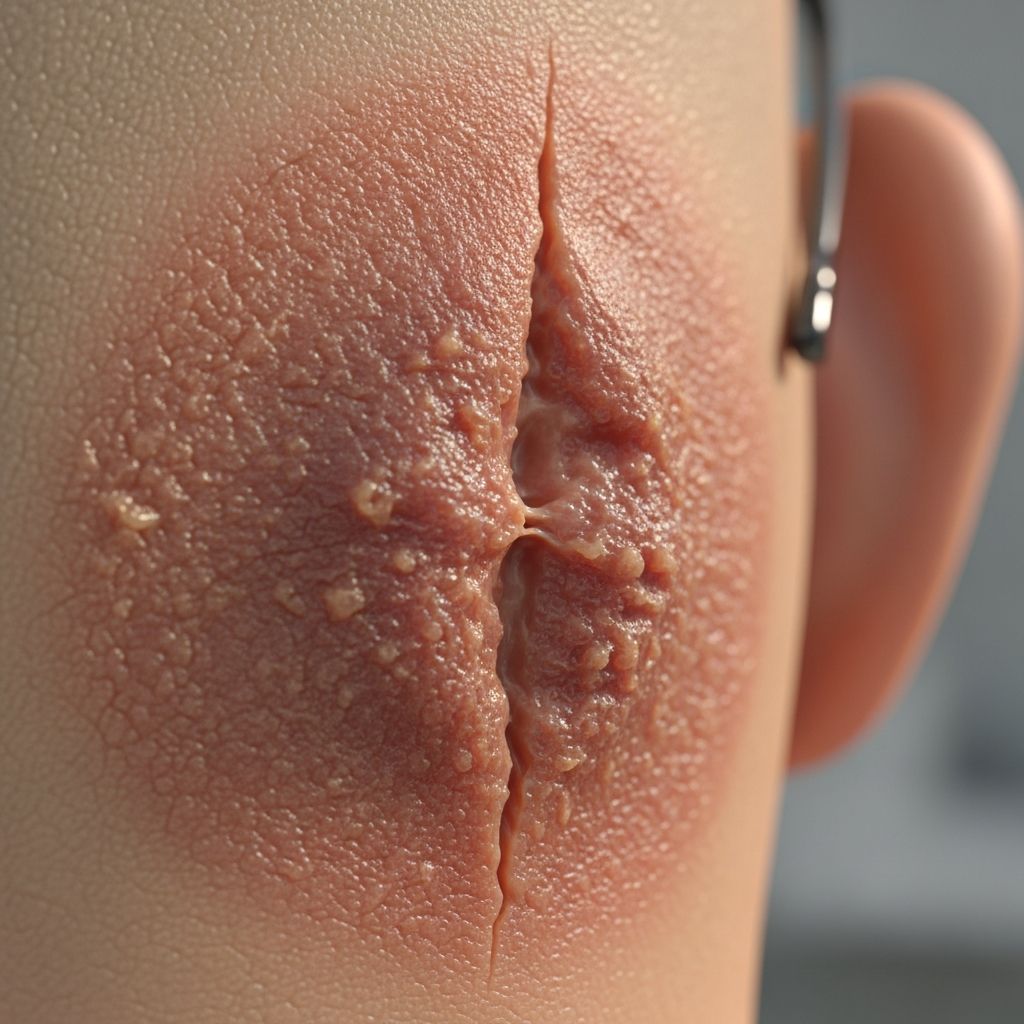
The primary etiology of acanthoma fissuratum is chronic mechanical trauma from pressure or friction exerted by poorly fitting eyeglass frames. Common sites include the retroauricular sulcus (behind the ear), superior auricular sulcus, and nasal bridge near the inner canthus. The lesion forms as the skin hypertrophies in response to repeated irritation, creating a protective barrier. Contributing factors include:
- Ill-fitting spectacle frames causing uneven pressure distribution.
- Excessive weight of glasses, especially metal frames.
- Concomitant skin conditions like eczema or psoriasis exacerbating irritation.
- Anatomical deformities, such as prominent ears or saddle nose.
- Rarely, other devices: hearing aids (external auditory canal), CPAP masks (nasal bridge), tight underwear (penis or vulva), or posterior fourchette trauma.
Pathophysiologically, sustained pressure induces epidermal hyperplasia, leading to acanthosis and hyperkeratosis. The central groove corresponds to the frame’s edge imprint, filled with keratin debris or inflammatory cells. This reactive process mimics pseudocarcinomatous hyperplasia but remains benign.
Clinical Features
Clinically, acanthoma fissuratum presents as a unilateral, firm, folded, flesh-coloured lesion—often a papule, nodule, or plaque—with a distinctive central longitudinal groove bisecting it, giving a “coffee bean” morphology. Size varies from 5-15 mm, with raised, everted edges and potential central ulceration, erosion, or fissuring, which may cause pain, tenderness, or pruritus. Common locations:
| Site | Description | Frequency |
|---|---|---|
| Retroauricular sulcus | Behind the ear, frame temple pressure | Most common |
| Superior auricular sulcus | Upper ear groove | Common |
| Nasal bridge | Lateral nose, inner canthus | Frequent |
| Other (penis, vulva, auditory canal) | Rare, device-specific | Uncommon |
Related Stories



Lesions are often solitary but can be multiple if bilateral pressure exists. Erythema, crusting, or suppuration occurs in ulcerated cases. A history of spectacle wear with discomfort at the site is pathognomonic.
Diagnosis
Diagnosis is primarily clinical, based on characteristic morphology, location, and trauma history. If the spectacle frame matches the lesion’s groove, confirmation is straightforward. However, due to resemblance to malignancy, a skin biopsy is recommended for atypical or persistent cases. Histopathological hallmarks include:
- Prominent acanthosis (epidermal thickening) with elongated, blunt rete ridges.
- Hyperkeratosis and variable parakeratosis.
- Central epidermal attenuation mirroring the clinical groove, often filled with keratinous debris, inflammatory cells, or spongiosis.
- Dermal perivascular chronic inflammatory infiltrate in fibrotic stroma; no granulomas or atypia.
- Hypergranulosis and dilated papillary vessels.
Imaging or dermoscopy is rarely needed but may show pressure-related changes. Clinical suspicion avoids unnecessary procedures in classic presentations.
Differential Diagnoses
Acanthoma fissuratum can mimic several conditions, necessitating careful evaluation:
- Basal cell carcinoma (BCC): Pearly borders, telangiectasia; biopsy distinguishes.
- Squamous cell carcinoma (SCC): Indurated, ulcerated; lacks groove.
- Seborrhoeic keratosis: Stuck-on appearance, no fissuring.
- Chondrodermatitis nodularis helicis: Ear-specific, nodular; histologically similar but no groove.
- Lichen simplex chronicus: Lichenified plaques from rubbing; less folded.
- Contact dermatitis: Diffuse erythema, no hypertrophy.
- Rare: Keratoacanthoma, Merkel cell carcinoma.
Biopsy resolves doubts, showing reactive hyperplasia without atypia.
Treatment
The cornerstone of treatment is eliminating the mechanical irritant, typically by adjusting or replacing eyeglass frames with lighter, better-fitting ones. This alone leads to spontaneous resolution within weeks. Supportive measures include:
- Topical corticosteroids for inflammation.
- Emollients to aid healing.
- For severe/ulcerated lesions: intralesional steroids, curettage, electrosurgery, or excision.
- Wound care if secondarily infected.
Patient education on frame hygiene and optician consultation prevents recurrence. No systemic therapy is required.
Outcome
Acanthoma fissuratum is entirely benign with excellent prognosis upon irritant removal. Lesions regress without scarring in most cases, though chronic cases may leave mild atrophy. Recurrence is rare with proper frame adjustment. No malignant potential exists, but follow-up ensures resolution and rules out mimics.
Frequently Asked Questions (FAQs)
Q: Is acanthoma fissuratum cancerous?
No, it is a benign reactive lesion, not cancer. Biopsy confirms absence of atypia if concerned.
Q: How long does it take to heal after removing glasses pressure?
Typically 2-4 weeks with proper adjustment and care.
Q: Can it occur without glasses?
Yes, rarely from hearing aids, CPAP masks, or clothing.
Q: Should I always get a biopsy?
Not for classic cases; biopsy if atypical or persistent.
Q: How to prevent it?
Ensure well-fitted, lightweight frames; regular optician checks.
References
- Acanthoma fissuratum — Wikipedia. 2023-10-15. https://en.wikipedia.org/wiki/Acanthoma_fissuratum
- Acanthoma Fissuratum: Lest we Forget — PubMed Central / NIH. 2017-03-20. https://pmc.ncbi.nlm.nih.gov/articles/PMC5372440/
- Acanthoma Fissuratum — Consultant360. 2019-12-17. https://www.consultant360.com/sites/default/files/journal-pdf/191217C360_Acanthoma%20Fissuratum.pdf
- Acanthoma fissuratum — DermNet NZ. 2023. https://dermnetnz.org/topics/acanthoma-fissuratum
- Pink Nodule Behind the Ear — MDedge / The Hospitalist. 2020. https://blogs.the-hospitalist.org/content/pink-nodule-behind-ear
Similar Articles








Read full bio of medha deb