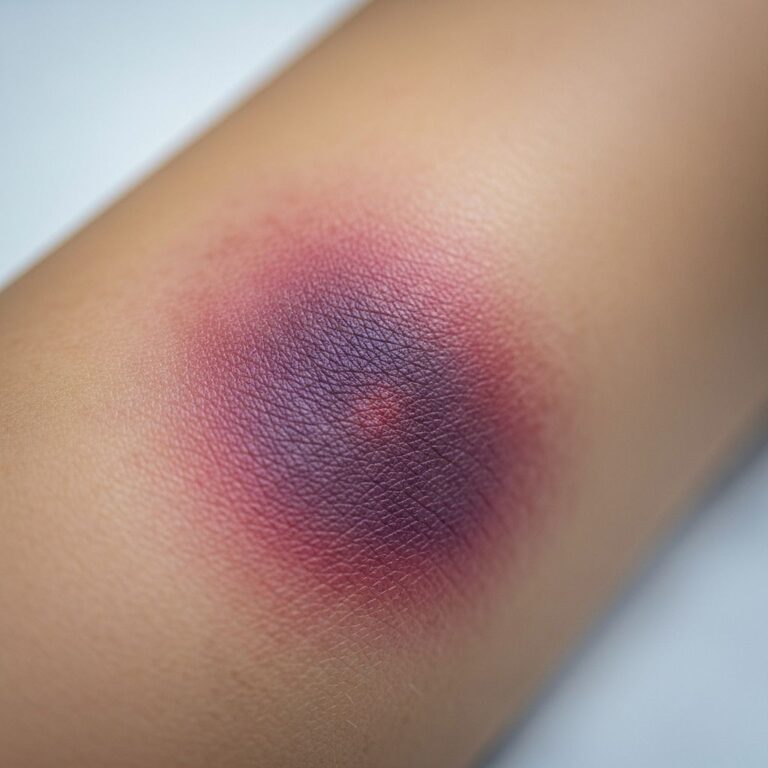
Achenbach Syndrome Guide To Causes, Symptoms & Treatment
Painful blue finger: A benign, self-resolving condition causing sudden bruising without serious underlying pathology.
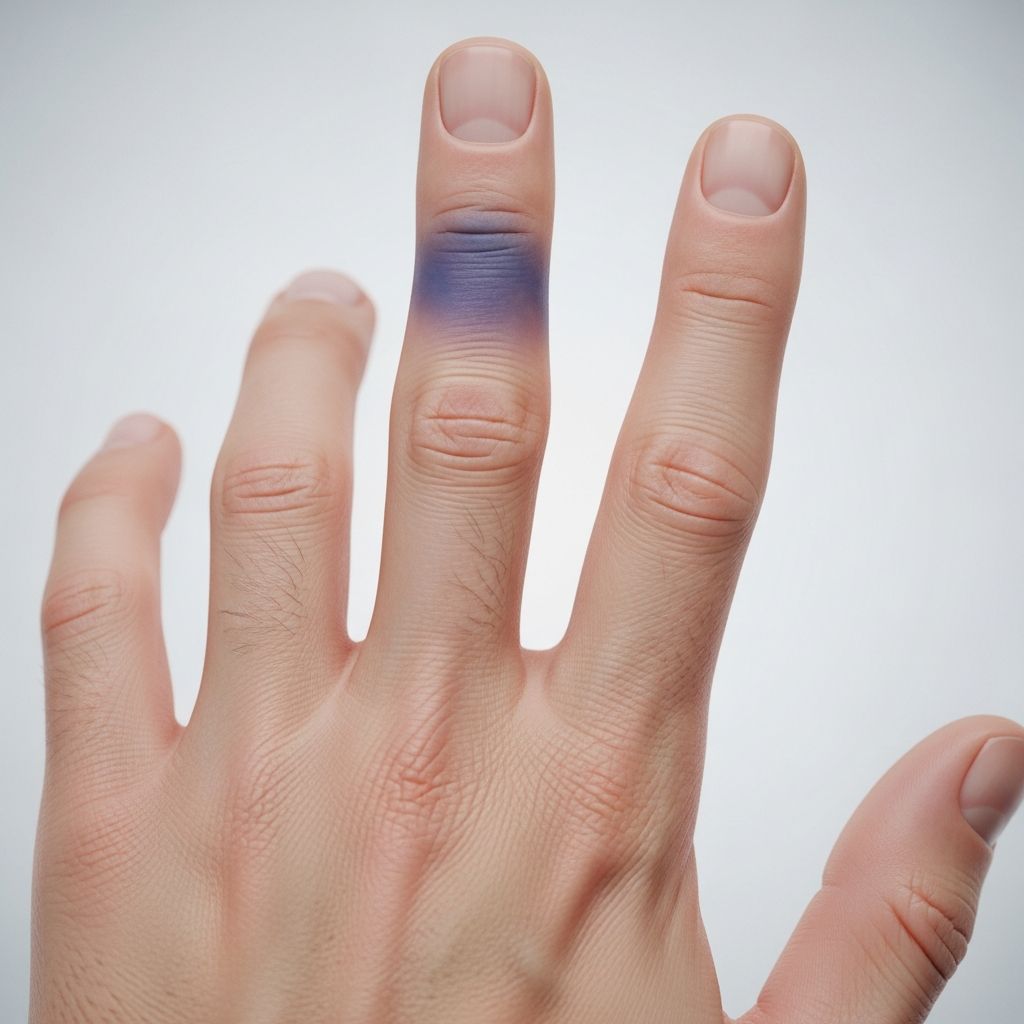
Achenbach syndrome is a paroxysmal recurring painful bruising of the finger(s) or palm, not associated with serious underlying conditions.
What is Achenbach syndrome?
Achenbach syndrome, also known as paroxysmal finger haematoma, painful blue finger or idiopathic blue finger, is characterised by recurrent spontaneous subcutaneous bleeding from small vessels in a finger or palm.
The affected area suddenly swells and turns blue or black following a painful episode. Swelling and bruising resolve over several days without residual effects.
Achenbach syndrome has been predominantly reported in middle-aged females, with a median age of onset of 48–50 years (range 22–76 years). It affects the fingers in 85% of cases and the palms in 15%.


Who gets Achenbach syndrome? (Epidemiology)
Achenbach syndrome is uncommon but under-reported. It is 5–10 times more common in females than males.
- Reported in all ethnicities (Caucasian, Asian, African)
- Predominantly in middle-aged women
- Median age of onset: 48–50 years
- Range: 22–76 years
Affected sites include:
- Fingers (85%): usually 2nd to 5th fingers
- Palms (15%)
Discoloration may be less obvious in skin of colour.
What causes Achenbach syndrome?
Achenbach syndrome is a subcutaneous bruise probably due to minor fragility of capillaries or a small vein in the palmar skin.
Preceding minor trauma may be recalled in 30% of cases such as sweeping, handwashing of clothing, cycling, or pinching. However, trauma is often not recalled and the condition characteristically follows minor or no trauma.
There is no associated serious cause for easy bruising such as a clotting disorder or vascular abnormality. Extensive investigations for coagulopathy or ischaemic events are invariably normal.
The pathophysiology is unclear but postulated mechanisms include:
- Capillary fragility: spontaneous rupture of subpapillary dermal capillaries
- Venous insufficiency: transient digital venous hypertension
- Muscle spasm: flexor tendon sheath compartment syndrome
No genetic or familial predisposition has been identified.
What are the clinical features of Achenbach syndrome?
Achenbach syndrome has an abrupt onset.
- Sudden burning pain in one finger
- Swelling and bluish discolouration of the volar (palm-side) aspect of the digit (spares the tip)
- Tenderness
- Pins and needles or numbness (in 20%)
The event lasts minutes to hours, followed by slow resolution over 3–4 days.
Recurrences are common (30–60% of patients), often affecting different fingers, weeks to years apart.
Clinical features summary table
| Feature | Description |
|---|---|
| Onset | Sudden, spontaneous |
| Site | Volar fingers (2nd-5th), palm |
| Symptoms | Burning pain, swelling, bruising, paraesthesia |
| Duration | Minutes-hours (acute), 3-4 days (resolution) |
| Recurrence | Common, different fingers |
Related Stories



How is Achenbach syndrome diagnosed?
Achenbach syndrome is diagnosed clinically on the typical history and clinical presentation.
Many patients have undergone exhaustive investigations for clotting disorders and ischaemic events, all of which are normal/negative.
Investigations to consider (usually normal)
- Full blood count
- Coagulation profile (PT, APTT, fibrinogen)
- Thrombophilia screen
- ESR/CRP
- Duplex ultrasound of digit
Acute phase may show localised haematoma formation.
What is the differential diagnosis for Achenbach syndrome?
Sudden painful bruising of a finger may represent:
| Condition | Key Differentiating Features |
|---|---|
| Achenbach syndrome | Sudden volar bruising, self-resolves 3–4 days, normal investigations, spares tip |
| Traumatic haematoma | History of trauma, slower onset |
| Raynaud phenomenon | Biphasic colour change, cold trigger, symmetrical |
| Acrocyanosis | Persistent cyanosis, cold-aggravated |
| Acute arterial occlusion | Pale/cyanosed/cold digit, absent pulse |
| Cellulitis | Fever, erythema, pus |
| Thrombosis | Risk factors, abnormal coagulation |
What is the treatment for Achenbach syndrome?
None required.
Reassurance is key. Symptoms are self-limiting.
- Analgesia (paracetamol)
- Cool compresses
- Elevation
Recurrences require no further action.
What is the outcome for Achenbach syndrome?
Excellent prognosis.
- Complete resolution without scarring or disability
- No long-term sequelae
- Recurrences usually milder
Prevention of Achenbach syndrome
None known. Fragile capillaries may predispose.
Related topics
- Raynaud phenomenon
- Acrocyanosis
- Periungual haematoma
Frequently Asked Questions
Q: Is Achenbach syndrome dangerous?
A: No. It is benign and self-resolving with no serious underlying cause.
Q: Why does my finger turn blue suddenly?
A: Spontaneous rupture of small vessels causes localised bleeding under the skin.
Q: How long does Achenbach syndrome last?
A: Acute phase minutes to hours; bruising resolves in 3–4 days.
Q: Will it recur?
A: Yes, in 30–60% of cases, often in different fingers.
Q: Do I need blood tests?
A: Usually not required if typical presentation. Normal results expected.
References
- Achenbach Syndrome: What It Is, Symptoms & Treatment — Cleveland Clinic. 2023-10-15. https://my.clevelandclinic.org/health/diseases/achenbach-syndrome
- Achenbach Syndrome: A Rare Case of Paroxysmal Finger Hematoma — PMC (Peer-reviewed). 2021-09-28. https://pmc.ncbi.nlm.nih.gov/articles/PMC8456254/
- Achenbach syndrome: Painful Blue Finger — DermNet NZ (Authoritative dermatology resource). 2024-05-12. https://dermnetnz.org/topics/achenbach-syndrome
- Paroxysmal finger hematoma — Cleveland Clinic Journal of Medicine. 2020-04-01. https://www.ccjm.org/content/87/4/194
- Achenbach Syndrome: A Benign Painful Blue Finger with Tip Sparing — Vascular Specialist International (Peer-reviewed). 2021-12-31. https://www.vsijournal.org/journal/view.html?uid=1129&vmd=Full
Similar Articles








Read full bio of Sneha Tete