Acral Lentiginous Melanoma Dermoscopy: 3-Step Diagnostic Guide
Essential guide to dermoscopic diagnosis of acral lentiginous melanoma on palms, soles, and digits for early detection.
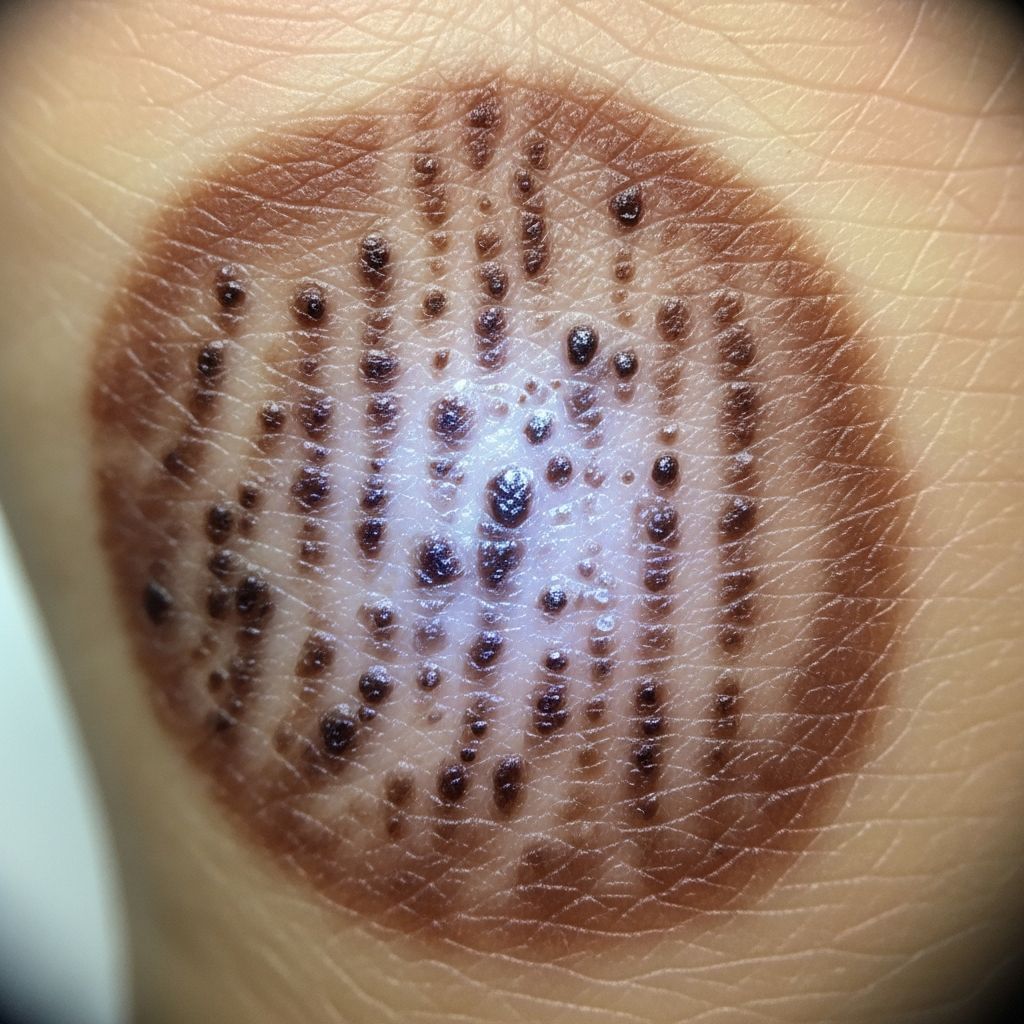
Acral lentiginous melanoma (ALM) is a subtype of melanoma that develops on the palms, soles, or subungual areas of the fingers and toes. It represents a significant proportion of melanomas in people with darker skin tones and requires specialized dermoscopic evaluation for early detection due to its often subtle clinical presentation.
What is acral lentiginous melanoma?
Acral lentiginous melanoma arises from melanocytes in acral sites—non-sun-exposed areas like the palms of the hands, soles of the feet, and undersides of digits. Unlike other melanomas linked to UV exposure, ALM is driven by genetic factors and mechanical stress. It accounts for about 2-3% of melanomas in Caucasians but up to 70% in Asian, African, and Hispanic populations. Early lesions appear as irregular macules, progressing to plaques or nodules if untreated, with a high risk of metastasis due to late diagnosis.
The term ‘lentiginous’ refers to the single-file proliferation of atypical melanocytes along the basal layer of the epidermis, a hallmark histological feature. Clinically, ALM often starts as a light brown macule, enlarging asymmetrically with variegated pigmentation, borders, and sometimes ulceration. Average age at diagnosis is 60-70 years, with no strong gender predilection.
Who gets acral lentiginous melanoma?
ALM occurs across all skin types but disproportionately affects individuals with Fitzpatrick skin types III-VI. Incidence is higher in populations with darker skin: 65-75% of melanomas in Japanese patients, 35-60% in African Americans, and similar rates in Indigenous Australians. Risk factors include chronic trauma to acral sites, genetic mutations (e.g., KIT gene), and family history of melanoma, though UV exposure is not a primary driver. It is rare in children but can occur.
- High-risk groups: Darker skin phototypes, older adults (>50 years), history of foot trauma or warts.
- Prevalence: Represents 1-2% of all melanomas globally but dominant acral subtype.
What are the clinical features of acral lentiginous melanoma?
Early ALM presents as an asymmetric, hyperpigmented macule (1-2 cm) with irregular borders and color variation (tan, brown, black). Advanced lesions show plaque formation, ulceration, bleeding, or nodule development. Common sites: big toe (most frequent), heel, palm thenar eminence. Hutchinson’s sign (periungual pigmentation) indicates subungual involvement. Symptoms may include pain or pruritus from pressure.
| Stage | Clinical Features |
|---|---|
| In situ | Flat, irregular macule <2 cm, subtle pigmentation |
| Early invasive | Enlarging plaque, variegated colors, blurred borders |
| Advanced | Ulcerated nodule, satellite lesions, lymphadenopathy |
Dermoscopy of acral lentiginous melanoma
Dermoscopy enhances diagnostic accuracy for acral lesions by revealing pigment distribution in volar skin’s unique dermatoglyphics (ridges and furrows). The gold standard pattern for ALM is the parallel ridge pattern (PRP), where pigmentation follows elevated skin ridges.
Most frequent dermoscopic features:
- Parallel ridge pattern (PRP): Filiform pigmentation along ridges (86% sensitivity, 99% specificity for early ALM). Light brown in early stages, darkening focally later.
- Irregular diffuse pigmentation (IDP): Structureless tan-black areas from epidermal melanocyte proliferation (61.9% prevalence).
- Grey or blue colors, irregular dots/globules, blue-white veil, polychromasia (≥4 colors).
- Asymmetry, irregular blotches, atypical vessels, regression structures in advanced cases.
Related Stories



In small lesions (<15 mm), PRP is less common (54.5%), necessitating scrutiny for subtle features like irregular fibrillar patterns.
3-step dermoscopic algorithm
The Koga-Saida 3-step algorithm guides acral lesion evaluation:
- Step 1: Check for PRP. Present → Suspect ALM (biopsy). Absent → Proceed.
- Step 2: Look for benign patterns. Parallel furrow (PF), lattice-like, fibrillar → Benign nevus.
- Step 3: Atypical findings. IDP, irregular pigmentation, dots → Biopsy regardless.
One positive criterion suffices for melanoma suspicion. Sensitivity ~88%, specificity 97%.
Dermoscopic patterns in acral volar skin
Parallel ridge pattern (melanoma)
Hallmark of ALM: thick, parallel lines on ridges. Early: uniform light brown; advanced: irregular, hyperpigmented bands.
Parallel furrow pattern (benign)
Pigmentation in furrows (hypopigmented ridges). Common in nevi.
Lattice-like pattern
Crisscrossing lines over ridges/furrows, sometimes with dots. Benign.
Fibrillar pattern
Transverse thin lines crossing dermatoglyphics. Benign, weight-bearing areas.

Differential diagnosis
Clinically and dermoscopically challenging:
- Acral nevus: PF, lattice-like, fibrillar; symmetric, stable.
- Congenital acral nevus: May mimic PRP but nested cells in furrows histologically.
- Trauma/hemorrhage: Globular, fleeting.
- Pigmented wart: Mosaic, keratin.
- Bowen’s disease: Vascular, scales.
Histology differentiates: ALM shows atypical melanocytes in ridges (crista profunda intermedia).
Pathology of acral lentiginous melanoma
Asymmetric basal melanocyte proliferation, pagetoid spread, dermal invasion in advanced stages. Early: single cells in stratum corneum; nests rare. Immunohistochemistry: S100, HMB45 positive.
Diagram note: Melanoma cells (red) in ridges vs. nevus nests (blue) in furrows.
Management
Biopsy suspicious lesions (excisional preferred). Staging via Breslow depth, sentinel node. Treatment: wide excision (1-2 cm margins), immunotherapy (PD-1 inhibitors), targeted therapy (BRAF rare). Prognosis better if <1 mm thick (5-year survival 80-90%).
Frequently Asked Questions (FAQs)
What is the most specific dermoscopic sign of acral lentiginous melanoma?
The parallel ridge pattern, with 99% specificity.
Can small acral lesions (<6 mm) be melanoma?
Yes; monitor evolving lesions, as PRP may be absent initially.
How does parallel ridge differ from parallel furrow?
Ridge: pigment on elevated ridges (malignant); Furrow: in depressions (benign).
Is dermoscopy reliable for acral nevi?
Yes, reduces unnecessary biopsies by identifying benign patterns.
What if no PRP but other atypia?
Biopsy; follow 3-step algorithm.
References
- Dermoscopic Patterns of Acral Melanocytic Lesions in Skin of Color — The Hospitalist. 2023. https://blogs.the-hospitalist.org/content/dermoscopic-patterns-acral-melanocytic-lesions-skin-color
- Acral lentiginous melanoma in situ: dermoscopic features and … — PMC (National Library of Medicine). 2020-11-23. https://pmc.ncbi.nlm.nih.gov/articles/PMC7688656/
- Acrolentiginous Melanoma — Dermoscopedia. Accessed 2026. https://dermoscopedia.org/Acrolentiginous_Melanoma
- Acral lentiginous melanoma dermoscopy — DermNet NZ. 2024. https://dermnetnz.org/topics/acral-lentiginous-melanoma-dermoscopy
- Key points in dermoscopic differentiation between early acral … — Turkish Dermatology. 2022. https://turkdermatoloji.org.tr/media/files/olgu_12_3.pdf
- Dermoscopy for Acral Melanocytic Lesions: Revision of the 3-step … — PMC (National Library of Medicine). 2022-09-15. https://pmc.ncbi.nlm.nih.gov/articles/PMC9464531/
Similar Articles








Read full bio of medha deb