Acral Lentiginous Melanoma: Comprehensive Guide
Rare melanoma on palms, soles, and nails: symptoms, causes, diagnosis, treatment, and prognosis explained.
What is acral lentiginous melanoma?
Acral lentiginous melanoma (ALM) is a rare subtype of melanoma, accounting for about 5-10% of all melanomas in white populations but up to 60-70% in darker-skinned individuals and Asians. Unlike common cutaneous melanomas linked to UV exposure, ALM arises on acral sites—the palms, soles, and subungual areas (under nails)—with no association to sun damage. It originates from melanocytes in the skin’s basal layer and is characterized by its lentiginous growth pattern, where atypical melanocytes proliferate along the epidermal-dermal junction.
ALM often presents insidiously, leading to delayed diagnosis and more advanced stages at detection compared to other melanomas. It has a distinct genetic profile, with lower rates of BRAF mutations (around 15-20%) and higher frequencies of NRAS, KIT, and MAPK pathway alterations, contributing to its aggressiveness. Early recognition is crucial, as survival rates drop significantly with thickness and ulceration.
Who gets acral lentiginous melanoma?
ALM affects people of all skin types but is disproportionately common in non-Caucasian populations. Incidence rates are highest among Asians, Africans, and Hispanics, where it represents the predominant melanoma subtype due to lower rates of UV-related cutaneous melanoma. It occurs equally in males and females, with peak incidence between ages 60-70, though cases in younger adults have been reported.
Risk factors differ from sun-exposed melanomas:
- Chronic trauma or friction on acral sites (e.g., from footwear or manual labor).
- Pre-existing lesions like melanocytic nevi or atypical lentigines on soles/palms.
- Genetic predispositions, including family history of melanoma or syndromes like familial atypical multiple mole melanoma (FAMMM).
- No strong link to UV exposure, unlike superficial spreading melanoma.
Population studies from the SEER database show ALM comprising 2-5% of U.S. melanomas, with worse outcomes in Black patients due to thicker tumors at diagnosis.
What causes acral lentiginous melanoma?
The precise etiology remains unclear, as ALM develops in sun-protected areas. Unlike cutaneous melanoma driven by UV-induced mutations (e.g., BRAF V600E in 50%), ALM shows:
- High rates of chromosomal aberrations (e.g., loss of 9p21, gain of 11q).
- Mutations in KIT (10-30%), NRAS (15-20%), and NF1, suppressing immune responses.
- A suppressive tumor microenvironment with fewer tumor-infiltrating lymphocytes compared to non-acral melanomas.
Trauma hypothesis suggests repeated injury to acral skin promotes melanocyte proliferation, though evidence is associative. Genetic factors and chronic inflammation may also play roles. Ongoing research explores epigenetic changes and microbiome influences on acral sites.
What are the clinical features of acral lentiginous melanoma?
ALM evolves slowly through phases: macular (flat, lentigo-like), plaque (elevated, irregular borders), and nodular (vertical growth with invasion). Common presentations include:
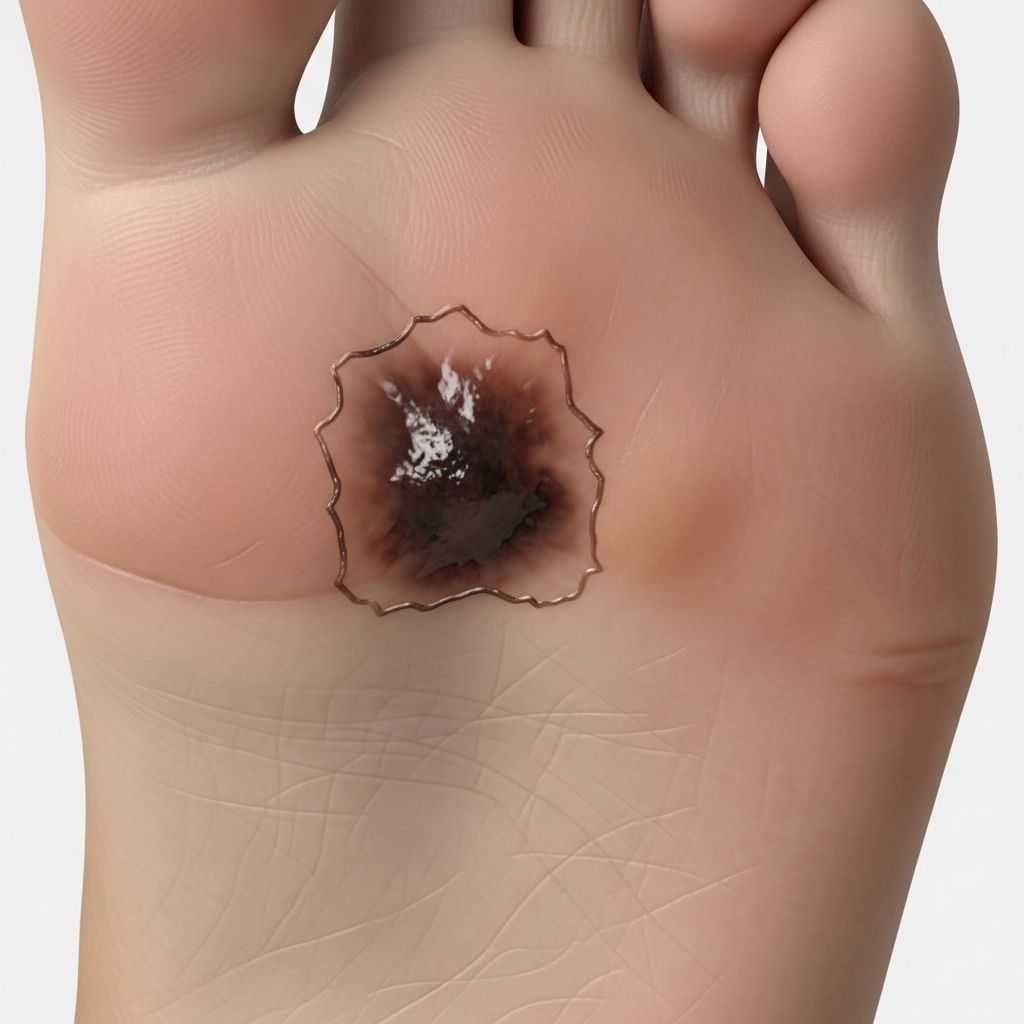
- Plantar/palmar: Hyperpigmented macule >7mm, irregular borders, asymmetry, color variation (black-brown, uneven). May ulcerate or form verrucous plaques.
- Subungual: Longitudinal melanonychia (dark nail streak), nail dystrophy, periungual pigmentation (Hutchinson’s sign), nail plate destruction.
Symptoms: Painless initially; later itching, bleeding, or tenderness. Delay in diagnosis averages 2-3 years due to misattribution as injury, callus, or fungal infection. Advanced lesions show Breslow thickness >4mm in 40-50% of cases.
| Feature | Description |
|---|---|
| A: Asymmetry | Irregular shape |
| B: Border | Notched, uneven |
| C: Color | Variegated black/brown/gray |
| D: Diameter | >6mm |
| E: Evolution | Changing size/color |
Related Stories



Diagnosis
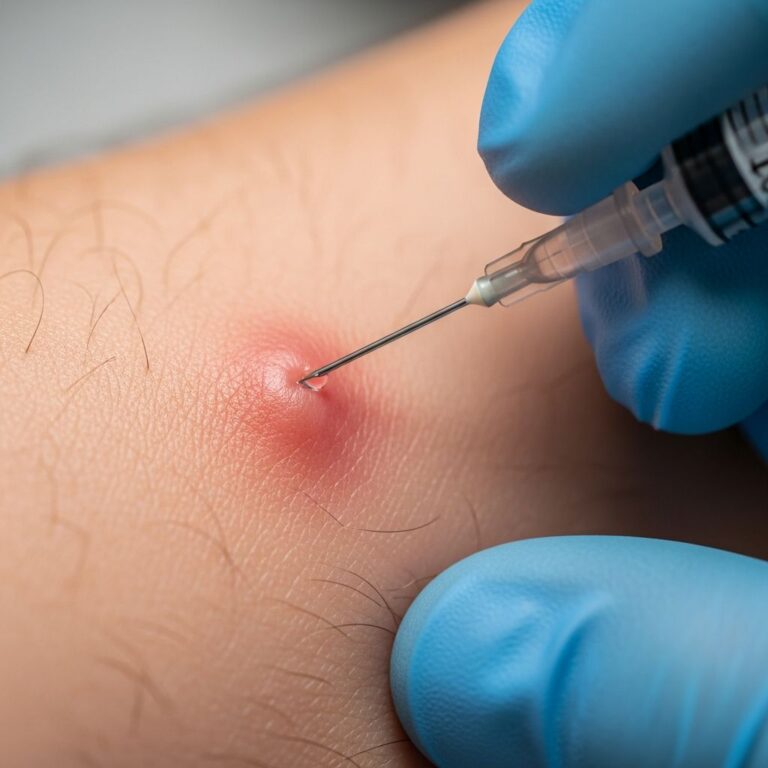
Diagnosis requires histopathology from punch, shave, or excisional biopsy. Clinical suspicion prompts biopsy; dermoscopy reveals atypical pigment networks, blue-white veils, or radial streaming.
Pathology
Histologically, ALM shows lentiginous proliferation of atypical melanocytes at the dermoepidermal junction, with pagetoid spread, upward maturation loss, and dermal invasion. Key features:
- Melanocytes >6/mm along basal layer.
- Cytologic atypia: enlarged nuclei, prominent nucleoli.
- Mitotic figures, necrosis in advanced cases.
Immunohistochemistry: Positive for S100, HMB45, Melan-A; low Ki-67 distinguishes from benign lesions.
Staging
AJCC 8th edition staging uses Breslow depth, ulceration, mitoses, lymphovascular invasion, nodal/metastatic status:
- Stage 0: In situ.
- Stage I-II: Localized (<4mm depth).
- Stage III: Nodal involvement.
- Stage IV: Distant mets.
Sentinel lymph node biopsy (SLNB) is recommended for >1mm depth or ulceration due to frequent understaging.
Differential diagnosis
- Plantar: Plantar warts, corn, poroma, squamous cell carcinoma.
- Palmar: Lentigo, junctional nevus, Bowen’s disease.
- Subungual: Onychomycosis, subungual hematoma, nevi, glomus tumor.
Dermoscopy and biopsy differentiate; longitudinal melanonychia needs monitoring if <3mm wide, biopsy if changing.
Prognosis and staging
ALM has poorer prognosis than cutaneous melanoma (CMM), with 5-year melanoma-specific survival (MSS) of 80-81% vs. 91-93% for CMM. 10-year MSS: 67.5% vs. 87.5%. Stage-stratified, worse in stage III (47.5% vs 56.7% 5-year survival).
Prognostic factors:
- Breslow thickness: Strongest predictor.
- Sentinel node positivity: Highest recurrence risk.
- Ulceration, age >60, male sex, race (worse in Blacks), node status.
Recent immunotherapy improves advanced disease outcomes, but early detection remains key.
Treatment of acral lentiginous melanoma
Mainstay: Wide local excision (WLE) with 1-2cm margins based on Breslow depth. Amputation for subungual/advanced disease to preserve function. SLNB for staging.
Advanced/metastatic:
- Immunotherapy: First-line anti-PD1 (nivolumab, pembrolizumab) or combo with ipilimumab (anti-CTLA4). 5-year OS 72-76%; better in BRAF-mutant.
- Targeted: Rare BRAF (vemurafenib/dabrafenib + trametinib); KIT inhibitors (imatinib) for KIT mutations.
- Radiation for nodal basins; neoadjuvant for resectable III/IV.
Multimodality (surgery + systemic/radiation) improves stage III survival. Goals: Cure, cosmesis, prevent recurrence.
What is the outcome for acral lentiginous melanoma?
Early-stage ALM is curable (>90% survival); advanced has higher recurrence. Immunotherapy has boosted 5-year survival from <10% to >50% in metastatic cases. Poorer than CMM due to biology, late diagnosis. Surveillance: Self-exam acral sites monthly, derm annually.
Prevention of acral lentiginous melanoma
- Self-inspect feet/hands/nails monthly for ABCDE changes.
- Wear protective footwear; avoid trauma.
- High-risk: Annual dermoscopy.
- No UV prevention needed.
Investigations
- Biopsy confirmation.
- Imaging: Ultrasound for nodes, PET-CT for staging.
- Genetic testing: BRAF/KIT/NRAS.
Frequently Asked Questions
Q: Is acral lentiginous melanoma caused by sun exposure?
A: No, ALM occurs on sun-protected acral sites and is unrelated to UV radiation, unlike cutaneous melanomas.
Q: How is ALM different from other melanomas?
A: It affects palms/soles/nails, has distinct genetics (low BRAF), poorer prognosis, and higher incidence in non-whites.
Q: Can ALM be cured if caught early?
A: Yes, early-stage ALM is highly curable with surgery; >90% survival when thin.
Q: What are the best treatments for advanced ALM?
A: Immunotherapy (nivolumab/ipilimumab) first-line; targeted therapy for mutations. Combo improves outcomes.
Q: How often should I check my feet for ALM?
A: Monthly self-exams, especially if dark-skinned or high-risk; see derm for changes.
References
- Acral lentiginous melanoma – Wikipedia — Wikipedia. 2023-10-01. https://en.wikipedia.org/wiki/Acral_lentiginous_melanoma
- Management of acral lentiginous melanoma — PubMed Central (PMC). 2024-02-15. https://pmc.ncbi.nlm.nih.gov/articles/PMC10882087/
- Acral Lentiginous Melanoma Overview — Moffitt Cancer Center. 2025-01-01. https://www.moffitt.org/cancers/melanoma/diagnosis/types/acral-lentiginous-melanoma/
- Acral lentiginous melanoma: Appearances, Causes, and Treatment — DermNet NZ. 2024-06-20. https://dermnetnz.org/topics/acral-lentiginous-melanoma
- Learn About Acral Lentiginous Melanoma Skin Cancer — Melanoma Research Alliance. 2024-03-10. https://www.curemelanoma.org/about-melanoma/types/acral-melanoma
- Acral Lentiginous Melanoma – Population, Treatment and Survival — PubMed Central (PMC). 2021-11-01. https://pmc.ncbi.nlm.nih.gov/articles/PMC8599631/
- Acral Lentiginous Melanoma — Memorial Sloan Kettering Cancer Center. 2024-08-15. https://www.mskcc.org/cancer-care/types/melanoma/types-melanoma/acral-lentiginous-melanoma
Similar Articles








Read full bio of medha deb