Actinic Keratosis Dermoscopy: Essential Guide To Features
Master dermoscopic diagnosis of actinic keratosis: patterns, features, and differentiation from skin cancers.
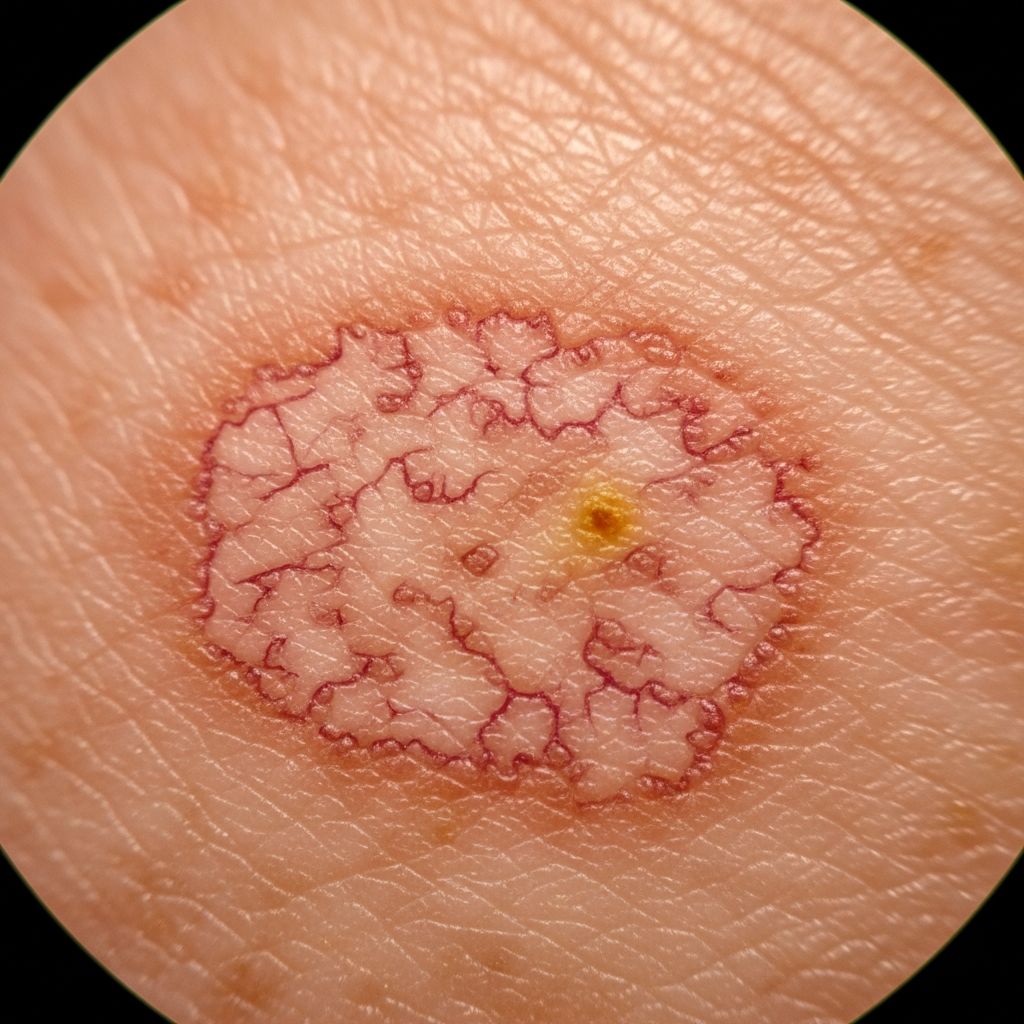
Actinic keratosis is an irregular, skin-coloured, red or pigmented papule or plaque most often found on a bald scalp, ear, face or back of the hand. Multiple lesions are often present. Dermoscopy enhances early detection and differentiation from malignant lesions like squamous cell carcinoma in situ (SCCIS).
What is dermoscopy?
Dermoscopy, also known as dermatoscopy or epiluminescence microscopy, is a non-invasive technique using a handheld dermoscope to examine skin lesions at magnification (10–100x). It visualises subsurface structures invisible to the naked eye, aiding diagnosis of actinic keratosis (AK) by revealing specific vascular, scale, and pigment patterns.
Key benefits for AK include identifying subtle lesions on sun-damaged skin, distinguishing from seborrhoeic keratoses, lentigo maligna, or basal cell carcinoma, and guiding biopsy decisions. Polarised dermoscopy improves vessel visualisation.
Who gets actinic keratosis?
Actinic keratosis affects fair-skinned individuals (Fitzpatrick skin types I–II) with chronic UV exposure from sun or tanning beds. Risk factors include age >40, outdoor occupations, immunosuppression (e.g., organ transplant), genetic syndromes like xeroderma pigmentosum, and prior skin cancers. Up to 60% of Australians over 40 have subclinical AKs.
What does actinic keratosis look like?
Clinically, AK presents as rough, scaly, erythematous papules (1–10 mm) on sun-exposed sites. Early lesions feel like sandpaper; hypertrophic ones form horns. Pigmented variants appear brown-black. They may itch, sting, or bleed if evolving to SCC.
Dermoscopy of nonpigmented facial actinic keratosis
Nonpigmented actinic keratosis on the face exhibits a characteristic
strawberry pattern
: red background with white follicular keratotic plugs resembling strawberry seeds. This reflects hyperkeratosis around hair follicles and vascular dilation.Core dermoscopic features include:
- Strawberry pattern: Red pseudopigment with white follicular openings (90% sensitivity).
- White superficial scale: Orthogonal thin scale perpendicular to surface.
- White rails/rail lines: Parallel white tracks along follicular openings, indicating keratin-filled infundibula.
- Rosy red follo-centred erythema: Blush around follicles.
- Thin red pseudopigment: Homogeneous pink-red hue.
The border is often sharp but blends into actinically damaged skin. Vascular patterns show dotted or glomerular vessels within white circles.
Strawberry pattern images
Visuals depict classic strawberry morphology on cheek and forehead, with magnified views highlighting white follicular plugs against red background.
Dermoscopy of nonpigmented nonfacial actinic keratosis
On trunk/limbs, AK lacks strawberry pattern, showing nonspecific features reflecting thicker stratum corneum:
- White-yellow keratin/scale masses
- Skin-coloured keratotic follicular plugs
- Peri-follicular haemorrhagic crust
- Reddish pseudopigment
- Polymorphous vessels: dotted, linear, bushy
- Structureless red areas
- Occasional rosettes (four white points around central brown/grey dot)
These patterns overlap with SCCIS, necessitating clinical correlation.
Dermoscopy of pigmented actinic keratosis
Pigmented AK combines nonpigmented features with melanin structures:
- Strawberry pattern + grey-brown dots/granularity around follicles
- Annular granular structures: Pigmented circles/granules around white follicular plugs
- Regular brown-grey dots/globules in superficial layers
- Blue-grey veil (less common than lentigo maligna)
- Preserved white follicular openings distinguish from lentigo maligna
Related Stories



Differentiation from pigmented SCCIS relies on retained strawberry elements and lack of atypical pigment networks.
Lichenoid actinic keratosis dermoscopy
Lichenoid variant shows marked vascular structures due to lichenoid infiltrate:
- Diffuse erythema/structureless red
- Prominent glomerular/dotted vessels
- Reduced scale/keratosis
- May mimic amelanotic melanoma
Biopsy recommended for symmetry loss or atypical vessels.
Hypertrophic actinic keratosis dermoscopy
Thick hyperkeratosis obscures structures:
- Yellow-white thick keratin mass
- Keratotic plugs/rainbow pattern
- Comet-tail vessels (comma-shaped)
- Polyscar-like structures
Often requires curettage to reveal underlying pattern.
Differential diagnosis on dermoscopy
AK mimics include:
| Lesion | Key Discriminating Dermoscopic Features |
|---|---|
| Seborrhoeic keratosis | Comedo-like openings, milia-like cysts, sharp borders, “stuck-on” appearance |
| Solar lentigo | Regular pigment network, moth-eaten border, fingerprint-like |
| Lentigo maligna | Atypical pigment network, annular-granular, grey veil destroying follicles |
| SCC in situ | White structureless areas, coiled vessels in clusters, loss of follicles |
| Amelanotic melanoma | Atypical polymorphous vessels, blue-white veil, irregular borders |
SCC arises in ~5–10% of AKs; suspect if ulceration, induration, or dermoscopic red dots/clusters.
Management of actinic keratosis
Treatment follows AAD guidelines: sun protection first-line. Lesion-directed (cryotherapy for solitary AKs) vs. field-directed (topicals like 5-FU, imiquimod, tirbanibulin; PDT) for multiple/subclinical lesions.
Dermoscopy guides therapy: strawberry pattern responds well to topicals; hypertrophic needs debulking. Post-treatment monitoring detects recurrence (20–40%). Nicotinamide 500mg BID reduces new AKs.
Prevention
- SPF50+ broad-spectrum sunscreen daily
- Sun avoidance 10am–4pm
- UPF50+ clothing, hats
- Nicotinamide supplementation
- Regular skin exams
Frequently asked questions
What is the most specific dermoscopic feature of facial actinic keratosis?
The strawberry pattern—red background with white follicular keratotic plugs—is pathognomonic for early facial AK.
Can dermoscopy reliably distinguish AK from squamous cell carcinoma?
Not always; SCCIS shows clustered dotted vessels, white keratin masses obliterating follicles, and polymorphous vasculature vs. AK’s preserved follicular structure. Biopsy suspicious lesions.
Is dermoscopy useful for pigmented actinic keratosis?
Yes, annular granular pigmentation around white follicular openings differentiates from lentigo maligna, which destroys the follicular architecture.
Do all actinic keratoses need treatment?
No; thin, asymptomatic AKs may regress with sun protection. Treat hypertrophic, symptomatic, or multiple lesions to prevent progression (10–15% SCC risk with >10 AKs).
How does nonfacial AK differ dermoscopically?
Lacks strawberry pattern; shows white-yellow scale, red pseudopigment, and nonspecific vessels.
References
- Actinic Keratosis Guidelines of Care — American Academy of Dermatology. 2023-06-01. https://www.aad.org/member/clinical-quality/guidelines/actinic-keratosis
- Actinic Keratosis: Diagnosis and Treatment — DermNet NZ. 2024-01-15. https://dermnetnz.org/topics/actinic-keratosis
- Actinic Keratosis: Comprehensive Review of Current Treatments — PMC / National Library of Medicine. 2024-05-20. https://pmc.ncbi.nlm.nih.gov/articles/PMC12262025/
- Actinic Keratosis Clinical Guidance — Primary Care Dermatology Society. 2023-11-10. https://www.pcds.org.uk/clinical-guidance/actinic-keratosis-syn-solar-keratosis
- Actinic Keratosis Dermoscopy — DermNet NZ. 2024-02-28. https://dermnetnz.org/topics/actinic-keratosis-dermoscopy
Similar Articles








Read full bio of medha deb