Acute Haemorrhagic Oedema Of Infancy: A Parent’s Guide
Rare benign skin vasculitis in infants: purpura, oedema, fever resolving spontaneously without treatment.
What is acute haemorrhagic oedema of infancy?
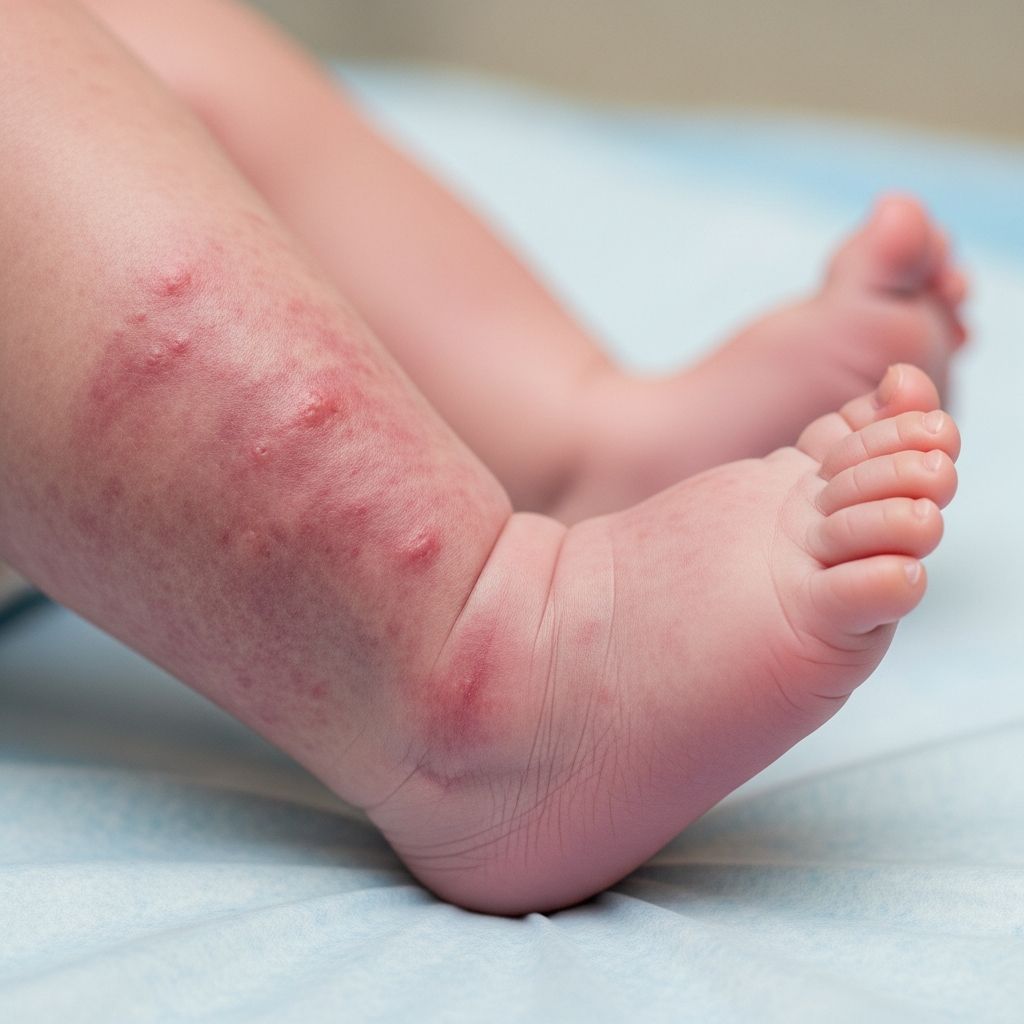
Acute haemorrhagic oedema of infancy (AHEI), also known as Finkelstein disease or Seidlmayer disease, is a rare, benign form of cutaneous small vessel vasculitis affecting infants. It presents with a characteristic triad of palpable purpura, oedema, and low-grade fever, typically in children aged 4 months to 2 years. Despite its alarming appearance, AHEI is self-limited, resolving spontaneously within 1–3 weeks without sequelae.
This condition manifests as large, well-demarcated, ecchymotic purpuric plaques often in cockade or targetoid patterns on the face, ears, and extremities. Unlike more severe vasculitides, infants remain systemically well, with rare visceral involvement. AHEI is distinguished from Henoch-Schönlein purpura (HSP) by its younger age group, facial predominance, and lack of IgA deposits in most cases.
Who gets acute haemorrhagic oedema of infancy (demographics)?
AHEI predominantly affects infants between 4 months and 2 years of age, with a mean onset around 8–12 months. It is more common in males, with a male-to-female ratio of approximately 1.5:1. The condition is rare, with fewer than 200 cases reported in literature, though underdiagnosis may occur due to its benign course.
Geographically, cases have been documented worldwide, with clusters reported in Europe, the Americas, and Asia. No ethnic predisposition is established, but it occurs in both light- and dark-skinned infants.
Causes of acute haemorrhagic oedema of infancy
The precise aetiology remains unknown, but AHEI is considered an immune-mediated leukocytoclastic vasculitis, possibly involving immune complex deposition in small vessels. It often follows a prodromal illness, suggesting a hypersensitivity reaction.
Reported triggers include:
- Infectious agents: Viral upper respiratory infections (e.g., adenovirus, rotavirus), bacterial infections (e.g., Streptococcus), and rarely parasitic.
- Medications: Antibiotics (e.g., amoxicillin), non-steroidal anti-inflammatory drugs.
- Immunisations: Recent vaccinations against diphtheria-tetanus-pertussis, Haemophilus influenzae type B, or pneumococcus.
In many cases, no trigger is identified. Debate persists on whether AHEI represents an infantile variant of HSP or a distinct entity, given overlapping histopathology but differing clinical features and immunofluorescence patterns.
Clinical features of acute haemorrhagic oedema of infancy
AHEI erupts abruptly 1–2 weeks after a prodrome, with evolution over 12–24 hours. Key features include:
| Feature | Description |
|---|---|
| Rash | Large (2–10 cm), annular or rosette-shaped purpuric plaques with ecchymotic centres; cockade/targetoid morphology; acral and facial distribution (spares trunk, buttocks); non-blanching, palpable. |
| Oedema | Non-pitting swelling of limbs, face, ears, and periorbital areas; may cause limb pain or refusal to bear weight. |
| Fever | Low-grade (<39°C), intermittent; present in 50–70% of cases. |
| Internal organ involvement | Rare (<5%): mild proteinuria/haematuria, gastrointestinal bleeding, orchitis; no long-term damage. |
Infants appear non-toxic, playful, and afebrile between episodes. Lesions may blister or ulcerate rarely but heal without scarring.
Related Stories



Diagnosis of acute haemorrhagic oedema of infancy
Diagnosis is clinical in typical cases: age <2 years, characteristic rash/oedema triad, and exclusion of mimics. Laboratory tests are often normal: mild leukocytosis/eosinophilia possible; normal inflammatory markers, coagulation, renal function.
Skin biopsy, if performed, shows leukocytoclastic vasculitis: perivascular neutrophils, nuclear dust, fibrinoid necrosis, endothelial swelling. Direct immunofluorescence reveals C3/IgM in vessels (IgA in only 30%, vs. 90% in HSP).
Differential diagnosis
- Henoch-Schönlein purpura (HSP): Older children (3–6 years), lower limb/buttock purpura, IgA deposits, frequent renal/GI involvement.
- Infectious purpura: Meningococcaemia (toxic, petechiae), viral exanthems.
- Kawasaki disease: Prolonged fever, mucosal changes, coronary risk.
- Urticaria multiforme: Transient wheals, no purpura.
- Child abuse: Bruising pattern inconsistent with AHEI.
- Other vasculitides: Cryoglobulinaemia, drug reactions.
Treatment of acute haemorrhagic oedema of infancy
No specific therapy is required; supportive care suffices. Reassurance is key for parents alarmed by the appearance. Measures include:
- Elevation of oedematous limbs.
- Analgesia (paracetamol) for discomfort.
- Monitor for rare complications (renal function, stool occult blood).
Systemic corticosteroids, antihistamines, or immunosuppressants do not hasten resolution and are not recommended. One case series noted prolonged course with steroids.
Outcome and complications of acute haemorrhagic oedema of infancy
AHEI resolves completely in 1–3 weeks, with rash fading to yellow-brown pigmentation before disappearing. Recurrences occur in <10%, usually mild and early. Long-term sequelae are absent; even rare visceral involvement resolves fully.
Follow-up: clinical review at 1–2 weeks; investigations only if systemic symptoms persist.
Frequently Asked Questions (FAQs)
Is acute haemorrhagic oedema of infancy dangerous?
No, it is benign and self-resolves without treatment or scarring. Rare organ involvement is transient.
Can it be prevented?
No known prevention; avoid unnecessary medications post-infection, but most cases are idiopathic.
Does it recur?
Infrequently (<10%); second episodes are shorter.
Is biopsy always needed?
No, only if diagnosis uncertain or HSP suspected.
What does the rash look like?
Red-purple, target-like plaques on face/legs; like large bruises with swelling.
History of acute haemorrhagic oedema of infancy
First described by Snow (1913, USA) as ‘post-infectious cockade purpura’. Finkelstein (1938, Europe) named it; also Seidlmayer disease. Recognized as distinct from HSP since 1990s.
References
- Acute hemorrhagic edema of infancy: a worrisome presentation, but … — Karremann M, Jordan JA, Bell N. 2013-09-26. https://pmc.ncbi.nlm.nih.gov/articles/PMC3772870/
- Acute haemorrhagic oedema of infancy (Finkelstein disease) — DermNet NZ. 2016-01-01. https://dermnetnz.org/topics/acute-haemorrhagic-oedema-of-infancy
- Acute Hemorrhagic Edema of Infancy — Semantics Scholar. 2016. https://pdfs.semanticscholar.org/af55/1e767caa279a7fa8d4339b980466b1caa4b0.pdf
Similar Articles








Read full bio of Sneha Tete