Acute Localised Exanthematous Pustulosis
Rare drug-induced skin reaction with localised pustules on face, neck, or chest, resolving quickly after medication withdrawal.
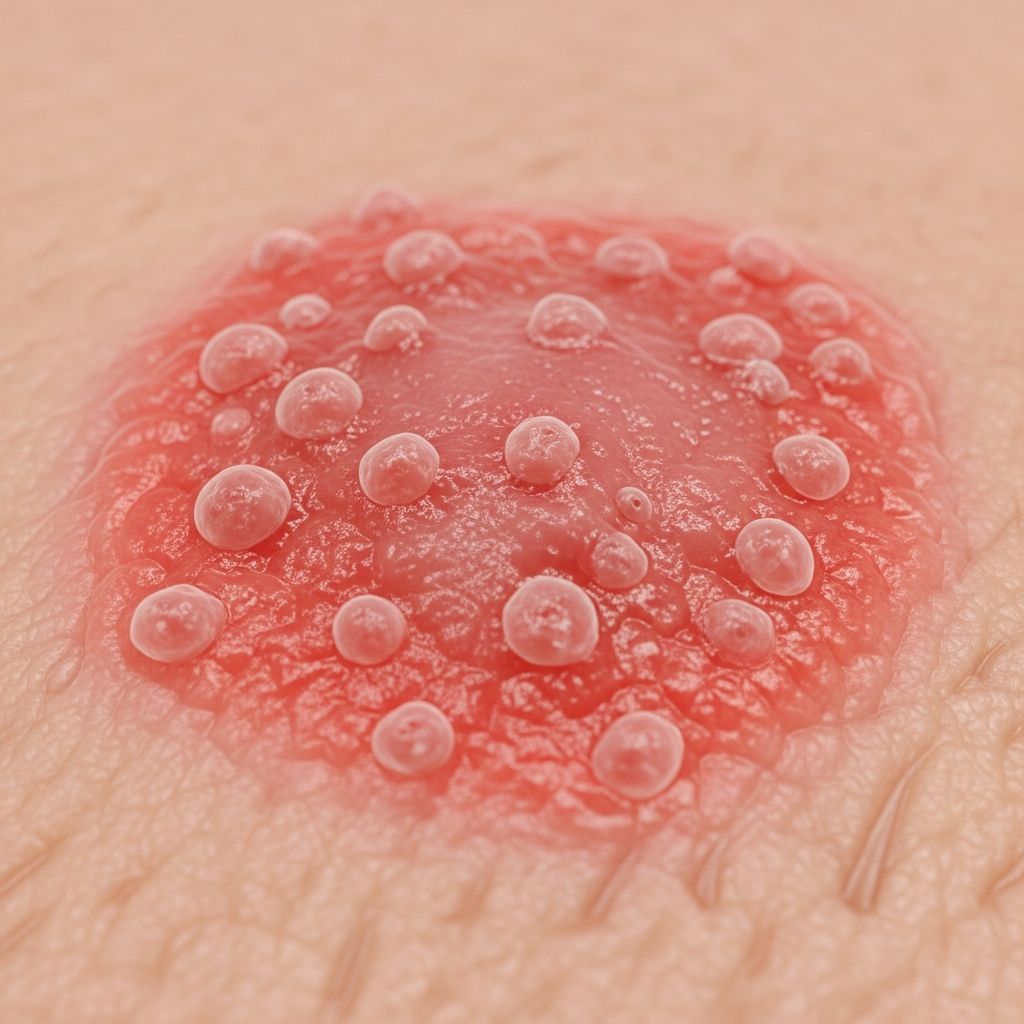
Acute localised exanthematous pustulosis (ALEP) is the localised form of acute generalised exanthematous pustulosis (AGEP). It can also be referred to as localised pustular drug eruption or localised toxic pustuloderma. ALEP is a rare form of drug reaction that arises a few days after starting a medication and usually resolves within a week of discontinuing the triggering agent.
Introduction
Acute localised exanthematous pustulosis (ALEP) represents a distinct clinical entity within the spectrum of severe cutaneous adverse reactions (SCARs). First formally described in 2005 by Prange et al., ALEP is characterized by the acute onset of multiple nonfollicular, pinhead-sized, sterile pustules on an erythematous and oedematous background, typically confined to the face, neck, or chest. Unlike the widespread involvement seen in AGEP, ALEP remains localised, making it a rarer variant with approximately 25 cases reported in the literature up to recent reviews.
This condition arises rapidly, often within hours to a few days of drug exposure, and resolves spontaneously within days to a week upon drug withdrawal. Systemic symptoms such as fever and neutrophilic leukocytosis are common, underscoring its hypersensitivity nature. ALEP is predominantly drug-induced, with antibiotics, particularly β-lactams like amoxicillin-clavulanic acid, implicated in the majority of cases.
Demographics
ALEP is very rare, with only a small number of documented cases worldwide. Limited data suggest a possible predilection for younger female patients, though insufficient evidence confirms this trend. Case reports span various ages, including a 35-year-old woman with facial and neck involvement post-amoxicillin and a 26-year-old woman with facial pustules after antibiotics. No strong ethnic or gender biases are established due to the scarcity of reports, but recognition is increasing with more publications on chemotherapeutic agents like paclitaxel.
Causes
The primary trigger for ALEP is medications, accounting for over 90% of cases. It manifests as a type IV hypersensitivity reaction, likely T-cell mediated, similar to AGEP.
- Antibiotics: Most common, especially amoxicillin (often with clavulanic acid), β-lactams, macrolides, cephalosporins, bactrim, and vancomycin.
- Non-steroidal anti-inflammatory drugs (NSAIDs): Reported in several instances.
- Other drugs: Antifungals, calcium antagonists, antiulcer medications, pembrolizumab, and taxanes like paclitaxel in cancer patients.
- Rare non-drug triggers: Limited evidence for contact allergens or herbal remedies, though most cases are systemic drug-related.
Drugs typically provoke symptoms 3–5 days post-initiation, though onset can be as early as hours in sensitized individuals. Recurrent eruptions in the same site have been noted, as in early amoxicillin cases.
Clinical Features
ALEP presents abruptly with localised clustered white or yellow, superficial, flaccid pustules (1–2 mm) atop erythematous, oedematous skin patches. Common sites include the face (cheeks, perioral), neck, and upper chest; trunk involvement is less frequent.
- Morphology: Nonfollicular, sterile pustules, often in herpetiform or linear arrangements; surrounding erythema with oedema gives a tight, swollen appearance.
- Symptoms: Tightness or discomfort rather than intense itch; burning sensation possible. Mild fever, fatigue, chills in some.
- Systemic signs: Neutrophilic leukocytosis and low-grade fever frequent; mucous membranes rarely affected (e.g., mild lip involvement).
- Duration: Peaks within days, resolves in 4–14 days post-drug cessation without scarring.
Related Stories



Histopathology confirms diagnosis: subcorneal/intraepidermal spongiform pustules, papillary dermal oedema, perivascular neutrophilic infiltrates with eosinophils, and mild spongiosis. No vasculitis in most, though mixed inflammation noted.
Complications
ALEP is generally benign and self-limited. Potential issues include:
- Post-inflammatory hyperpigmentation: Common in affected areas, resolving over months.
- Secondary infection: Rare due to sterile pustules, but possible if manipulated.
- Drug hypersensitivity extension: Unclear risk of progression to AGEP or other SCARs like DRESS or SJS/TEN; monitoring advised.
- Recurrence: Possible upon re-exposure to culprit drug.
No reports of long-term sequelae like nail or joint involvement, distinguishing it from pustular psoriasis.
Diagnosis
Diagnosis relies on clinical presentation, drug history, histopathology, and exclusion of mimics. EuroSCAR scoring for AGEP can be adapted, focusing on localised features.
- Key criteria: Acute onset pustules on erythematous base post-drug, sterile cultures, neutrophilia, rapid resolution.
- Investigations: Skin biopsy (essential), blood tests (WBC, CRP), pustule swabs (negative).
Differential Diagnoses
| Condition | Key Distinguishing Features |
|---|---|
| Acute Generalised Exanthematous Pustulosis (AGEP) | Widespread body involvement (>50% skin); more pustules. |
| Pustular Psoriasis | Chronic/recurrent, thicker plaques, positive Nikolsky (negative in ALEP). |
| Bacterial Folliculitis | Follicular pustules, positive cultures. |
| Fixed Drug Eruption | Recurrent in same site, hyperpigmented macules, no pustules. |
| Impetigo | Honey-crusted, contagious, Gram-positive cocci on swab. |
| Contact Dermatitis | Itchy vesicles, geometric distribution. |
Treatment
The cornerstone is immediate withdrawal of the suspected drug, leading to rapid improvement within days.
- Supportive care: Emollients, cool compresses for comfort.
- Topical corticosteroids: Moderate potency (e.g., clobetasol) for inflammation/pruritus.
- Systemic corticosteroids: Short course (e.g., prednisone 40 mg/day) for severe cases or delayed resolution; taper slowly.
- Antihistamines: If symptomatic itch.
- Avoid: Rechallenge with culprit; patch testing controversial.
Prognosis excellent; full resolution without sequelae in most.
Frequently Asked Questions
What causes ALEP?
ALEP is mainly triggered by medications, especially antibiotics like amoxicillin. It occurs due to a hypersensitivity reaction.
How quickly does ALEP appear?
Symptoms start suddenly, often 3–5 days after drug initiation, sometimes within hours.
Is ALEP contagious?
No, pustules are sterile and non-infectious.
Does ALEP leave scars?
Typically no, but post-inflammatory pigmentation may occur temporarily.
How is ALEP diagnosed?
By clinical features, recent drug exposure, biopsy showing subcorneal pustules, and ruling out infections.
What is the treatment for ALEP?
Stop the offending drug; use topical or oral steroids if needed. Resolves in days to weeks.
Can ALEP recur?
Yes, if re-exposed to the same drug.
Who is at risk for ALEP?
Anyone on triggering meds; possibly younger females, but rare overall.
This comprehensive overview draws from peer-reviewed cases, emphasising ALEP’s distinct profile for accurate management in dermatology practice.
References
- Acute Localized Exanthematous Pustulosis (ALEP): Review of a Case and All Published Cases — PMC/NIH. 2017-11-15. https://pmc.ncbi.nlm.nih.gov/articles/PMC5698205/
- Acute localised exanthematous pustulosis — DermNet NZ. 2023. https://dermnetnz.org/topics/acute-localised-exanthematous-pustulosis
- Acute localized exanthematous pustulosis induced by paclitaxel — Anais Brasileiros de Dermatologia. 2022. https://www.anaisdedermatologia.org.br/en-acute-localized-exanthematous-pustulosis-induced-articulo-S0365059622000319
- Acute Localized Exanthematous Pustulosis on the Face — PMC/NIH. 2012. https://pmc.ncbi.nlm.nih.gov/articles/PMC3276799/
- Acute localized exanthematous pustulosis: Clinical features — Wiley Online Library. 2021. https://onlinelibrary.wiley.com/doi/abs/10.1111/dth.15087
Similar Articles








Read full bio of Sneha Tete