Addison’s Disease: Overview, Causes, Symptoms & Treatment
Complete guide to understanding Addison's disease: causes, symptoms, diagnosis, and effective treatment options.
Addison’s Disease: Complete Overview
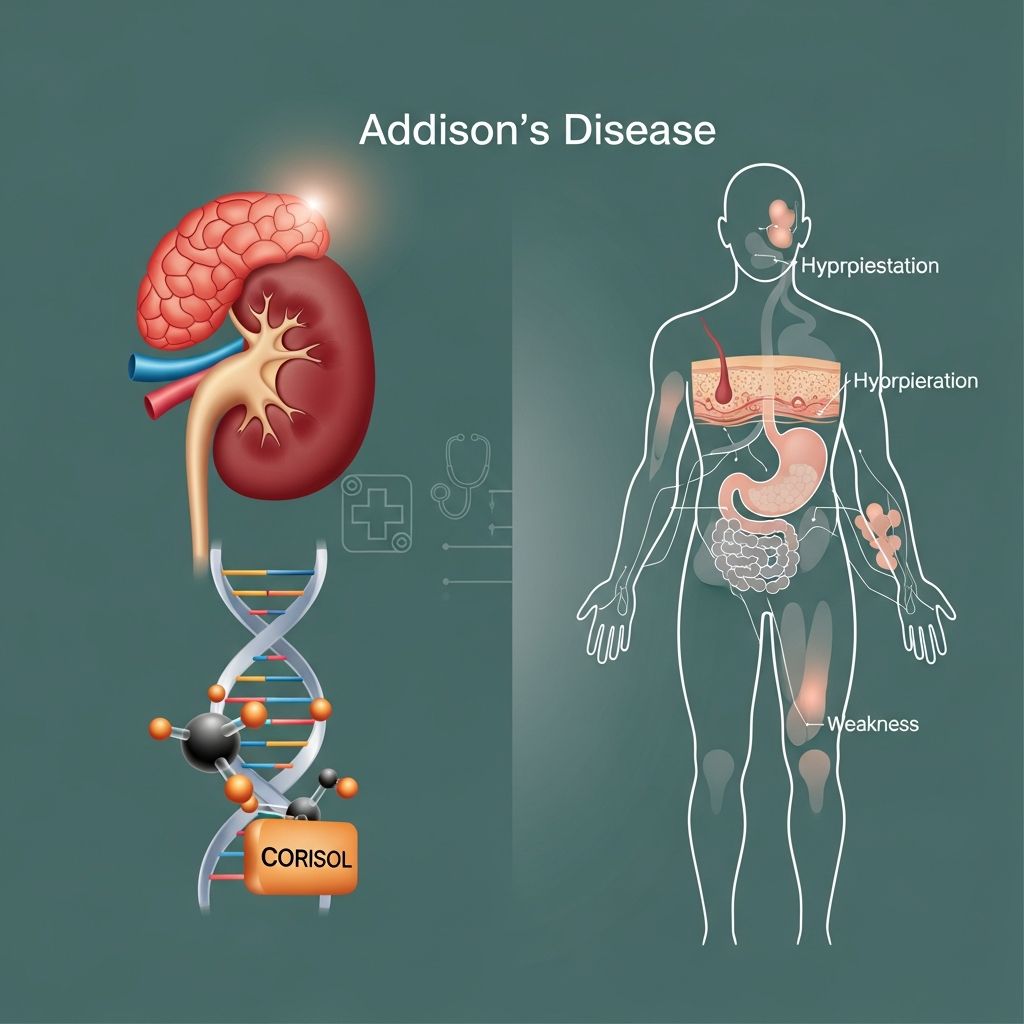
Addison’s disease is a rare chronic condition in which your adrenal glands don’t produce enough of the hormones cortisol and aldosterone. Also known as primary adrenal insufficiency, this condition is treatable with medication, though it requires lifelong management. The disease affects approximately 1 in 100,000 people in the United States, making it relatively uncommon, yet its symptoms can be serious if left untreated.
The adrenal glands are small, triangular-shaped organs located above each kidney. These glands produce several essential hormones, including cortisol, which helps your body respond to stress and maintain blood pressure, and aldosterone, which regulates sodium and potassium levels in your blood. When these glands fail to produce adequate amounts of these hormones, your body cannot maintain normal physiological functions, leading to the varied and sometimes debilitating symptoms associated with Addison’s disease.
Understanding the Causes of Addison’s Disease
The causes of Addison’s disease vary, but the most common cause is an autoimmune response where the immune system mistakenly attacks the adrenal glands. Approximately 75% of cases result from this autoimmune attack. In autoimmune Addison’s disease, the body’s immune system attacks the outer portion of the adrenal glands (the adrenal cortex), where cortisol and aldosterone are produced.
The autoimmune destruction typically occurs gradually, with symptoms generally not appearing until approximately 90% of the adrenal cortex has been damaged—a process that can take several months to years. Importantly, autoimmune Addison’s disease can occur as an isolated condition or as part of rare inherited syndromes known as autoimmune polyendocrine syndromes types I and II (also called Schmidt syndrome).
Beyond autoimmune causes, other factors can damage the adrenal glands and lead to Addison’s disease:
- Infections: Tuberculosis, meningitis, influenza, cytomegalovirus, and HIV can damage the adrenal glands. Historically, tuberculosis was a major cause of Addison’s disease and remains prominent in developing countries.
- Hemorrhage: Bleeding into the adrenal glands can cause damage and hormone deficiency.
- Tumors: Cancerous growths can affect adrenal function.
- Surgery: Surgical removal of the adrenal glands can result in Addison’s disease.
- Congenital conditions: Congenital adrenal hyperplasia, where adrenal glands are larger than normal at birth, can contribute to hormone imbalances.
Additionally, people with certain autoimmune diseases are at higher risk of developing Addison’s disease, including Type 1 diabetes, vitiligo, pernicious anemia, myasthenia gravis, and testicular failure.
Recognizing Symptoms of Addison’s Disease
Addison’s disease typically develops gradually, with symptoms emerging slowly over time as adrenal damage progresses. This gradual onset can make recognition difficult, and diagnosis is often delayed or missed initially. The symptoms vary from person to person, but common manifestations include:
- Extreme fatigue and generalized weakness
- Darkening of the skin (hyperpigmentation), which may be harder to detect on darker skin tones
- Loss of appetite and weight loss
- Abdominal pain, nausea, and vomiting
- Salt cravings
- Dizziness or light-headedness, particularly when standing up
- Joint pain, muscle weakness, and muscle cramps
- Headaches
- Low-grade fever
- Increased thirst and frequent urination
- Difficulty concentrating
- Anxiety and depression
- Darker skin on the inside of the cheeks and lips (buccal mucosa)
Related Stories



While Addison’s disease can develop at any age, it most commonly affects adults between 30 and 50 years old, though it can occasionally occur in children.
Adrenal Crisis: A Medical Emergency
One of the most critical aspects of Addison’s disease is the potential for an acute adrenal crisis, a severe endocrine emergency that requires immediate medical attention. An adrenal crisis occurs when hormone levels drop critically low and can be triggered by physical stress, illness, infection, injury, or surgery.
Symptoms of an adrenal crisis include:
- Severe hypotension (dangerously low blood pressure)
- Hyponatremia (low sodium levels)
- Hyperkalemia (high potassium levels)
- Hypoglycemia (low blood sugar)
- Severe abdominal pain
- Confusion or altered mental status
If you suspect an adrenal crisis, seek emergency medical care immediately, as this condition can be life-threatening without prompt treatment.
Diagnosis of Addison’s Disease
Diagnosing Addison’s disease requires a systematic approach, as early symptoms are often nonspecific and can mimic other conditions. Healthcare providers should maintain high clinical suspicion to avoid misdiagnosis, especially since many patients are diagnosed only after presenting with an acute adrenal crisis.
The diagnostic process typically involves:
- Clinical assessment: Your healthcare provider will review your symptoms and medical history, looking for patterns consistent with adrenal insufficiency.
- Serum morning cortisol test: A morning cortisol level below 3 mcg/dL is a key diagnostic indicator.
- ACTH stimulation test: This measures how your adrenal glands respond to adrenocorticotropic hormone (ACTH). In Addison’s disease, the cortisol response is blunted.
- Plasma ACTH level: An elevated ACTH level above 200 pg/mL, combined with low cortisol, confirms Addison’s disease diagnosis.
- Aldosterone and renin levels: High renin levels with low aldosterone support the diagnosis.
- Imaging studies: CT or MRI scans may be performed to evaluate the adrenal glands and rule out other causes.
Early recognition and proper diagnostic testing are essential for initiating appropriate treatment and preventing life-threatening complications.
Treatment and Management of Addison’s Disease
Addison’s disease is a chronic condition requiring lifelong treatment with hormone replacement therapy. The goal of maintenance therapy is to replace the hormones your body cannot produce adequately, maintaining physiologic levels of glucocorticoids and mineralocorticoids.
Glucocorticoid replacement: Patients typically receive glucocorticoid medications (such as hydrocortisone or prednisone) to replace cortisol. The dosage is carefully adjusted based on individual needs and stress levels.
Mineralocorticoid replacement: Fludrocortisone is commonly prescribed to replace aldosterone, helping regulate sodium and potassium balance.
Stress management: During times of physical or emotional stress, infection, or illness, patients may need to increase their medication dosage temporarily under medical supervision.
Regular monitoring: Ongoing medical care is essential to adjust medication dosages as needed and monitor for complications. Patients should maintain regular appointments with their endocrinologist or healthcare provider.
Medical identification: Patients with Addison’s disease should wear medical alert bracelets or identification cards indicating their condition and providing information about their medication needs in case of emergency.
Living with Addison’s Disease
With proper treatment and management, most people with Addison’s disease can lead normal, active lives. However, certain lifestyle considerations are important:
- Medication adherence: Taking prescribed hormones exactly as directed is crucial for symptom control and preventing crises.
- Stress management: Developing healthy coping mechanisms and stress reduction techniques can help minimize physical and emotional stress.
- Adequate nutrition: A balanced diet with sufficient salt intake (as often craved by patients) supports optimal health.
- Regular exercise: Moderate physical activity promotes overall health and well-being when coordinated with medication management.
- Sleep and rest: Prioritizing adequate sleep helps manage fatigue and supports immune function.
- Medical preparedness: Always carry emergency medication and ensure family, friends, and colleagues understand your condition and know what to do in an adrenal crisis.
Differentiating Addison’s Disease from Related Conditions
It’s important to distinguish Addison’s disease from related adrenal conditions. Secondary adrenal insufficiency occurs when the pituitary gland doesn’t release enough adrenocorticotropic hormone (ACTH), which normally activates the adrenal glands to produce cortisol. This differs from Addison’s disease (primary adrenal insufficiency), where the adrenal glands themselves are damaged.
In contrast, Cushing’s syndrome represents the opposite problem: the body has too much cortisol (hypercortisolism) rather than too little. While both Addison’s disease and Cushing’s syndrome involve cortisol regulation, they present with entirely different symptoms and require different treatment approaches.
Frequently Asked Questions About Addison’s Disease
Q: How rare is Addison’s disease?
A: Addison’s disease is quite rare, affecting approximately 1 in 100,000 people in the United States. Despite its rarity, it’s important to recognize and treat appropriately.
Q: Can Addison’s disease be cured?
A: Addison’s disease cannot be cured, but it is effectively treatable with hormone replacement therapy. Most people with properly treated Addison’s disease can live normal, active lives.
Q: Is Addison’s disease hereditary?
A: While most cases of Addison’s disease are not directly inherited, the autoimmune form can occur as part of rare inherited syndromes called autoimmune polyendocrine syndromes (types I and II). If you have a family history of Addison’s disease or autoimmune disorders, inform your healthcare provider.
Q: What should I do if I suspect an adrenal crisis?
A: Seek emergency medical care immediately. Adrenal crisis is a medical emergency requiring prompt treatment with intravenous fluids and high-dose steroids. Call emergency services or go to the nearest emergency department.
Q: Can I stop taking my Addison’s disease medication?
A: No. Addison’s disease requires lifelong hormone replacement therapy. Stopping or significantly reducing medication without medical supervision can trigger an adrenal crisis and be life-threatening. Always consult your healthcare provider before making any changes to your medication regimen.
Q: How often should I see my healthcare provider?
A: Most patients with Addison’s disease benefit from regular follow-up appointments with their endocrinologist or primary care physician to monitor symptoms, adjust medication dosages as needed, and screen for related autoimmune conditions.
References
- Addison’s Disease: What It Is, Causes, Symptoms & Treatment — Cleveland Clinic. 2025. https://my.clevelandclinic.org/health/diseases/15095-addisons-disease
- Addison Disease – StatPearls — National Center for Biotechnology Information (NCBI), National Institutes of Health. 2025. https://www.ncbi.nlm.nih.gov/books/NBK441994/
- Addison’s Disease — National Health Service (NHS). 2025. https://www.nhs.uk/conditions/addisons-disease/
- Addison Disease: MedlinePlus Medical Encyclopedia — U.S. National Library of Medicine. 2025. https://medlineplus.gov/ency/article/000378.htm
Similar Articles








Read full bio of Sneha Tete