Adenosine Injection: Uses, Dosage, and Side Effects
Complete guide to adenosine injection: mechanism, uses, dosage, side effects, and safety information.
What is Adenosine Injection?
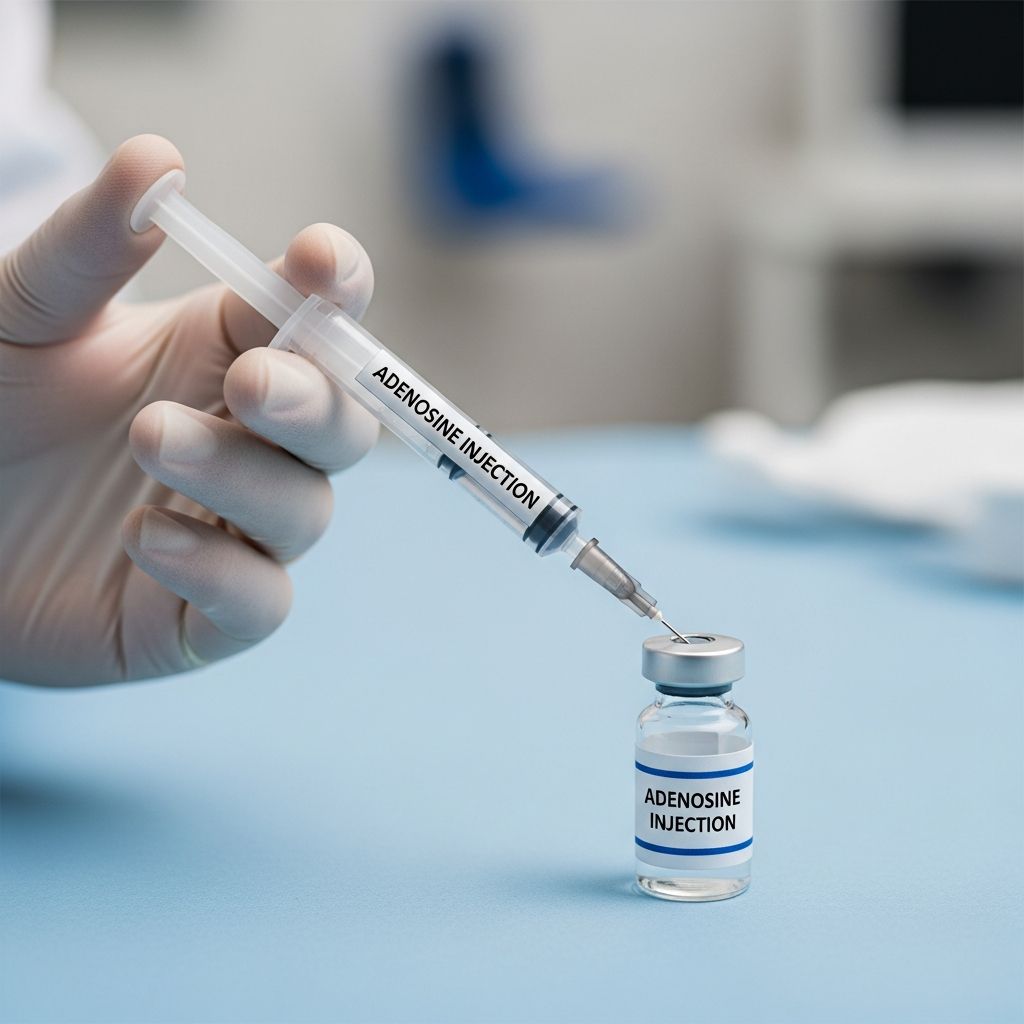
Adenosine injection is a prescription medication administered intravenously by healthcare professionals to evaluate heart function and treat certain cardiac conditions. This medicine works by dilating the arteries of the heart and increasing blood flow, helping healthcare providers identify coronary artery disease and other cardiac abnormalities. Adenosine is available under brand names including Adenocard and Adenoscan, and is provided as an injectable solution that must be administered only by or under the direct supervision of a doctor.
The medication represents an important advancement in cardiac care, offering a safer alternative to traditional exercise stress testing for patients who cannot undergo adequate physical exercise. Its rapid action and short duration make it particularly valuable in both diagnostic and therapeutic settings.
How Adenosine Injection Works
Adenosine functions as a naturally occurring substance in the body that plays a crucial role in regulating heart rate and blood vessel function. When administered as an injection, adenosine causes the coronary arteries to dilate or open wider, mimicking the cardiovascular response that occurs during physical exercise. This pharmacological effect allows healthcare providers to assess how your heart responds to increased blood flow demands without requiring you to exercise.
By increasing blood flow to the heart muscle by three to five times the resting amount, adenosine helps identify areas where blood flow may be restricted due to coronary artery disease or other conditions. The medication achieves this through its interaction with adenosine receptors in the heart and blood vessels, triggering the vasodilation response necessary for accurate cardiac assessment.
A remarkable characteristic of adenosine is its ultra-short half-life, meaning the body rapidly metabolizes and clears the medication. Within approximately 10 seconds of administration, only half of the dose remains in your system. This rapid clearance is a significant safety feature that contributes to the medication’s favorable side effect profile.
Medical Uses of Adenosine Injection
Cardiac Stress Testing
One of the primary uses of adenosine injection is in pharmacologic stress testing, specifically for myocardial perfusion scintigraphy. This diagnostic procedure is used in combination with Thallium-201 as a stress agent for patients unable to undergo adequate exercise stress testing. Healthcare providers use this test to check the blood flow to your heart and determine if your heart is receiving sufficient blood supply while your body is under simulated exercise stress compared to when you are at rest.
During an adenosine stress test, a healthcare provider injects a small amount of contrast or radioactive marker into your vein while you are resting and again after receiving the adenosine medication. A special imaging scanner, such as magnetic resonance imaging (MRI) or computed tomography (CT), captures images of the contrast or marker as it passes through your blood vessels and heart muscle, creating detailed computer images for healthcare provider review.
Arrhythmia Treatment
Adenosine serves as an important medication for treating supraventricular tachycardia (SVT) by blocking or slowing electrical impulses at the atrioventricular node, located between the upper and lower chambers of the heart. The medication’s ability to create transient atrioventricular nodal block makes it potentially the drug of first choice for acute termination of SVT. Research indicates that adenosine helps terminate more than 95% of junctional reentrant tachycardias through its atrioventricular nodal blocking effects.
Beyond arrhythmia termination, adenosine serves as a valuable diagnostic tool. Its transient atrioventricular block can unmask atrial deflections on the electrocardiogram (ECG), facilitating the identification of arrhythmia origin and mechanism, particularly in patients with Wolff-Parkinson-White syndrome.
Related Stories



Diagnostic Applications
Healthcare providers increasingly use adenosine as a diagnostic aid in evaluating wide QRS complex tachycardias. Preliminary investigations suggest that adenosine may be useful in differentiating SVT with aberration from sustained ventricular tachycardia. Small trials conducted in controlled electrophysiologic laboratory environments have shown encouraging results with no documented instances of hemodynamic decompensation.
Dosage Information
The recommended dosage of adenosine for adults is 6 mg (one vial) given as a rapid intravenous bolus. When administered through an intravenous line, healthcare providers must flush the line with saline immediately afterward to ensure complete medication delivery and prevent local irritation.
For patients who do not respond to the initial 6 mg dose, healthcare providers may administer additional doses in escalating amounts. Research shows that of patients who eventually respond to adenosine, approximately half will revert to normal heart rhythm in less than 30 seconds after the first injection. The medication’s rapid action and short duration allow healthcare providers to administer repeated doses over short periods without concern about drug accumulation.
The specific dosage may vary depending on the indication and individual patient factors. Healthcare providers determine the appropriate dose based on the patient’s clinical condition, body weight, and other medications they may be taking.
Side Effects and Adverse Reactions
Common Side Effects
Approximately 80% of people experience minor side effects from adenosine administration. The most common side effects include:
- Facial flushing and warm sensation
- Chest discomfort or chest pressure
- Shortness of breath
- Dizziness or lightheadedness
- Headache
- Palpitations or awareness of heartbeat
- Nausea
These adverse effects are transient and clinically insignificant, primarily because of adenosine’s ultra-short half-life. Most side effects go away seconds after the infusion ends in the majority of people. Patients typically tolerate these side effects better when informed of their transient nature before the injection.
Cardiovascular Effects
Adenosine can cause a decrease or increase in your heart rate, and your blood pressure may come down slightly. These cardiovascular effects are generally temporary and resolve quickly as the medication is eliminated from your system. Some patients may experience transient slowing of the sinus rate, which resolves once the medication wears off.
Safety and Precautions
Is Adenosine Safe?
Yes, adenosine injection is generally considered safe for its indicated uses. The medication has few side effects, and they typically go away quickly. Researchers have demonstrated the safety profile of adenosine for stress testing by evaluating over 15,000 people who received the medication. The rapid clearance of adenosine from the body provides a significant safety margin that negates nearly all potential adverse effects.
Conditions Requiring Caution
Certain medical conditions require special consideration before adenosine administration. Patients with the following conditions should only receive adenosine with caution, as it may worsen their condition:
- Hypertension (high blood pressure)
- Hypotension (low blood pressure)
- History of seizures
- History of stroke
- Coronary artery stenosis or ischemia
- Heart valve disease
Contraindications and Conditions to Avoid
Adenosine should not be used in patients with certain serious conditions. These include:
- Severe unstable angina or unstable heart or blood vessel problems, as adenosine may increase the risk of heart attack
- Severe asthma, bronchitis, emphysema, or other significant breathing problems or lung disease
- Second or third-degree heart block without a functioning pacemaker
- Sinus node disease (such as sick sinus syndrome) without a functioning pacemaker
- Atrial fibrillation or heart rhythm problems that are unmanaged
Patients with severe sinus node dysfunction should receive adenosine only if they have a functioning ventricular pacemaker. Patients with uncorrected low blood volume (hypovolemia) or certain heart and blood vessel diseases may experience increased risk for more serious side effects.
Important Considerations Before Treatment
Medication Interactions
Certain substances can interact with adenosine and affect its efficacy or safety. Caffeine and theophylline are competitive antagonists of adenosine receptors and will prevent adenosine from binding and producing its effects. Patients should avoid caffeine intake before adenosine administration. Dipyridamole blocks the uptake of adenosine into cells, enhancing adenosine’s effects by allowing more time for binding to cell-surface receptors, which may intensify both therapeutic and adverse effects.
Pre-Treatment Information
Be sure to tell your healthcare provider about all medical conditions you have and all medications you take, including those you purchase without a prescription and herbal supplements. This information helps your healthcare provider determine if adenosine is appropriate for you and allows them to monitor you appropriately during and after the procedure.
You should not receive adenosine if you have certain conditions, such as severe asthma, severe breathing problems, or certain unmanaged abnormal heart rhythms. Your healthcare provider will assess whether adenosine is the right choice for your specific situation.
Duration and Clearance
Adenosine has a remarkably short duration of action. The medication only remains in your body for approximately five minutes. Within 10 seconds, only half of the medicine is still in your system. This ultra-short half-life means that side effects typically disappear seconds after the infusion ends in most people, making adenosine a relatively safe option even for patients who might experience side effects during administration.
This rapid clearance also means that repeated doses can be administered over short periods without concern about drug accumulation in the body, making it useful for both diagnostic and therapeutic applications.
Alternative Options
Regadenoson (Lexiscan)
Both Lexiscan (regadenoson) and adenosine are medications that open blood vessels and increase blood flow to the heart. Healthcare providers use regadenoson more frequently than other medicines for stress tests. A primary difference between the two medications is the injection time: regadenoson only takes 10 seconds to inject a dose, while adenosine takes about five minutes. The choice between these medications depends on individual patient factors and healthcare provider preference.
When to Contact Your Healthcare Provider
While adenosine side effects are generally minor and short-lived, contact your healthcare provider if you experience:
- Persistent chest pain or pressure that does not resolve after the procedure
- Severe shortness of breath
- Fainting or loss of consciousness
- Severe palpitations or irregular heartbeat that persists
- Signs of allergic reaction, such as difficulty breathing, rash, or swelling
- Any other concerning symptoms
Frequently Asked Questions
Q: What is the difference between Adenocard and Adenoscan?
A: Both are brand names for adenosine injection. The primary difference relates to their specific uses—Adenocard is used for terminating certain arrhythmias, while Adenoscan is used for cardiac stress testing. Your healthcare provider will determine which formulation is appropriate for your condition.
Q: How quickly does adenosine work?
A: Adenosine works very rapidly. Approximately half of patients who respond to adenosine for arrhythmia termination will revert to normal rhythm in less than 30 seconds after the first injection. The medication’s effects begin almost immediately after intravenous administration.
Q: Can adenosine be given orally?
A: No, adenosine must be given intravenously. The medication is rapidly taken up and inactivated by cells throughout the body, so oral administration would not be effective. It must be administered directly into the bloodstream by a healthcare professional.
Q: Is adenosine safe for patients with asthma?
A: Adenosine should not be used in patients with severe asthma or other significant breathing problems. If you have asthma or respiratory disease, inform your healthcare provider before receiving adenosine so they can determine if an alternative medication is more appropriate.
Q: How long do adenosine side effects last?
A: Most adenosine side effects are very short-lived, resolving within seconds after the infusion ends. Due to the medication’s ultra-short half-life, adverse effects are typically gone within one minute or less in most people.
Q: Can I eat or drink before an adenosine stress test?
A: Your healthcare provider will give you specific pre-test instructions, which typically include avoiding caffeine for 24 to 48 hours before the test, as caffeine can interfere with adenosine’s effects. Ask your provider about fasting and other dietary restrictions specific to your test.
Q: What should I expect during an adenosine stress test?
A: During the test, your healthcare provider will place an intravenous line and take initial imaging scans while you rest. Then adenosine will be infused over about five minutes, during which you may experience side effects like flushing, shortness of breath, or chest discomfort. Imaging scans will be taken during the adenosine infusion. You will be monitored closely throughout the procedure, and the side effects will resolve quickly once the infusion ends.
Q: Is adenosine safe during pregnancy?
A: Always inform your healthcare provider if you are pregnant or may be pregnant. Your healthcare provider will assess the risks and benefits of adenosine administration in your specific situation and may recommend alternative diagnostic approaches if appropriate.
References
- Adenosine (intravenous route) – Side effects & uses — Mayo Clinic. 2024. https://www.mayoclinic.org/drugs-supplements/adenosine-intravenous-route/description/drg-20084866
- Adenosine – Cleveland Clinic Journal of Medicine — Cleveland Clinic Journal of Medicine, Vol. 57, No. 4, 1990. https://www.ccjm.org/content/ccjom/57/4/383.full.pdf
- Adenosine Stress Test — Cleveland Clinic. 2025. https://my.clevelandclinic.org/health/diagnostics/16839-cardiac-mri-adenosine-stress-test
- Antiarrhythmic Drugs: Types, Uses and Side Effects — Cleveland Clinic. 2025. https://my.clevelandclinic.org/health/drugs/22867-what-are-antiarrhythmics
- The use of adenosine for repair of penetrating cardiac injuries — The Annals of Thoracic Surgery, 2001. https://www.ovid.com/journals/tants/fulltext/10.1016/s0003-4975(01)02457-2
Similar Articles








Read full bio of Sneha Tete