Adult-Onset Dermatomyositis: Diagnosis, Cancer Risk, Treatment
Understanding the symptoms, causes, diagnosis, and treatment of adult-onset dermatomyositis, a rare autoimmune disease affecting skin and muscles.
Adult-onset dermatomyositis is a form of dermatomyositis (DM), an idiopathic inflammatory myopathy (IIM) characterised by muscle weakness and a distinctive skin rash. It typically affects adults aged 40–60 years, with a female predominance. What is adult-onset dermatomyositis?
What is adult-onset dermatomyositis?
Adult-onset dermatomyositis is strongly associated with malignancy; up to 25% of affected adults have an underlying malignancy at diagnosis, most commonly adenocarcinomas (eg, ovarian, lung, gastric, pancreatic, and colorectal cancers). Dermatomyositis is thought to be caused by a microangiopathy affecting skin and muscle. There is a genetic predisposition, with associations including the PTPN22 gene and certain HLA alleles (eg, HLA-DRB1*0301).
Most patients have disease-associated autoantibodies, confirming its autoimmune nature. Myositis-specific autoantibodies (MSAs) such as anti-Mi-2, anti-TIF1γ, anti-NXP2, anti-MDA5, and anti-SAE help classify subtypes and predict complications like malignancy or interstitial lung disease (ILD).
Who gets adult-onset dermatomyositis?
Adult-onset dermatomyositis has an incidence of 5–10 per million. It is more common in women (F:M = 2:1). Peak onset is in the 40–60-year age group.
Causes
The exact cause is unknown, but triggers may include:
- Viral infections (eg, Coxsackie B, parvovirus).
- Drugs (eg, hydroxyurea, statins, penicillamine).
- Vaccinations.
- UV light exposure.
- Malignancy (paraneoplastic in 15–25% of adults).
In paraneoplastic DM, anti-TIF1γ antibodies are strongly linked to cancer.
Clinical features
Skin changes often precede muscle weakness. A face rash is the commonest initial sign, followed by scalp symptoms then hand changes.
Cutaneous features
Characteristic skin changes include:
- Heliotrope rash: Violaceous erythema on eyelids with or without periorbital oedema (may be subtle in dark skin).
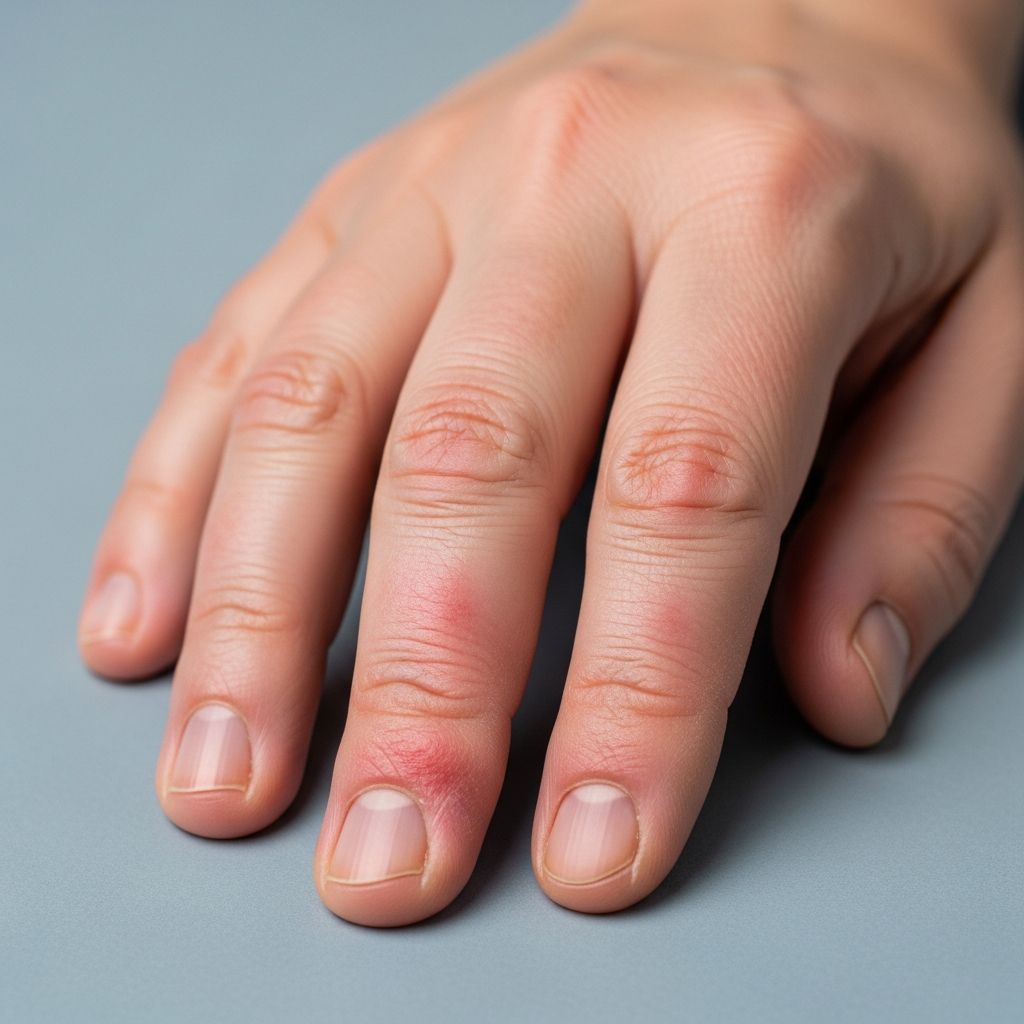
- Gottron papules: Flat-topped violaceous papules over knuckles (MCP/PIP joints).
- Gottron sign: Erythema over elbows, knees, malleoli.
- Photosensitive rash: Reticulate erythema on face, neck, upper chest (‘V-sign’), shoulders and upper back (‘shawl sign’).
- Periungual changes: Telangiectasia, cuticles overgrowth.
- Scalp pruritus and erythema.
- Poikiloderma: Pigmentation, atrophy, telangiectasia.
- Rarely, ulcerations (especially anti-MDA5+ amyopathic DM).
Muscle involvement
Proximal muscle weakness affects upper arms and thighs. Early signs:
- Difficulty rising from chair.
- Climbing stairs.
- Raising arms overhead.
- Combing hair.
Muscles may be tender and achy. Amyopathic DM has skin signs without clinical myositis (though subclinical myositis on tests).
Systemic features
Other manifestations:
- Dysphagia (oesophageal involvement).
- Interstitial lung disease (especially anti-MDA5+).
- Arthralgia/arthritis.
- Fatigue, fever, weight loss.
- Cardiac (myocarditis, arrhythmias).
- Raynaud phenomenon.
Diagnosis
Diagnosis requires:
- Compatible clinical features (skin + proximal weakness).
- Abnormal muscle enzymes (CK, aldolase elevated).
- EMG showing myopathic changes.
- Muscle biopsy: Perifascicular atrophy, inflammation.
- Skin biopsy: Interface dermatitis.
Bohan and Peter criteria are classic (requires 4/5, definite; 3/5 probable). Myositis autoantibodies aid subtyping.
Investigations
Mandatory malignancy screen in adults (due to 25% risk):
- Age-appropriate cancer screening + CT chest/abdomen/pelvis.
- ± PET-CT, mammography, gynae exam, tumour markers, endoscopy.
- Repeat screening at 6/12 months if initial negative.
Other tests:
| Investigation | Purpose |
|---|---|
| Muscle enzymes (CK, LDH, AST/ALT) | Monitor myositis activity |
| ANA, ENA, myositis autoantibodies | Subtyping, prognosis |
| PFTs, HRCT chest | Detect ILD |
| Echo, ECG | Cardiac involvement |
| Manometry, barium swallow | Dysphagia assessment |
Management
Multidisciplinary: Rheumatology, dermatology, oncology, pulmonology.
Systemic treatment
First-line: Prednisolone 0.5–1 mg/kg/day + steroid-sparing agent (methotrexate, azathioprine).
- IVIG for refractory disease or dysphagia.
- Cyclosporin, tacrolimus, mycophenolate for ILD.
- Rituximab for refractory cases.
- Biologics (eg, JAK inhibitors) emerging.
Skin-directed
- Topical steroids, tacrolimus.
- Hydroxychloroquine 200–400 mg/day.
- Sunscreen, avoid triggers.
Related Stories



Prognosis
Mortality 10–20% at 5 years, worse with malignancy, ILD, dysphagia. Anti-MDA5+ has poor prognosis. Treat malignancy aggressively. Relapsing-remitting course common; 20–30% monophasic.
Amyopathic dermatomyositis
Skin signs without clinical myositis (clinically amyopathic DM, CADM). Still requires malignancy screen and myositis autoantibodies. Risk of ILD.
Malignancy association
15–25% of adult DM. Screen aggressively. Anti-TIF1γ predicts cancer (up to 70% risk). Malignancy treatment often improves DM.
Differential diagnosis
- Drug-induced DM (statins, checkpoint inhibitors).
- Overlap syndromes (with scleroderma, lupus).
- Polymyositis (no rash).
- Other rashes: Lupus, rosacea, eczema.
Guidelines
- International Myositis Assessment and Clinical Studies Group (IMACS).
- European League Against Rheumatism (EULAR).
Frequently asked questions
Q: Is adult-onset dermatomyositis curable?
A: Not curable but manageable with immunosuppression. Remission possible in 20–30%.
Q: How is malignancy screened in dermatomyositis?
A: Age-appropriate screening + CT CAP, PET-CT if high-risk antibodies.
Q: What is the role of IVIG?
A: Second-line for refractory myositis, rapid dysphagia improvement.
Q: Can dermatomyositis affect lungs?
A: Yes, interstitial lung disease in 20–30%, especially anti-MDA5+ subtype.
Q: Is sun exposure bad for dermatomyositis?
A: Yes, photosensitivity common; use high-SPF sunscreen.
References
- Adult-onset dermatomyositis — DermNet NZ. 2023. https://dermnetnz.org/topics/adult-onset-dermatomyositis
- Dermatomyositis — University of Utah Health. 2024-01-15. https://healthcare.utah.edu/dermatology/services/autoimmune-skin-diseases/dermatomyositis
- Dermatomyositis — Penn Medicine. 2024. https://www.pennmedicine.org/conditions/dermatomyositis
- Dermatomyositis — EyeWiki (AAO). 2025-06-12. https://eyewiki.org/Dermatomyositis
- Signs and Symptoms of Dermatomyositis — Muscular Dystrophy Association. 2023. https://www.mda.org/disease/dermatomyositis/signs-and-symptoms
- Dermatomyositis — NORD (NIH). 2024-02-20. https://rarediseases.org/rare-diseases/dermatomyositis/
- Dermatomyositis – Symptoms & causes — Mayo Clinic. 2025-03-10. https://www.mayoclinic.org/diseases-conditions/dermatomyositis/symptoms-causes/syc-20353188
Similar Articles








Read full bio of medha deb