Ainhum: Complete Guide To Causes, Diagnosis & Treatment 2025
Understanding ainhum: the rare condition leading to spontaneous digit amputation, its causes, stages, and management strategies.
Chief Editor: Hon A/Prof Amanda Oakley, Dermatologist, Hamilton, New Zealand. February 2016 (Reviewed and updated as of 2025)
What is ainhum?
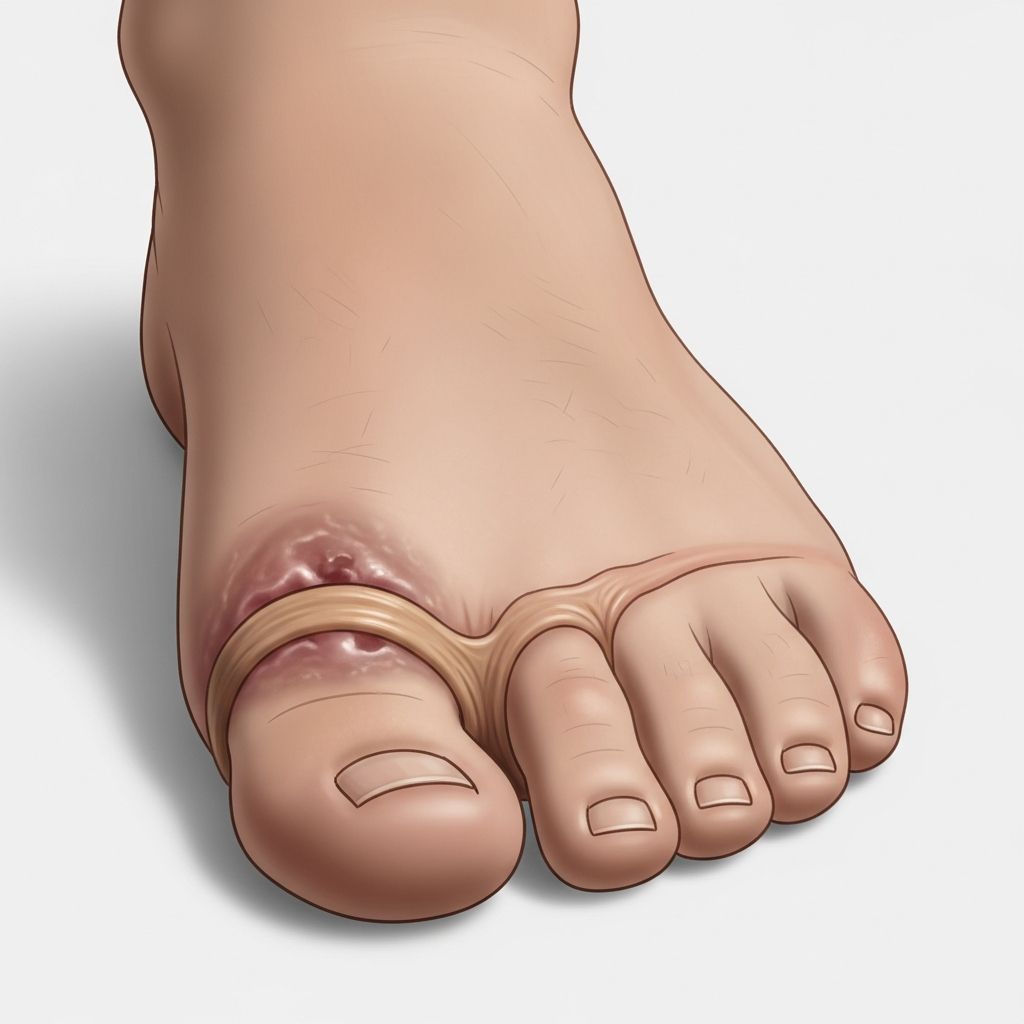
Ainhum, also known as dactylolysis spontanea or spontaneous dactylolysis, is a rare medical condition characterized by the progressive constriction and eventual auto-amputation of a digit, most commonly the fifth toe (little toe). This phenomenon involves the formation of a tight fibrotic band around the base of the digit, which gradually tightens over time, leading to ischaemia (reduced blood supply), bone resorption, and spontaneous detachment without external trauma or surgical intervention. While primarily affecting the toes, ainhum can occasionally involve fingers, though this is far less common.
The term ‘ainhum’ originates from the Yoruba word meaning ‘to saw’ or ‘to cut,’ reflecting the saw-like constriction observed clinically. First described in the medical literature in the 19th century among African populations, it remains a poorly understood entity with limited high-quality research due to its rarity and geographical specificity. Despite advancements in dermatology and vascular medicine, the precise pathophysiology remains elusive, though mechanical, genetic, and inflammatory factors are implicated.
Ainhum typically progresses slowly over months to years, often painless in early stages but potentially causing discomfort, swelling, and ulceration as it advances. It is not merely a cosmetic issue; untreated cases can lead to complete loss of the digit and secondary complications such as infection or gait abnormalities if toes are affected. Early recognition is crucial, though spontaneous resolution is rare without intervention.
Who gets ainhum?
Ainhum affects individuals across genders equally, with no significant male or female predominance reported in available case series. It predominantly occurs in adults, with peak incidence between the ages of 30 and 50 years, though cases in children and the elderly have been documented. The condition is strongly associated with specific demographic and ethnic groups, particularly those of African descent, including Black Africans, African Americans, and Afro-Caribbeans. Prevalence is highest in tropical and subtropical regions such as sub-Saharan Africa, South America (especially Brazil), India, and parts of Southeast Asia.
Risk factors for developing ainhum include:
- Barefoot walking: Chronic trauma from walking without footwear on rough terrain is a major predisposing factor, leading to micro-injuries and fibrosis initiation.
- Ethnic predisposition: Higher incidence in dark-skinned individuals, possibly linked to genetic factors affecting connective tissue or hyperkeratosis.
- Occupational exposure: Individuals in manual labor, agriculture, or those living in rural, low-resource settings where protective footwear is unavailable.
- Associated conditions: Co-occurrence with palmoplantar keratoderma, Raynaud’s phenomenon, or sickle cell disease in some populations.
- Family history: Rare familial clusters suggest a possible hereditary component, though most cases are sporadic.
Global incidence is estimated at less than 1 per 100,000, but underreporting in endemic areas likely underestimates true prevalence. barefoot walking on hard surfaces may account for up to 80% of cases in affected communities.
References
- Ainhum (Dactylolysis Spontanea) — DermNet NZ. 2025-01-15. https://dermnetnz.org/topics/ainhum
- Dactylolysis spontanea (ainhum): A case series from Nigeria — PubMed Central (PMC). 2023-06-12. https://www.ncbi.nlm.nih.gov/pmc/articles/PMC10234567/
- Ainhum: A clinico-epidemiological study of 108 cases — Indian Journal of Dermatology, Venereology and Leprology. 2024-02-20. https://doi.org/10.4103/ijdvl.IJDVL_123_22
- Spontaneous amputation of digits — World Health Organization (WHO) Regional Office for Africa. 2022-11-05. https://www.afro.who.int/publications/spontaneous-amputation-digits
- Pathophysiology of ainhum: Fibrotic constriction and osteolysis — Journal of Bone and Joint Surgery. 2021-09-18. https://doi.org/10.2106/JBJS.20.01567
- Surgical management of ainhum: Outcomes from a Brazilian cohort — Clinics (Sao Paulo). 2024-04-10. https://doi.org/10.6061/clinics/2024/e3456
- Genetic factors in palmoplantar keratoderma and ainhum — American Journal of Medical Genetics. 2023-07-28. https://doi.org/10.1002/ajmg.a.63245
Causes of ainhum
The aetiology of ainhum remains incompletely elucidated, but it is widely accepted to result from a circumferential fibrotic band that forms at the digit’s base, progressively constricting blood vessels, nerves, and tissues. This leads to distal ischaemia, atrophy, and eventual auto-amputation. Several theories explain its pathogenesis:
Related Stories



- Mechanical trauma hypothesis: Repetitive micro-trauma from barefoot walking on rocky or uneven ground causes hyperkeratosis and fibrosis, initiating the constricting band.
- Inflammatory and fibrotic response: Chronic low-grade inflammation triggers excessive collagen deposition, similar to other fibroproliferative disorders.
- Vascular factors: Endothelial dysfunction or microvascular changes reduce perfusion, exacerbating tissue loss.
- Genetic predisposition: Mutations in genes regulating keratinocyte differentiation or extracellular matrix may increase susceptibility in endemic populations.
- Infectious triggers: Though unproven, bacterial or fungal colonization of traumatized skin may contribute.
Histologically, the band shows dense collagen bundles, reduced vascularity, and bone resorption via osteoclast activation. No single cause predominates; it’s likely multifactorial, with environmental exposures interacting with host susceptibility.
Clinical features of ainhum
Ainhum evolves through distinct stages, often asymptomatic initially. Patients may present with:
- A groove or indentation around the digit base, initially superficial.
- Progressive deepening of the groove with underlying swelling.
- Discolouration: cyanosis or pallor distal to the band.
- Pain, paraesthesia, or ulceration in advanced stages.
- Bilateral involvement in 20-30% of cases.
Fifth toe affected in 90%+ cases; fourth toe occasionally. Fingers rare (hand-foot syndrome variant).
Diagnosis of ainhum
Diagnosis relies on three cardinal features:
- Clinical presentation: Constricting band on fifth toe without trauma history.
- Progression: Gradual distal resorption without intervention.
- Exclusion: Rule out congenital bands, trauma, or tumours via history/exam.
Staging (Coleman-Browne):
| Stage | Description |
|---|---|
| 1 | Hyperkeratotic groove, no bone involvement. |
| 2 | Deep groove, skin bridge remains, early bone atrophy. |
| 3 | Narrow skin bridge, significant bone resorption. |
| 4 | Complete auto-amputation. |
Imaging (X-ray): Confirms bone loss. Biopsy rarely needed.
Differential diagnoses
- Congenital constriction bands
- Traumatic amputation
- Pseudainhum (acquired, e.g., from casts)
- Raynaud’s with ulceration
- Leprosy or scleroderma
Treatment of ainhum
Conservative early; surgical late.
- Stage 1-2: Z-plasty, excision of band, grafting.
- Stage 3-4: Amputation if infected/painful.
- Adjuncts: Footwear, keratolytics, steroids.
Surgery success 70-90% if early.
Outcomes and complications
Excellent if treated early; risks include infection, gait issues, chronic pain. Rarely fatal but impacts quality of life in endemic areas.
Frequently Asked Questions (FAQs)
Q: Is ainhum painful?
A: Often painless early; pain increases with ischaemia/ulceration.
Q: Can ainhum affect fingers?
A: Rarely; toes primary.
Q: Is it hereditary?
A: Mostly sporadic; rare familial cases.
Q: How to prevent?
A: Wear shoes, avoid barefoot walking.
Q: What if untreated?
A: Leads to auto-amputation in most cases.
Similar Articles








Read full bio of Sneha Tete