Alitretinoin: Uses, Dosage, and Treatment Guide
Comprehensive guide to alitretinoin: A retinoid treatment for severe hand eczema and Kaposi's sarcoma.
What Is Alitretinoin?
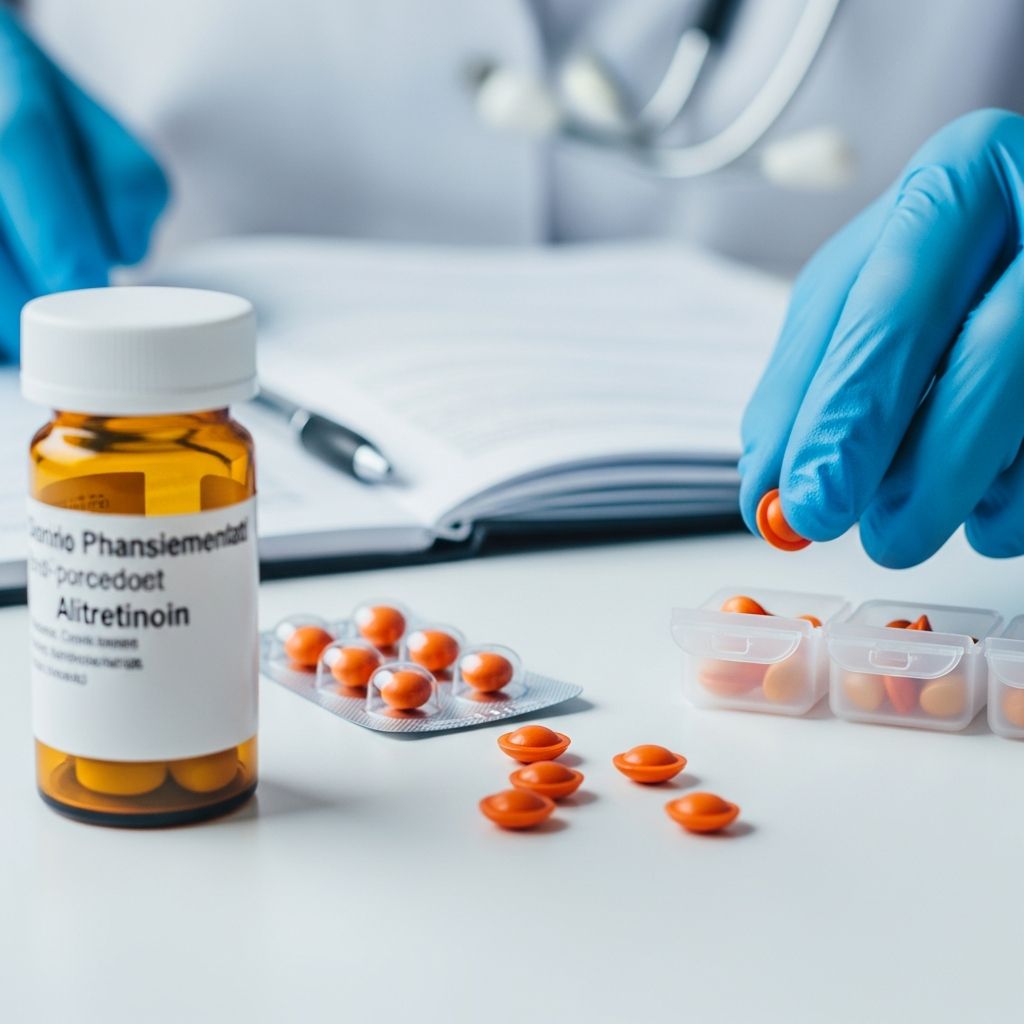
Alitretinoin is a pan retinoic acid agonist, a synthetic derivative of vitamin A that plays a crucial role in regulating gene expression, cell growth, and development.1 The medication is available as oral capsules under the brand name Toctino® and as a topical 0.1% gel formulation under the brand name Panretin®. Alitretinoin works through multiple mechanisms, including anti-inflammatory and immunomodulatory effects, as well as anti-proliferative and apoptotic actions, making it effective for various dermatological conditions.2
Clinical Uses of Alitretinoin
Severe Chronic Hand Eczema
Alitretinoin capsules (Toctino®) represent the primary indication for severe chronic hand dermatitis or eczema that does not respond to potent topical corticosteroid therapy.3 This condition, also referred to as recalcitrant chronic hand eczema, poses significant challenges in treatment and substantially impacts quality of life. The systemic administration of alitretinoin has proven extremely efficacious in managing these cases, particularly when conventional topical therapies have failed.4
The medication is licensed for this indication specifically when:
- Hand eczema is severe and persistent
- The condition has failed to respond to very strong steroid creams or ointments
- Alternative topical treatments have proven inadequate
- Patients require systemic intervention
AIDS-Related Kaposi’s Sarcoma
In the United States, topical alitretinoin gel (0.1%) is indicated for treating skin lesions in AIDS-related Kaposi’s sarcoma.5 This formulation received FDA approval on March 2, 1999, and EMA approval on October 11, 2000. The medication is specifically designed for localized skin manifestations and is not indicated when systemic therapy against Kaposi’s sarcoma is required.
Clinical studies demonstrate significant efficacy: patients treated with topical alitretinoin 0.1% gel showed a sixfold improvement in cutaneous tumor response rates compared to placebo. In extended treatment studies, the overall response rate increased from 35% after an initial 12-week course to 56% after an additional 163 weeks of continued therapy.6
Off-Label Uses
Beyond its primary indications, alitretinoin has demonstrated effectiveness in several other dermatological conditions:
- Palmoplantar pustular psoriasis: Oral alitretinoin improves this condition through immunomodulatory effects on keratinocytes, fibroblasts, mast cells, dendritic cells, and T cells, bringing about rapid subsidence of plaques and pustules
- Cutaneous lichen planus: The medication regulates cell proliferation, differentiation, and apoptosis, with demonstrated effectiveness at 30 mg daily
- Lichen simplex chronicus: Systemic alitretinoin at 30 mg daily for 12 weeks has shown promise in refractory cases
- Cutaneous T-cell lymphoma (CTCL): Alitretinoin’s anti-proliferative, immune-modulating, and pro-apoptotic properties have produced significant improvement after 4-5 months of 30 mg daily dosing
- Pyogenic granuloma: Topical 0.1% alitretinoin gel has shown utility in treating this vascular lesion
Mechanism of Action
Alitretinoin functions through two primary mechanisms that explain its broad therapeutic efficacy in dermatological conditions:
Anti-inflammatory and Immunomodulatory Effects
The medication suppresses the expression of chemokine receptors, which prevents chemotaxis—the movement of inflammatory cells toward affected tissue. By reducing skin cell turnover and decreasing skin inflammation, alitretinoin modulates the immune response at multiple levels, affecting key cellular actors in inflammatory dermatological diseases.
Anti-proliferative and Apoptotic Effects
Alitretinoin demonstrates the ability to inhibit cell growth and promote programmed cell death (apoptosis) in abnormal cells. This mechanism is particularly important in conditions involving hyperproliferative skin cells and malignant lesions such as Kaposi’s sarcoma.
Related Stories



Dosage and Administration
Oral Capsules (Toctino®)
For severe chronic hand eczema, alitretinoin is administered as oral capsules. The typical therapeutic approach involves:
- Standard dosing of 30 mg daily for most conditions requiring systemic therapy
- Treatment duration typically ranging from 12 to 24 weeks depending on response
- Careful monitoring for efficacy and adverse effects
- Dose adjustments based on individual tolerance and clinical response
Topical Gel (Panretin®)
For cutaneous lesions of AIDS-related Kaposi’s sarcoma, the topical formulation is applied as follows:7
- Sufficient quantities to cover only affected areas
- Initial application: twice daily
- Frequency may be gradually increased to 3-4 times daily based on lesion tolerance
- If application site toxicity occurs, frequency may be reduced
- Temporary discontinuation may be necessary if severe irritation develops
Side Effects and Adverse Reactions
Topical Application Side Effects
Topical alitretinoin commonly causes local skin reactions at the site of application:
| Frequency | Side Effect | Incidence Rate |
|---|---|---|
| Very Common | Rash | 77% |
| Very Common | Pain/burning sensation | 34% |
| Very Common | Itchiness | 11% |
| Common | Exfoliative dermatitis | 1-10% |
| Common | Edema (swelling) | 1-10% |
| Common | Skin changes/discoloration | 1-10% |
| Common | Paresthesia (tingling) | 1-10% |
Systemic Side Effects
Oral alitretinoin may produce systemic adverse effects, though these are less common than topical reactions:
- Rare effects (less than 0.1% frequency): Benign intracranial hypertension, vasculitis
- Unknown frequency: Anaphylactic reactions, hypersensitivity reactions, depression, mood changes, suicidal ideation, decreased night vision
Contraindications and Precautions
Alitretinoin should not be used in patients with the following conditions:8
- Hepatic insufficiency
- Severe chronic kidney disease
- Uncontrolled hypercholesterolemia
- Uncontrolled hypertriglyceridemia
- Uncontrolled hypothyroidism
- Hypervitaminosis A (excessive vitamin A levels)
- Hypersensitivity to alitretinoin or any formulation excipients
Pregnancy Considerations
As a vitamin A derivative, alitretinoin carries teratogenic potential. Women of childbearing age must use effective contraception during treatment. However, alitretinoin’s significantly shorter half-life compared to isotretinoin and acitretin makes it advantageous for women in the reproductive age group who require retinoid therapy.
Advantages Over Other Retinoids
Alitretinoin offers several clinical advantages when compared to other systemic retinoids:
| Factor | Alitretinoin | Isotretinoin | Acitretin |
|---|---|---|---|
| Half-life | Very short | Long | Long |
| Safety Profile | Favorable | Strict monitoring required | Moderate monitoring |
| Teratogenicity Concern | Lower risk | High risk (long half-life) | Moderate-high risk |
| First-line Use | Increasingly preferred | Severe acne only | Psoriasis primarily |
Clinical Efficacy and Outcomes
Alitretinoin demonstrates substantial clinical effectiveness across its approved and off-label indications. For severe hand eczema, the medication produces significant improvement in patients who have exhausted conventional topical therapies. The improvement in quality of life is notable, as chronic hand dermatitis often impairs occupational functioning and daily activities.
For Kaposi’s sarcoma, the sixfold improvement in tumor response rates compared to vehicle control represents a meaningful therapeutic advance for immunocompromised patients. The ability to achieve progressively higher response rates with extended treatment (from 35% to 56% over 175 weeks) demonstrates that prolonged therapy may enhance outcomes.
Alitretinoin’s favorable safety profile compared to other systemic retinoids, combined with its short half-life and broad spectrum of activity, positions it as a valuable therapeutic option for multiple retinoid-responsive dermatological conditions.
Frequently Asked Questions
Q: How long does alitretinoin treatment typically last?
A: Treatment duration varies by indication. For severe hand eczema, typical courses last 12-24 weeks. For Kaposi’s sarcoma, treatment continues as long as beneficial response occurs. Some patients benefit from extended therapy lasting several months to years.
Q: Can alitretinoin be used during pregnancy?
A: No. Alitretinoin is contraindicated in pregnancy due to teratogenic potential. Women of childbearing age must use reliable contraception during treatment and discuss fertility plans with their healthcare provider.
Q: Is alitretinoin covered by insurance?
A: Coverage varies by insurance plan and indication. Topical alitretinoin for Kaposi’s sarcoma and oral alitretinoin for severe hand eczema typically have better coverage, but verification with your specific insurance provider is necessary.
Q: What should I do if I experience severe side effects?
A: Contact your healthcare provider immediately. For topical applications, temporarily discontinue use until symptoms subside. For oral medication, dosage adjustment or discontinuation may be necessary. Never stop treatment without medical guidance.
Q: Can alitretinoin be combined with other treatments?
A: Yes, alitretinoin has been successfully combined with biologic agents like adalimumab and etanercept in psoriasis management. However, all combination therapies must be discussed with and approved by your dermatologist.
Q: How does alitretinoin compare to topical corticosteroids for hand eczema?
A: Alitretinoin is reserved for severe cases that have failed to respond to potent topical corticosteroids. It offers a systemic approach addressing underlying immune and inflammatory mechanisms when topical therapies prove inadequate.
References
- Alitretinoin in Dermatology—An Update — National Institutes of Health, National Center for Biotechnology Information. 2015. https://pmc.ncbi.nlm.nih.gov/articles/PMC4601442/
- Alitretinoin — Wikipedia. https://en.wikipedia.org/wiki/Alitretinoin
- Alitretinoin — DermNet NZ. https://dermnetnz.org/topics/alitretinoin
- Alitretinoin: uses, dosing, warnings, adverse events, interactions — Oncology News Central. https://www.oncologynewscentral.com/drugs/monograph/16973-301047/alitretinoin-topical
- Alitretinoin (topical route) – Side effects & dosage — Mayo Clinic. https://www.mayoclinic.org/drugs-supplements/alitretinoin-topical-route/description/drg-20061592
- Alitretinoin – BAD Patient Hub – Skin Health Info — British Association of Dermatologists. https://www.skinhealthinfo.org.uk/condition/alitretinoin/
Similar Articles








Read full bio of medha deb