Aquagenic Urticaria: Comprehensive Guide To Water Allergy
Aquagenic urticaria causes hives from water contact—learn symptoms, causes, diagnosis, and management strategies for this rare condition.
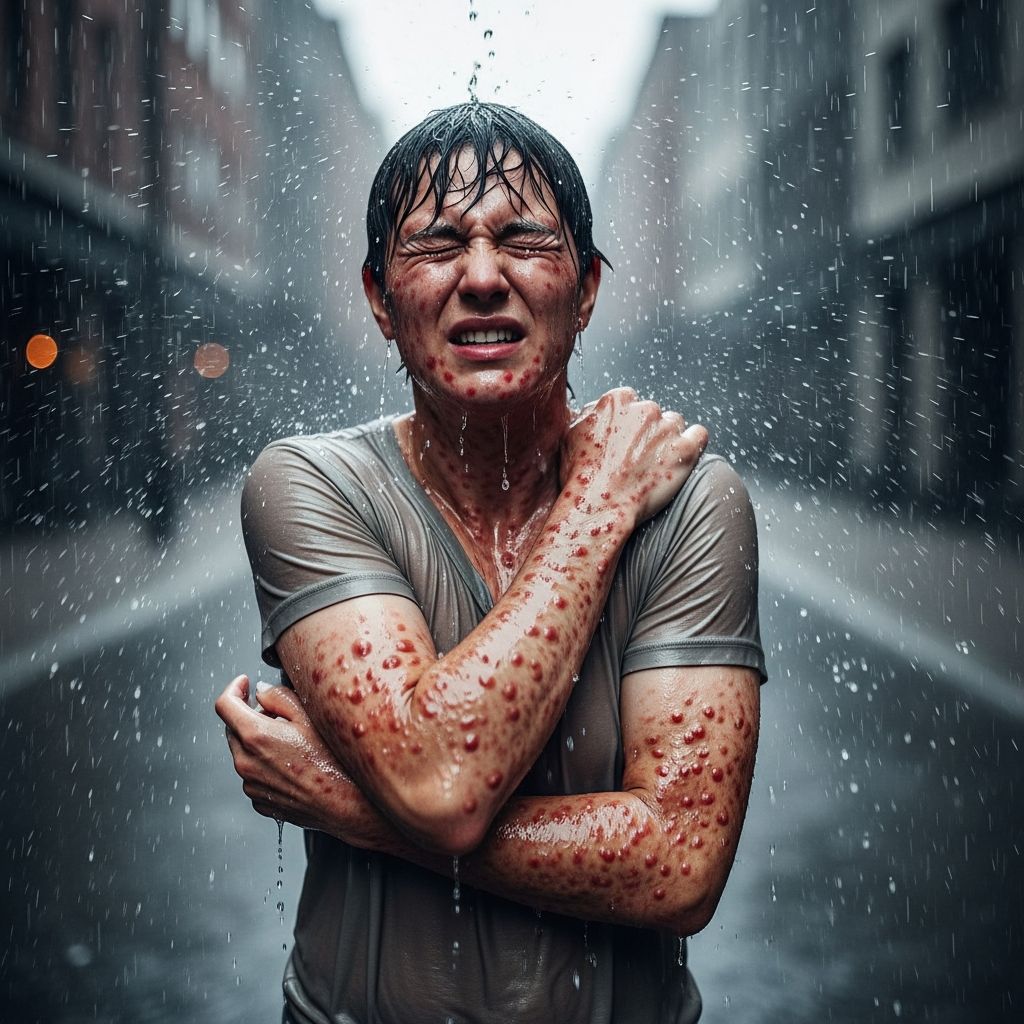
Aquagenic urticaria, commonly referred to as a water allergy, is an extraordinarily rare condition where contact with water—regardless of its temperature—triggers hives, intense itching, burning sensations, and skin swelling on the affected areas. This form of physical urticaria affects an estimated fewer than 100 people worldwide, making it one of the most uncommon dermatological disorders documented in medical literature.
Despite its name, aquagenic urticaria is not a true IgE-mediated allergy to water molecules themselves, as water (H2O) is chemically inert and incapable of eliciting an allergic response in the classical sense. Instead, it represents a non-immunologic physical urticaria where water acts as a trigger for mast cell degranulation, releasing histamine and other mediators that provoke the characteristic symptoms. First described in medical literature in 1964, only around 37 cases had been reported by 2017, highlighting its extreme rarity.
What Is Aquagenic Urticaria?
Aquagenic urticaria falls under the category of chronic inducible urticarias (CIndU), specifically physical urticarias induced by external stimuli. In this condition, exposure of the skin to water—even in minute amounts like sweat or tears—leads to the rapid development of small, punctate wheals (hives) surrounding hair follicles, often described as a ‘peppery’ or prickly rash. These lesions typically measure 1-3 mm in diameter and appear within 1-5 minutes of contact, peaking at 10-15 minutes and resolving spontaneously within 30-60 minutes after drying the skin.
The reaction occurs independently of water temperature, distinguishing it from related conditions like cold urticaria (triggered by cold water) or cholinergic urticaria (provoked by heat and sweat). While tap water, rain, and sweat universally provoke symptoms, some patients report tolerance to seawater due to its higher salinity, suggesting osmotic or ionic factors may modulate severity in select cases. Systemic symptoms are rare but can include lip swelling or throat irritation from ingested water, and in extreme instances, anaphylaxis-like reactions with wheezing and shortness of breath.
Symptoms of Water Allergy
Symptoms manifest swiftly upon water contact and are confined to the exposed skin areas unless water is ingested. Common presentations include:
- Hives (wheals): Small, red or skin-toned bumps, often perifollicular, that itch intensely.
- Burning or stinging: A prickling or burning sensation, sometimes more prominent than itching.
- Erythema: Reddening of the skin, which may be subtle on darker skin tones.
- Swelling: Mild edema around wheals, rarely extending deeply.
In severe flares, symptoms can escalate to larger wheals or plaques, particularly in patients with thinned stratum corneum (e.g., post-epilation). Internal exposure via drinking water may cause perioral rash, swollen lips, or dysphagia. Anaphylactic symptoms—difficulty breathing, wheezing—are exceptionally rare but demand immediate medical intervention. Symptoms invariably resolve upon drying, typically within 30 minutes to 2 hours.
Related Stories



Causes of Aquagenic Urticaria
The precise pathophysiology remains elusive due to the condition’s rarity and limited research. Proposed mechanisms include:
- Mast cell activation: Water may dissolve allergenic substances on the skin surface, penetrating the stratum corneum to stimulate dermal mast cells, triggering histamine release.
- Sebum-water interaction: Contact with skin sebum (oils from sebaceous glands) could form irritants that provoke mast cell degranulation, independent of histamine in some cases.
- Salinity/osmotic effects: Variations in response to tap vs. saltwater hint at ion-dependent pathways.
No genetic predisposition is firmly established, though familial cases exist. It often emerges in puberty or early adulthood, with females comprising the majority of reports. Associations with other conditions like epilepsy have been noted anecdotally but lack confirmation.
Diagnosis: Ruling Out Mimics
Diagnosis hinges on clinical history and provocation testing, as no biomarkers exist. Key steps include:
- Water challenge test: Application of warm (35°C) water-soaked cloth to the forearm for 30 minutes, eliciting characteristic wheals.
- Differential testing: Ice cube (cold urticaria), saline, heat pads (cholinergic), and aquagenic pruritus provocation to exclude confounds.
- Skin biopsy (rarely): May show mast cell degranulation but is nonspecific.
Aquagenic pruritus, which causes itching without hives, is a critical distinguisher. Early diagnosis prevents unnecessary avoidance behaviors and guides symptom management.
Treatment and Management Strategies
No curative therapy exists, but symptom control is achievable. First-line approaches include:
- Second-generation H1-antihistamines: Non-sedating options like cetirizine (up to 4x standard dose) or fexofenadine reduce wheal formation and pruritus in most patients.
- Topical emollients: Petrolatum or mineral oil barriers applied pre-exposure prevent water penetration.
Refractory cases may benefit from:
| Treatment | Description | Efficacy Notes |
|---|---|---|
| Omalizumab | Anti-IgE monoclonal antibody | Case reports show complete remission |
| Phototherapy (PUVA/NB-UVB) | Controlled UV exposure | Partial response in small series |
| Doxepin (low-dose) | Tricyclic antidepressant with antihistamine effects | Sedation limits use |
| Capsaicin cream | Desensitizes C-fibers | Burning induction phase challenging |
Lifestyle adaptations are cornerstone: short air-dry showers, waterless shampoos, moisture-wicking clothing, cotton gloves for chores, and rain gear. These minimize flares while preserving quality of life.
Living With Aquagenic Urticaria: Practical Tips
Daily management demands creativity:
- Use dry shampoos and wipes for hygiene.
- Apply barrier creams before unavoidable exposure.
- Opt for hydrophobic fabrics and prepare for humidity/sweat.
- Educate family on anaphylaxis risks, though rare.
Psychosocial impacts—avoidance of swimming, bathing rituals—can lead to isolation; counseling supports coping.
Frequently Asked Questions (FAQs)
Is aquagenic urticaria a real allergy to water?
No, it’s not a true allergy but a physical urticaria where water triggers mast cell histamine release, mimicking allergic symptoms.
Can you develop aquagenic urticaria suddenly?
Yes, it often onset abruptly in adolescence or early adulthood, though triggers remain unknown.
How rare is water allergy?
Extremely rare; fewer than 100 cases reported globally, with prevalence unknown.
Does aquagenic urticaria go away?
Unknown due to scarcity; some cases remit spontaneously, others persist lifelong.
Can people with aquagenic urticaria drink water?
Usually yes, if avoiding skin contact, but severe cases risk oral/throat symptoms or anaphylaxis.
What is the life expectancy with this condition?
Unchanged with proper management; risks stem from untreated severe reactions.
Is it hereditary?
Rare familial clusters reported, but no clear genetic pattern.
References
- Aquagenic urticaria: diagnostic and management challenges — Khan S, et al. Journal of Allergy and Clinical Immunology: In Practice. 2016-10-21. https://pmc.ncbi.nlm.nih.gov/articles/PMC5136360/
- Water allergy: Symptoms, causes, treatment, and FAQs — Medical News Today. 2023-11-15. https://www.medicalnewstoday.com/articles/water-allergy
- Aquagenic Urticaria: Causes, Symptoms, and Treatment — Healthline. 2023-08-10. https://www.healthline.com/health/aquagenic-urticaria
- Physical urticarias — Zuberbier T, et al. Journal of Allergy and Clinical Immunology. 2022-04-01. https://www.jacionline.org/article/S0091-6749(22)00254-0/fulltext
- Inducible urticaria: Clinical presentation, laboratory tests, and management — Maurer M, et al. Journal of the European Academy of Dermatology and Venereology. 2021-12-15. https://doi.org/10.1111/jdv.17689
Similar Articles








Read full bio of Sneha Tete