Alopecia Areata: Diagnosis, Treatment, Prognosis Guide
Authoritative facts about alopecia areata: what it is, who gets it, causes, diagnosis, treatments, and outlook for this common cause of hair loss.
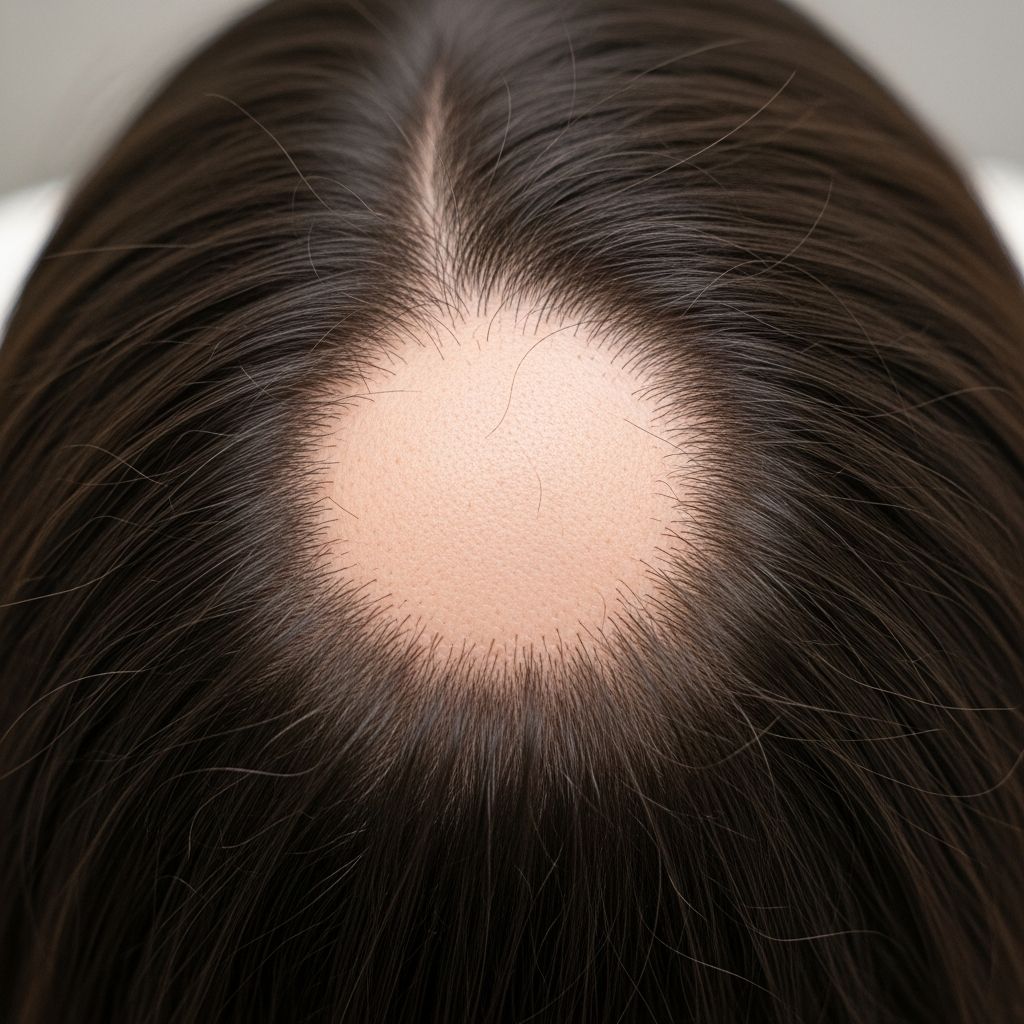
Alopecia areata is a form of autoimmune non-scarring alopecia characterised by a patchy onset of hair loss, typically reversible, that may be associated with short fine regrowth hair (vellus hair).
Who gets alopecia areata (who is at risk)?
Alopecia areata can affect any hair-bearing area. Approximately 2% of the population will experience at least one episode of alopecia areata over their lifetime. It affects both sexes equally and children as well as adults. Peak age of onset is between 15–30 years.
There is a family history in 10–42% of cases. First-degree relatives of patients with alopecia areata have a 5-fold increased risk of developing the disease. Concordance rates in monozygotic twins range from 18–42%.
Atopic dermatitis is more common in patients with alopecia areata, especially those with early-onset disease. Other autoimmune disorders are associated including thyroid disease (≤25%), vitiligo (≤15%) and lupus erythematosus.
What is the cause of alopecia areata?
Alopecia areata is an autoimmune disorder resulting from a breakdown of immune privilege of the hair follicle. The immune privilege of the hair follicle is maintained by lack of MHC class I expression and local production of immunosuppressive cytokines.
In alopecia areata, there is a peribulbar lymphocytic infiltrate (‘swarm of bees‘) consisting predominantly of CD8+ T cells with some CD4+ T cells, natural killer cells and Langerhans cells. Intralesional deposition of immunoglobulins and complement has also been reported.
Genetic factors predispose to alopecia areata. Genome-wide association studies have identified susceptibility loci on chromosomes 6, 10, 18 and others.
Environmental triggers may initiate the autoimmune response in genetically susceptible individuals. These include viral infections, trauma and stress.
What are the clinical features of alopecia areata?
The classic presentation is a round or oval patch of sudden non-scarring hair loss (‘patchy alopecia’). Individual patches are usually asymptomatic but may be associated with itching, burning or tingling.
Examination reveals a smooth, hairless plaque with no scaling, atrophy or follicular change. The follicular orifices are visible. At the periphery of active lesions, there may be a zone of increased hair shedding (‘cadaver hairs’ or ‘exclamation mark hairs’).
Regrowth occurs first as terminal hair then fine vellus hair (‘salt and pepper’ regrowth).
Clinical variants
- Diffuse alopecia areata: sudden diffuse thinning resembling telogen effluvium
- Ophiasis alopecia areata: band-like hair loss along the occipital and temporal margins
- Alopecia areata totalis: complete scalp hair loss (<5% of patients)
- Alopecia areata universalis: complete scalp and body hair loss (<1% of patients)
- Alopecia areata incognita (diffuse reticular alopecia): acute diffuse hair loss without discrete patches
- Acute diffuse and total alopecia (ADTA): very extensive acute hair loss
Dermoscopy of alopecia areata
Dermoscopy (dermatoscopy, trichoscopy) is useful for diagnosis. Characteristic features include:
- Yellow dots (hyperkeratotic follicular plugs)
- Short vellus hairs (regrowth)
- Exclamation mark hairs (‘tapered proximal shaft’)
- Black dots (damaged hairs)
Related Stories



Diagnosis of alopecia areata
The diagnosis is usually clinical, based on typical history and examination findings. Dermoscopy supports the diagnosis.
Scalp biopsy is rarely required but shows a peribulbar lymphocytic infiltrate (‘swarm of bees’). Vertical sections show a ‘peribulbar lymphocytic infiltrate’. Transverse sections show an increased telogen:anagen ratio (>10%).
The main differential diagnoses include:
- Tinea capitis – consider mycology
- Trichotillomania – broken hairs of variable length
- Secondary syphilis (‘moth-eaten’ alopecia) – consider serology
- Discoid lupus erythematosus – scarring, dyspigmentation
Management and treatment of alopecia areata
Treatment is based on the extent of hair loss and patient factors. Spontaneous regrowth occurs in 80% of patients with limited patchy alopecia within 1 year. Extensive disease has a poorer prognosis.
Intralesional corticosteroid (first line for limited scalp alopecia)
Triamcinolone acetonide 2.5–5 mg/mL is injected intradermally (0.1 mL per site) every 4–6 weeks. Up to 40–50% response rate. Side effects include dermal atrophy, hypopigmentation and telangiectasia.
Topical corticosteroid (children, facial hair loss)
Clobetasol propionate 0.05% ointment or foam applied twice daily. Occlusion may improve efficacy. Side effects include folliculitis, acne and perioral dermatitis.
Minoxidil (adjunctive)
5% solution or foam twice daily promotes regrowth and maintenance.
Topical immunotherapy (extensive alopecia)
Diphenylcyclopropenone (DPCP) or squaric acid dibutyl ester (SADBE) induces allergic contact dermatitis. Response rates 50–60%. Requires weekly application and monitoring.
Systemic corticosteroids (rapid control)
Prednisone 0.5–1 mg/kg/day for 1–2 months then taper. High relapse rate on withdrawal.
JAK inhibitors (severe, refractory disease)
Baricitinib (Olumiant®) is FDA-approved for severe alopecia areata. Ritlecitinib (Litfulo®) approved for adolescents and adults.
Other treatments
- Anthralin 0.5–2% ointment (irritant therapy)
- Excimer laser (308 nm)
- Platelet-rich plasma (PRP)
Investigations to consider
- FBC, U&E, LFT (if systemic therapy)
- TFT, TPO antibodies (thyroid disease)
- ANA (connective tissue disease)
Complications of alopecia areata
- Nail dystrophy (10–15%): pitting, trachyonychia
- Onychomadesis, Beau lines
- Psychosocial distress
Possible outcomes (prognosis)
Favourable prognostic factors:
- First episode, single patch
- Young age (<10 years)
- Short duration (<1 year)
- Hair regrowth at periphery
Poor prognostic factors:
- Ophiasis pattern
- Alopecia totalis/universalis
- Atopic disease
- Family history
- Long duration (>10 years)
- Associated autoimmune disease
Prevention
No proven prevention strategies exist.
Alopecia areata guidelines
- 2024 British Association of Dermatologists guidelines
- 2011 American Hair Research Society guidelines
Frequently Asked Questions
Q: Is alopecia areata permanent?
A: No, alopecia areata is usually reversible. However, extensive forms like alopecia totalis/universalis have lower regrowth rates.
Q: Can alopecia areata be cured?
A: There is no cure but treatments promote regrowth and control progression.
Q: Does alopecia areata affect nails?
A: Yes, 10–15% develop nail changes like pitting and trachyonychia.
Q: Is alopecia areata contagious?
A: No, it is autoimmune, not infectious.
Q: Can stress cause alopecia areata?
A: Stress may trigger episodes in susceptible individuals but is not the primary cause.
References
- A Complete Guide to Alopecia Areata — International Society of Hair Restoration Surgery (ISHRS). 2023. https://ishrs.org/alopecia-areata/
- Hair loss types: Alopecia areata diagnosis and treatment — American Academy of Dermatology (AAD). 2024. https://www.aad.org/public/diseases/hair-loss/types/alopecia/treatment
- Understanding Alopecia Areata — National Alopecia Areata Foundation (NAAF). 2024. https://www.naaf.org/navigation-toolkit/understanding-alopecia-areata/
- Alopecia Areata — Merck Manuals Professional Edition. 2024. https://www.merckmanuals.com/professional/dermatologic-disorders/hair-disorders/alopecia-areata
- Alopecia Areata: The Voice of the Patient — U.S. Food and Drug Administration (FDA). 2018-11-15. https://www.fda.gov/files/about%20fda/published/Alopecia-Areata–The-Voice-of-the-Patient.pdf
- Alopecia Areata: Diagnosis, Treatment, and Steps to Take — National Institute of Arthritis and Musculoskeletal and Skin Diseases (NIAMS). 2024. https://www.niams.nih.gov/health-topics/alopecia-areata/diagnosis-treatment-and-steps-to-take
Similar Articles








Read full bio of Sneha Tete