Alzheimer’s Disease Causes: 7 Critical Risk Factors
Unraveling the complex causes of Alzheimer's disease: from amyloid plaques and genetics to lifestyle and environmental risks.
Alzheimer’s disease (AD) is the most common cause of dementia, characterized by progressive cognitive decline due to brain cell degeneration. It results from a combination of genetic, lifestyle, and environmental factors leading to abnormal protein buildup in the brain.
What Is Alzheimer’s Disease?
Alzheimer’s disease is a neurodegenerative disorder that primarily affects memory, thinking, and behavior. It involves the gradual loss of neurons and synapses in the brain, starting in areas responsible for memory like the hippocampus. Over time, it spreads to other regions, impairing daily functioning. The disease is progressive, with early stages showing mild forgetfulness and later stages leading to severe cognitive impairment and dependency.
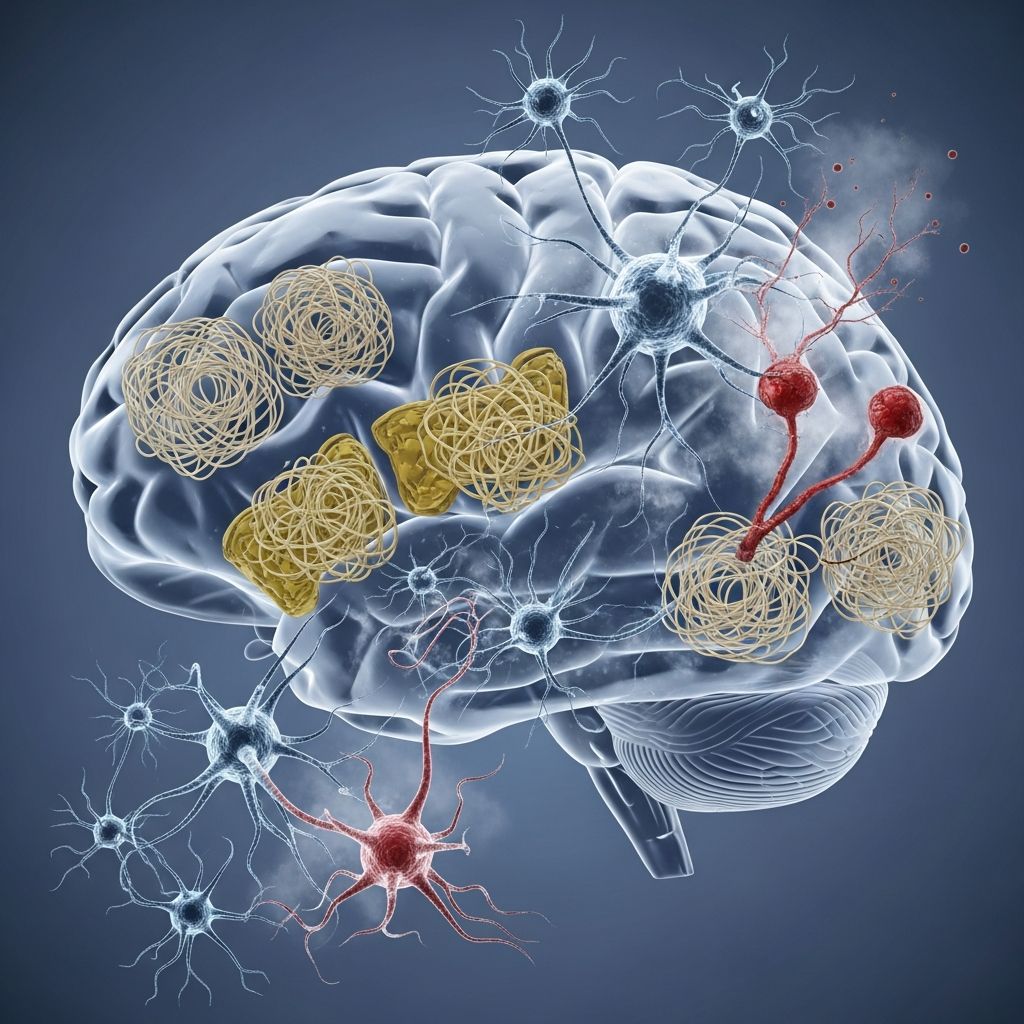
Pathologically, AD is marked by two hallmark features: extracellular amyloid-beta (Aβ) plaques and intracellular neurofibrillary tangles (NFTs) made of hyperphosphorylated tau protein. These changes disrupt communication between brain cells and trigger inflammation and cell death.
Brain Changes in Alzheimer’s Disease
The core pathology of AD begins with the abnormal accumulation of proteins. Amyloid plaques form when fragments of amyloid precursor protein (APP) fail to break down properly, clumping around neurons and interfering with cell signaling. Tau protein, normally stabilizing microtubules in neurons, becomes hyperphosphorylated, forming tangles that destabilize the cell’s internal structure, leading to collapse and death.
Additionally, brain atrophy occurs, with shrinkage in the cortex and hippocampus. Neurotransmitter levels, particularly acetylcholine, decrease, impairing signal transmission between neurons. This process often starts decades before symptoms appear, making early detection challenging.
Theories on What Causes Alzheimer’s Disease
Several hypotheses explain AD pathogenesis, though none fully account for all cases. The amyloid hypothesis posits that Aβ accumulation is the primary trigger, initiating a cascade of tau pathology, inflammation, and neuronal loss. Evidence includes genetic mutations increasing Aβ production in familial AD.
The cholinergic hypothesis highlights deficits in acetylcholine due to loss of cholinergic neurons in the basal forebrain, contributing to memory impairment. This is supported by the efficacy of acetylcholinesterase inhibitors in symptom management.
Other theories include vascular issues reducing brain blood flow, oxidative stress from free radicals, and inflammatory responses exacerbating damage. AD is multifactorial, with these processes interacting over time.
Risk Factors for Alzheimer’s Disease
Risk factors for AD are divided into non-modifiable and modifiable categories. Understanding them is crucial for prevention strategies.
Age
Age is the greatest risk factor; the likelihood of developing AD doubles every five years after age 65. By age 85, the risk approaches 50%. This reflects cumulative brain changes rather than a direct cause.
Family History and Genetics
Genetics play a significant role, especially in early-onset AD (before age 65), which accounts for 1-5% of cases. Rare mutations in APP, PSEN1, and PSEN2 genes on chromosomes 21, 14, and 1, respectively, cause autosomal dominant familial AD by altering Aβ processing.
For late-onset AD, the APOE-ε4 allele on chromosome 19 increases risk 3-15 fold but does not guarantee disease. About 70% of AD cases have genetic components, though environmental interactions are key.
Down Syndrome
Individuals with Down syndrome, due to trisomy 21 (extra APP gene copy), develop amyloid plaques earlier, with AD symptoms often appearing by age 40-50. Up to 80% develop dementia by their 60s.
Related Stories



Head Trauma
Severe or repeated traumatic brain injuries (TBIs) increase AD risk, particularly in those over 50. Studies show higher dementia rates post-TBI, possibly due to accelerated protein aggregation and inflammation.
Some Health Conditions
- Cardiovascular risks: High blood pressure, high cholesterol, obesity, diabetes, and smoking damage brain vessels, reducing oxygen supply and promoting Aβ buildup.
- Sleep disorders: Poor sleep or sleep apnea disrupts Aβ clearance via the glymphatic system, raising risk.
- Depression: Linked to increased inflammation and vascular changes.
Air Pollution
Exposure to fine particulate matter from traffic and biomass burning accelerates neurodegeneration in animal models and correlates with higher dementia rates in humans.
Excessive Alcohol Use
Heavy drinking causes brain atrophy and is associated with early-onset dementia, independent of other factors.
Can You Prevent Alzheimer’s Disease?
While there’s no guaranteed prevention, modifiable risks offer hope. The FINGER study demonstrated that multi-domain interventions reduce cognitive decline.
| Risk Factor | Prevention Strategy |
|---|---|
| Cardiovascular health | Manage blood pressure, cholesterol, diabetes; quit smoking |
| Physical inactivity | 150 minutes moderate exercise weekly |
| Poor diet | Mediterranean or MIND diet rich in fruits, vegetables, omega-3s |
| Cognitive inactivity | Mental stimulation via learning, social engagement |
| Sleep issues | 7-9 hours quality sleep nightly |
Lifestyle changes can lower risk by up to 40%, per recent analyses. Genetic testing is recommended for high-family-risk individuals.
Frequently Asked Questions (FAQs)
What is the main cause of Alzheimer’s disease?
The exact cause is unknown, but amyloid plaques and tau tangles are central, triggered by genetic, age-related, and environmental factors.
Does Alzheimer’s disease run in families?
Yes, family history increases risk, especially with APOE-ε4 or rare mutations causing early-onset forms.
Can lifestyle prevent Alzheimer’s?
Modifying risks like diet, exercise, and smoking may reduce incidence by 30-40%.
Is head injury a risk for Alzheimer’s?
Yes, severe TBIs elevate risk, particularly with repeated injuries.
How does Down syndrome relate to Alzheimer’s?
Extra chromosome 21 leads to early amyloid buildup, causing AD in most by age 60.
References
- Comprehensive Review on Alzheimer’s Disease: Causes and Treatment Approaches — Breijyeh Z, Karaman R. 2020-12-01. https://pmc.ncbi.nlm.nih.gov/articles/PMC7764106/
- Alzheimer’s disease – Causes — NHS. 2023-07-28. https://www.nhs.uk/conditions/alzheimers-disease/causes/
- Alzheimer’s disease – Symptoms and causes — Mayo Clinic. 2024-08-05. https://www.mayoclinic.org/diseases-conditions/alzheimers-disease/symptoms-causes/syc-20350447
- 2025 Alzheimer’s disease facts and figures — Alzheimer’s Association. 2025-03-06. https://alz-journals.onlinelibrary.wiley.com/doi/10.1002/alz.70235
Similar Articles








Read full bio of Sneha Tete