Undefined Amalgam Tattoo: 3 Management Options Explained
Understanding amalgam tattoos: benign oral pigmentation from dental amalgam, causes, diagnosis, and management options.
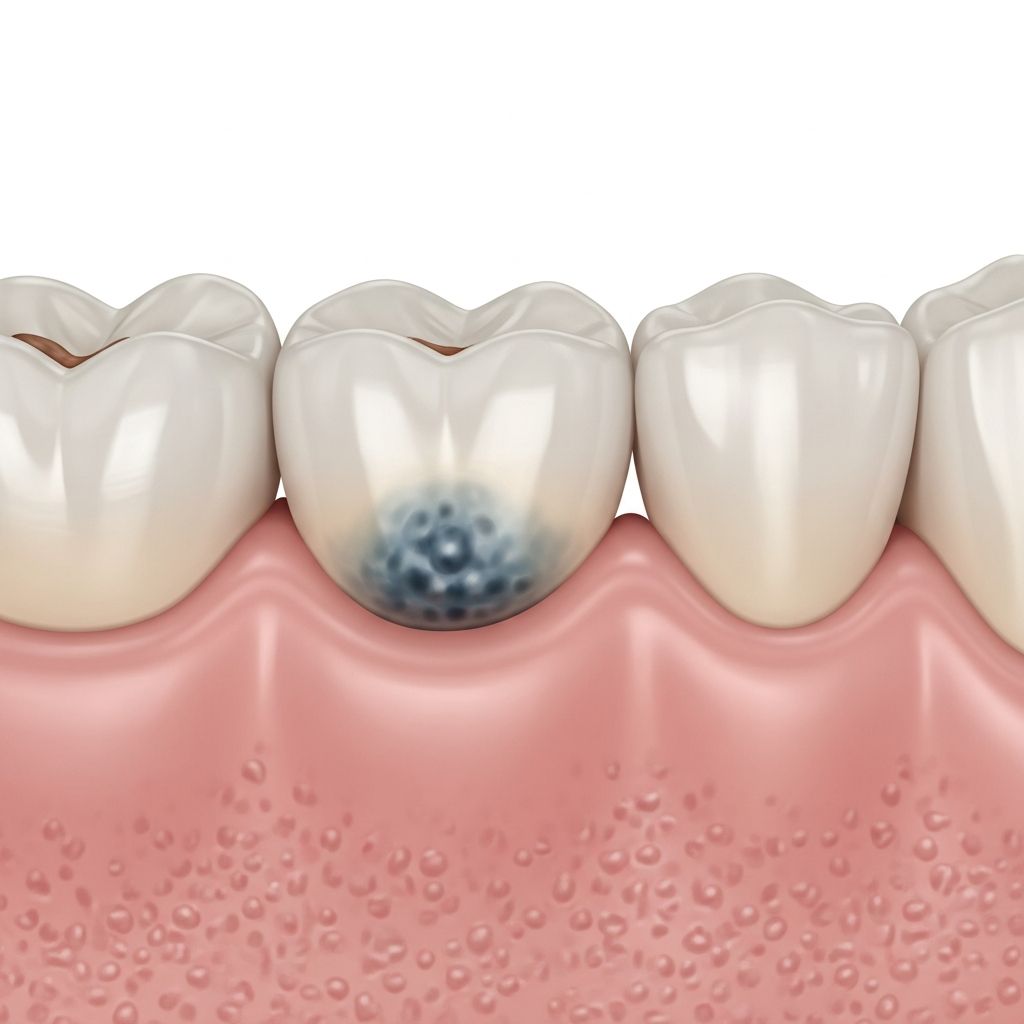
Amalgam tattoo is a benign, solitary, blue, grey, black or silver pigmentation of the oral mucosa resulting from the inadvertent deposition of amalgam (silver-containing dental restorative material) into the soft tissues of the mouth during dental procedures.
What is an amalgam tattoo?
An amalgam tattoo is the most common cause of a localized pigmentation of the oral mucosa, occurring in up to 1 in 5 of the population. It is a type of exogenous pigmentation caused by the accidental implantation of metallic particles into the soft tissues during dental treatment. The tattoo-like lesion appears as a flat, blue, grey, black or silver macule or patch, usually less than 1 cm in greatest dimension, and most commonly affects the gingiva near teeth restored with amalgam.
Amalgam fillings, composed primarily of silver (50%), tin (29%), copper (20%) and mercury (15%), have been used in dentistry for over 150 years. During placement, removal, or adjustment of these fillings, microscopic particles can abrade into the surrounding mucosa, creating a permanent discoloration that does not fade over time.
Who gets amalgam tattoos?
Amalgam tattoos can develop in anyone who has undergone dental procedures involving amalgam restorations. They are most prevalent in:
- Adults over 30 years, correlating with cumulative dental work.
- Patients with a history of amalgam fillings, crowns, extractions, or root canal treatments on amalgam-restored teeth.
- Individuals in regions where amalgam remains a standard restorative material, though its use is declining due to concerns over mercury content.
Prevalence studies estimate amalgam tattoos in 0.4–9% of dental patients, with higher rates in older populations. No gender predilection exists, but lesions are more noticeable in those with lighter oral mucosa pigmentation.
What causes amalgam tattoos?
Amalgam tattoos result from iatrogenic implantation of amalgam particles into soft tissues during common dental procedures:
- Class V cavity preparations on gingival margins.
- Placement, finishing, and polishing of amalgam restorations.
- Extraction of amalgam-restored teeth, where particles fall into sockets.
- Prosthetic crown fabrication and cementation.
- Endodontic surgery (apicoectomy).
- Periodontal scaling or aggressive flossing shortly after amalgam placement.
- Orthodontic bands or appliances adjacent to amalgam fillings.
Particles as small as 10–100 micrometres embed deeply into connective tissue. Over time, soluble components like mercury, tin, copper, and zinc leach out, leaving insoluble silver-mercury granules that cause the persistent pigmentation.
What are the clinical features of amalgam tattoo?
Amalgam tattoos present as:
- Solitary or occasionally multiple asymptomatic macules or patches.
- Colour: blue, grey, black, silver or dark brown; uniform or stippled.
- Size: 0.2–1.0 cm (range 1 mm to 2 cm).
- Shape: ovoid, irregular; well-defined.
- Surface: smooth; no induration or ulceration.
Common sites (in order of frequency):
| Site | Frequency |
|---|---|
| Mandibular gingiva (incisor/premolar area) | 39% |
| Maxillary tuberosity | 18% |
| Mandibular premolar gingiva | 13% |
| Other gingival sites | 30% |
Lesions often appear adjacent to teeth with amalgam restorations. Rarely, tattoos may be found on the palate, buccal mucosa or floor of mouth. Pigmentation may be visible radiographically as radiopaque areas.
Diagnosis
Related Stories



Diagnosis of amalgam tattoo is usually clinical, based on:
- History of recent dental work with amalgam.
- Location adjacent to amalgam-restored teeth.
- Characteristic flat, grey-blue pigmentation.
Investigations include:
- Intraoral radiograph: Reveals fine radiopaque particles.
- Biopsy if diagnosis uncertain (e.g., irregular borders, rapid growth, symptoms).
Histopathology shows fine, brown-black granular pigment in superficial connective tissue macrophages, blood vessel walls, collagen fibres and muscle. Pigment is refractile under polarised light, negative for iron (Perls) and melanin (Fontana-Masson).
Differential diagnosis
Key differentials for oral pigmentation include:
| Condition | Distinguishing features |
|---|---|
| Melanotic macule | Brown-black; no radiopacity; Fontana-Masson positive. |
| Nevi | Life-long; may be raised/nodular. |
| Melanoma | Irregular borders/colour; rapid growth; ulceration; history of melanoma. |
| Foreign body (e.g., graphite) | Traumatic history; Perls negative. |
| Medication-induced (minocycline, antimalarials) | Diffuse; systemic drug history. |
| Heavy metal (bismuth, silver) | Generalised pigmentation. |
Malignant melanoma must be excluded in palatal lesions or those with asymmetry, border irregularity, colour variation, diameter >6 mm, evolving size (ABCDE rule).
Complications
Amalgam tattoos are typically asymptomatic and benign. Rare complications include:
- Local chronic inflammation or foreign body giant cell reaction (~38% histologically).
- Lichenoid reactions adjacent to amalgam restorations.
- Anecdotal reports of sinusitis, headache, or systemic symptoms resolving post-excision, possibly due to mercury hypersensitivity or HLA-DR upregulation.
- Cosmetic concerns, especially visible on anterior gingiva or lips.
No evidence links amalgam tattoos to mercury toxicity or malignancy.
Management
As amalgam tattoos are harmless and asymptomatic, no treatment is required. Management options for cosmetic concerns or diagnostic uncertainty:
- Surgical excision: Complete removal with narrow margins; primary closure or graft.
- Laser ablation: Er,Cr:YSGG or diode lasers for superficial lesions.
- Observation: With patient reassurance and dental records notation.
Prevent by using rubber dam, high-volume suction, and atraumatic techniques during amalgam procedures.
Prevention
- Minimize aerosol generation during amalgam finishing/polishing.
- Use high-speed evacuation and rubber dam isolation.
- Alternative materials: Composite resins or glass ionomers for gingival margins.
- Patient education post-procedure regarding potential pigmentation.
Histopathology
Microscopic features:
- Granular brown-black pigment within macrophages, fibroblasts, endothelium and muscle fibres.
- Foreign body giant cells phagocytosing pigment (38% cases).
- Lymphocytic infiltrate; fibrosis in chronic lesions.
- Polariscopic refractile; negative iron/melanin stains.
Elemental analysis confirms silver, tin, mercury.
Frequently asked questions
Are amalgam tattoos dangerous?
No, they are benign and do not become cancerous. Routine removal is unnecessary.
Will an amalgam tattoo go away on its own?
No, the pigmentation is permanent as silver particles remain insoluble.
Can amalgam tattoos cause mercury poisoning?
No evidence supports systemic toxicity from oral amalgam tattoos.
When should I have an amalgam tattoo removed?
For cosmetic reasons, diagnostic doubt, growth, symptoms, or melanoma history.
Is laser treatment effective for amalgam tattoos?
Yes, certain lasers can ablate superficial pigmentation with minimal scarring.
References
- Amalgam tattoo: a cause of sinusitis? — PMC – PubMed Central – NIH. 2017-03-01. https://pmc.ncbi.nlm.nih.gov/articles/PMC5349031/
- 5 Impressive Facts About Amalgam Tattoo — AZ Dentist. 2023-01-15. https://azdentist.com/conditions/oral-amalgam-tattoo/
- An Overview of Amalgam Tattoos for the Dental Hygienist — Today’s RDH. 2022-06-10. https://www.todaysrdh.com/an-overview-of-amalgam-tattoos-for-the-dental-hygienist/
- What Is an Amalgam Tattoo? Causes, Symptoms, and Treatment Options — AFC Dentistry. 2024-02-20. https://afcdentistry.com/what-is-an-amalgam-tattoo-causes-symptoms-and-treatment-options/
- Amalgam Tattoo: Symptoms, Causes, and More — WebMD. 2023-11-05. https://www.webmd.com/oral-health/what-is-an-amalgam-tattoo
- Amalgam tattoo — DermNet NZ. 2024-08-12. https://dermnetnz.org/topics/amalgam-tattoo
Similar Articles








Read full bio of Sneha Tete