American Trypanosomiasis: Symptoms, Diagnosis, Treatment
Chagas disease: a parasitic infection caused by Trypanosoma cruzi, transmitted mainly by triatomine bugs, with acute skin signs and chronic organ damage.
What is American trypanosomiasis?
American trypanosomiasis, also known as
Chagas disease
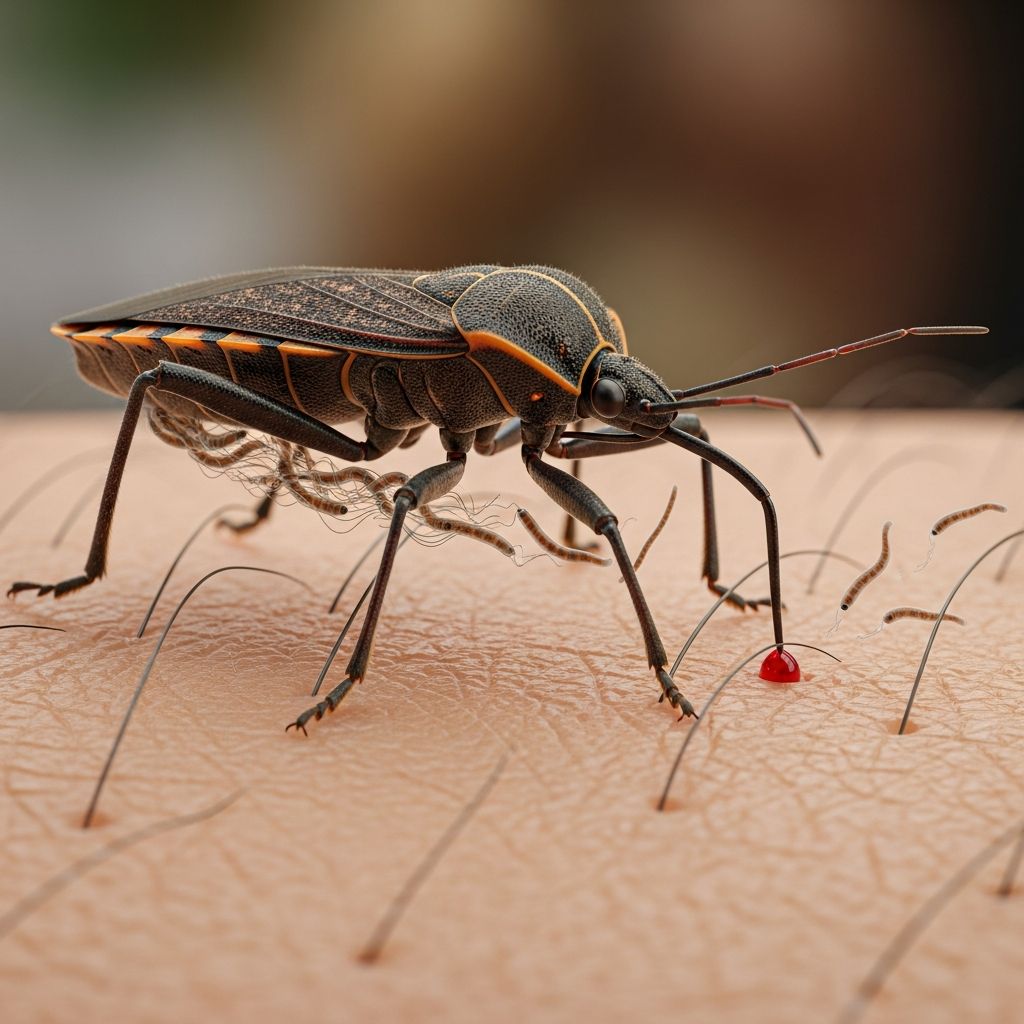
, is a potentially life-threatening systemic infection caused by the zoonotic protozoan parasite Trypanosoma cruzi. This parasite belongs to the family Trypanosomatidae and is primarily transmitted to humans by haematophagous (blood-feeding) triatomine insects, commonly called ‘kissing bugs’ due to their tendency to bite around the mouth and face.Chagas disease affects an estimated 6–7 million people worldwide, predominantly in Latin America, though cases are increasingly reported in non-endemic regions like the United States, Europe, and Australia due to migration of infected individuals and vectors. The disease manifests in two phases: an acute phase, often mild or asymptomatic with characteristic skin lesions, and a chronic phase that can lead to severe cardiac, digestive, or neurological complications decades later.
In the acute phase, high parasitemia allows direct detection of parasites, while chronic phase relies on serology. Without treatment, 20–30% of infected individuals develop chronic symptomatic disease, making early diagnosis critical.
Who gets American trypanosomiasis?
Chagas disease primarily affects people living in rural areas of Latin America where triatomine bugs infest poor-quality housing with adobe, thatch, or cracked walls that provide harbourage for the insects. Endemic countries include Argentina, Bolivia, Brazil, Chile, Colombia, Ecuador, Paraguay, Peru, Uruguay, Venezuela, and parts of Central America and Mexico.
High-risk groups include:
- Rural poor populations in substandard housing.
- Indigenous communities and agricultural workers.
- Individuals exposed through blood transfusion, organ transplantation, or congenital transmission from infected mothers (1–10% risk to newborns).
- Travelers to endemic areas staying in rustic accommodations.
- Immunocompromised patients (e.g., HIV/AIDS, transplant recipients) at risk of reactivation.
In non-endemic regions, cases arise from imported infections via migration (chronic carriers) or local vectors in southern US states like Texas, where Triatoma species are found. Globally, over 300,000 infected individuals reside in the US, Spain, and other countries.
What causes American trypanosomiasis?
Trypanosoma cruzi is a haemoflagellate protozoan with a complex life cycle involving insect vectors, mammalian reservoirs (e.g., armadillos, opossums, raccoons), and humans. Six distinct phylogenetic lineages (TcI–TcVI) exist, with varying pathogenicity and geographic distribution; TcI predominates in the US.
The parasite cycles between:
- Epimastigotes: Proliferative form in the insect midgut.
- Trypomastigotes: Infective, motile forms in mammalian blood and insect hindgut feces.
- Amastigotes: Intracellular replicative form in host tissues.
Transmission occurs via contaminated triatomine feces rubbed into bite wounds or mucous membranes. Other routes include oral (contaminated food/drink), congenital, vector-free (transfusion, transplant), and laboratory accidents.
What are the clinical features of American trypanosomiasis?
Acute Chagas disease
The incubation period is 1–2 weeks. Most infections (90%) are asymptomatic or present with non-specific flu-like symptoms: fever, fatigue, headache, myalgia, arthralgia, lymphadenopathy, and hepatosplenomegaly.
Characteristic dermatological signs include:
- Chagoma: Painless, indurated, erythematous nodule (2–20 cm) at inoculation site, often on face, arms, or legs, with regional lymphadenopathy. Evolves to satellite lesions.
- Romaña’s sign: Unilateral periorbital edema, conjunctivitis, and preauricular lymphadenopathy when parasites enter via conjunctiva. Lasts 1–2 months.
- Schizotrypanides: Generalized morbilliform rash (measles-like) due to embolic skin showers of parasites.
Related Stories



Severe acute cases (1–5%) may involve myocarditis, meningoencephalitis, or pneumonitis, with high mortality in children and immunocompromised. Foodborne outbreaks cause facial edema, jaundice, and hemorrhagic manifestations.
Chronic Chagas disease
After apparent resolution, parasites persist subclinically (indeterminate form). 20–30% progress to symptomatic chronic disease after 10–30 years.
| Organ System | Clinical Features |
|---|---|
| Cardiac (20–30%) | Dilated cardiomyopathy, apical aneurysm, conduction abnormalities (RBBB, AV block), thromboembolism, sudden death. Right-sided involvement common with pale myocardium and hemorrhages. |
| Digestive (10%) | Megaviscera: megaesophagus (dysphagia, aspiration), megacolon (constipation, volvulus). Achalasia-like. |
| Neurological | Meningoencephalitis in reactivated cases (HIV, transplants). Peripheral neuropathy rare. |
| Cutaneous (reactivation) | Panniculitis, ulcers, subcutaneous nodules in immunocompromised. |
Reactivation
In HIV/AIDS or immunosuppressed patients, quiescent infection reactivates with fever, skin lesions (panniculitis), myocarditis, or meningoencephalitis. High mortality if untreated.
How is the diagnosis made?
Acute phase: Direct parasitological methods preferred.
- Microscopy of fresh blood, buffy coat, or thin/thick smears for trypomastigotes.
- PCR for T. cruzi DNA (high sensitivity).
- Tissue biopsy (amastigotes in H&E/Giemsa stain).
Chronic phase: Serology with two tests (IFA, ELISA, haemagglutination) detecting IgG antibodies. PCR or xenodiagnosis for inconclusive cases.
Skin biopsy of chagoma shows amastigote pseudocysts. Differential: leishmaniasis, erysipelas, cellulitis, insect bites.
What is the treatment for American trypanosomiasis?
Antiparasitic therapy with benznidazole (first-line) or nifurtimox is curative in acute phase (60–90% efficacy), congenital, and early chronic infections. Efficacy drops to 20–60% in established chronic disease but recommended to reduce progression.
- Benznidazole: 5–7 mg/kg/day orally for 60 days. Adverse effects: rash, neuropathy, bone marrow suppression.
- Nifurtimox: 8–10 mg/kg/day for 90 days. GI upset, neuropathy.
Treatment indicated for acute, congenital, reactivated, children <18 years, and early chronic phase (including women of childbearing age). Symptomatic chronic management: pacemakers, antiarrhythmics, surgery for megaviscera.
What is the outcome for American trypanosomiasis?
Acute mortality <5%, higher in severe cases. Chronic cardiomyopathy has 50–75% 10-year mortality. Treatment prevents chronic disease in acute cases and halves progression risk in chronic. Lifelong serologic monitoring post-treatment.
How can American trypanosomiasis be prevented?
Vector control
- Insecticides (pyrethroids) on housing walls.
- Housing improvement: plastering cracks, screened windows.
- Bednets treated with insecticides.
Personal protection
- Use bednets in endemic areas.
- Insect repellents (DEET).
- Avoid sleeping in poorly constructed rural homes.
Medical prophylaxis
- Screen blood donors, organ transplants, pregnant women in endemic areas/non-endemic with risk.
- Trypanocidal treatment of infected pregnant women.
WHO initiatives have reduced incidence by 70% in some areas via vector control.
Related topics
- Leishmaniasis
- Cutaneous larva migrans
- Delusions of parasitosis
Frequently asked questions (FAQs) about American trypanosomiasis
What is a chagoma?
A chagoma is a localised, painless, erythematous indurated swelling at the site of T. cruzi inoculation.
What is Romaña’s sign?
Romaña’s sign is unilateral bipalpebral oedema with conjunctivitis due to conjunctival inoculation.
Is Chagas disease curable?
Yes, with benznidazole or nifurtimox, especially in acute phase.
Can Chagas disease be transmitted sexually?
Rarely; mainly vector-borne, congenital, transfusion.
Is there a vaccine for Chagas disease?
No vaccine available; prevention relies on vector control.
References
- Trypanosoma cruzi infection: a review with emphasis on cutaneous manifestations of acute and chronic disease and on the disease in immunocompromised hosts — Acién M, et al. International Journal of Dermatology. 2012-05-01. https://onlinelibrary.wiley.com/doi/abs/10.1111/j.1365-4632.2011.05380.x
- American Trypanosomiasis (Chagas Disease) — Center for Food Security and Public Health, Iowa State University. 2017. https://www.cfsph.iastate.edu/Factsheets/pdfs/trypanosomiasis_american.pdf
- Chagas disease (American trypanosomiasis) — World Health Organization. 2024-04-25. https://www.who.int/news-room/fact-sheets/detail/chagas-disease-(american-trypanosomiasis)
- DPDx – American Trypanosomiasis — Centers for Disease Control and Prevention. 2024. https://www.cdc.gov/dpdx/trypanosomiasisamerican/index.html
- Chagas Disease in the U.S. | Skin Signs, Symptoms & Kissing Bug — MedCram. 2023. https://www.youtube.com/watch?v=Pdfumd3OFjE
Similar Articles








Read full bio of medha deb