Amorolfine For Fungal Nail Infections: 6 To 12 Month Guide
Effective weekly nail lacquer treatment for fungal infections in fingernails and toenails, with 6-12 months for full results.
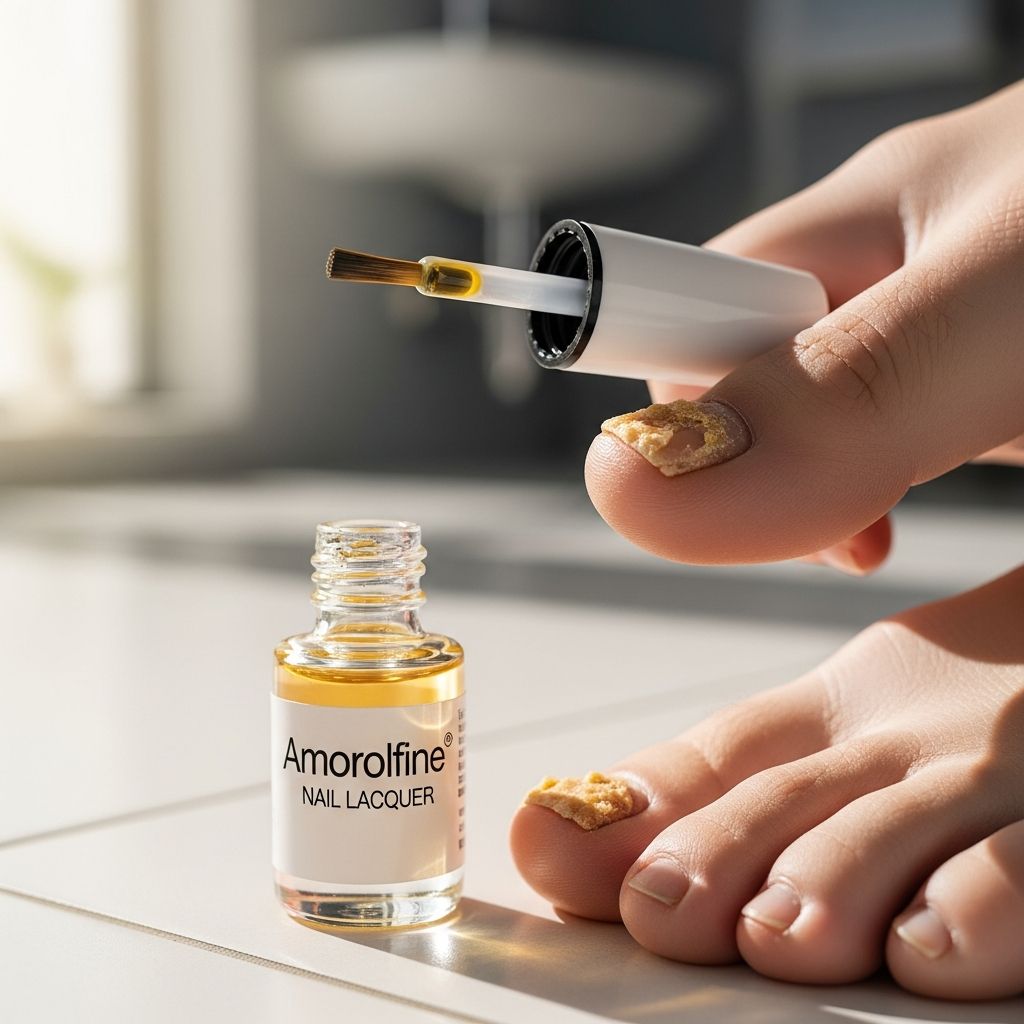
Amorolfine is an antifungal treatment specifically designed for fungal infections of the fingernails and toenails, known as onychomycosis. It is applied as a nail lacquer once each week, with treatment typically requiring 6 to 12 months for complete resolution.
About amorolfine nail lacquer
| Type of medicine | Antifungal |
|---|---|
| Used for | Fungal infections of the fingernails and toenails |
| Also called | Loceryl4; Curanail4; Clavusimyl4; Omicur4; Schollmed4 |
| Available as | Nail lacquer |
Amorolfine nail lacquer is a topical antifungal medication used to treat
onychomycosis
, the medical term for fungal nail infections affecting fingernails or toenails. These infections often originate from athlete’s foot or other fungal skin conditions and cause nails to thicken, discolor (turning yellow, white, or brown), become brittle, and sometimes painful. While severe cases may require oral antifungal tablets like terbinafine, amorolfine is ideal for milder infections, particularly those limited to the tip or edges of 1-2 nails.The active ingredient,
amorolfine (5% concentration)
, belongs to a class of morpholine antifungals. It works by inhibiting the enzyme delta-14-reductase and cholestenol delta-isomerase, which disrupts ergosterol synthesisa key component of fungal cell membranes. Without ergosterol, fungal cell walls weaken, preventing growth and leading to cell death. This mechanism provides broad-spectrum activity against dermatophytes (e.g., Trichophyton species), yeasts (e.g., Candida), and molds responsible for most nail infections.Unlike oral treatments, amorolfine has minimal systemic absorption, reducing the risk of liver toxicity or drug interactions. Its film-forming lacquer penetrates the nail plate via transungual delivery, reaching the nail bed where fungi reside. Concentration builds up over time, remaining active for about two weeks post-application.
Before using amorolfine nail lacquer
To ensure safe and effective use, consult a doctor or pharmacist if you have any uncertainties. Amorolfine is suitable for adults over 18 with mild infections affecting 1-2 nails, specifically the upper half or sidesnot the entire nail base or matrix.
- Pregnancy and breastfeeding: Avoid use during pregnancy or breastfeeding unless advised by a doctor, as safety data is limited.
- Other medicines: No known interactions with oral medications, but inform your doctor of any concurrent treatments.
- Age restrictions: Not recommended for children under 18.
- Allergies: Do not use if allergic to amorolfine or excipients.
Fungal nail infections are contagious, spreading via shared tools or direct contact. Use separate files for infected and healthy nails, and dispose of used ones properly to prevent reinfection.
How to use amorolfine nail lacquer
Amorolfine requires consistent weekly application for optimal results. Follow these steps meticulously:
- Prepare the nail: Remove any polish or previous lacquer using the provided alcohol pad. Gently file down the affected nail surface with the disposable nail file to remove debris and improve penetration. Use a fresh file each timedo not reuse on healthy nails.
- Apply the lacquer: Using the applicator spatula, coat the entire infected nail, including the proximal area near the cuticle. Ensure even coverage without excess.
- Dry: Allow 3-5 minutes for the lacquer to dry completely, forming a protective film.
- Frequency: Apply once weekly. Some clinicians recommend twice weekly for severe casesfollow medical advice.
- Cleaning between applications: Use the alcohol pad to remove old lacquer before reapplying. Avoid organic solvents like acetone.
- Duration: Continue until the nail is fully healthy, typically 6 months for fingernails and 9-12 months for toenails, as nails grow slowly (about 2-3 mm/month).
Related Stories



Important tips:
- Wash hands before and after application.
- Avoid nail varnish, artificial nails, or pedicures during treatment.
- If lacquer contacts skin or eyes, rinse immediately with water.
- Monitor progress every 3 months; consult a doctor if no improvement.
How long does it take to work?
**Amorolfine** is effective but requires patience due to slow nail growth. Fingernails may show improvement in 6 months, while toenails need 9-12 months. Visible changes occur as the infected nail grows out and is replaced by healthy nail.
Clinical studies report:
| Outcome | Amorolfine 5% (Once/Twice Weekly) |
|---|---|
| Mycological cure (negative culture/microscopy) | 55-60% |
| Complete cure (clinical + mycological) | 38-46% after 6-12 months |
| Overall efficacy (toenail onychomycosis) | 60-71% |
Continue treatment even if initial changes are subtle. If no progress after 3 months or worsening, seek professional evaluationoral therapy or lab confirmation may be needed.
Side-effects of nail lacquer
Amorolfine is well-tolerated with mostly mild, local effects resolving as nails regrow.
| Common side effects | What to do |
|---|---|
| Broken or brittle nails, nail discolouration | This will pass as your nail regrows |
| Burning sensation, redness, itching, irritated skin around nail | If troublesome, speak with your doctor or pharmacist |
Rare effects include erythema, onycholysis (nail lifting), or nail bed inflammation. Systemic side effects are negligible due to low absorption. Discontinue if severe reactions occur and consult a healthcare provider.
How to store amorolfine nail lacquer
Store below 30C in a cool, dry place away from children. Do not use after expiry; discard unused lacquer properly. Keep applicator clean and sealed.
Frequently Asked Questions (FAQs)
Q: Can amorolfine be used on all nails?
A: Best for mild infections on 1-2 nails (upper half/sides). Severe or widespread cases need doctor assessment for oral alternatives.
Q: How effective is amorolfine compared to ciclopirox?
A: Both are effective topicals; amorolfine (5%) shows 38-60% complete/mycological cure rates. Combination with orals boosts efficacy. Amorolfine lacks anti-inflammatory action but penetrates well.
Q: Is amorolfine safe during pregnancy?
A: Avoid unless advised by a doctor due to limited data.
Q: Can I paint my nails over amorolfine?
A: No—remove polish before each application. Avoid cosmetics during treatment.
Q: What if treatment fails?
A: Consult a doctor for microscopy/culture tests. Oral terbinafine or itraconazole may be prescribed.
Preventing Reinfection
To avoid recurrence (common in 20-50% of cases):
- Keep feet dry and clean; wear breathable shoes/socks.
- Treat athlete’s foot promptly.
- Disinfect clippers/files; don’t share.
- Continue good foot hygiene post-treatment.
Amorolfine offers a convenient, effective option for managing onychomycosis without systemic risks, supported by decades of clinical use.
References
- Amorolfine Antifungal Nail Lacquer: What It Is & How to Use It The Independent Pharmacy. 2023. https://www.theindependentpharmacy.co.uk/fungal-nail-infections/guides/about-amorolfine
- Amorolfine for fungal nail infections (Loceryl, Curanail) Patient.info. 2022-11-07. https://patient.info/medicine/amorolfine-for-fungal-nail-infections-loceryl-curanail
- Amorolfine Wikipedia (citing 1992 studies). 2024. https://en.wikipedia.org/wiki/Amorolfine
- Amorolfine vs. ciclopirox lacquers for the treatment of onychomycosis PMC/NCBI (Peer-reviewed). 2015-03-26. https://pmc.ncbi.nlm.nih.gov/articles/PMC4360009/
- Care Antifungal 5%w/v Medicated Nail Lacquer (PIL) Medicines.org.uk (MHRA official). 2023. https://www.medicines.org.uk/emc/files/pil.7411.pdf
- Amorolfine: Uses, Interactions, Mechanism of Action DrugBank (official drug database). 2024. https://go.drugbank.com/drugs/DB09056
Similar Articles








Read full bio of Sneha Tete