Amsler Grid: 7-Step Home Vision Test For Early Macular Signs
Master the Amsler grid for at-home vision monitoring to catch retinal issues early and safeguard your eyesight effectively.
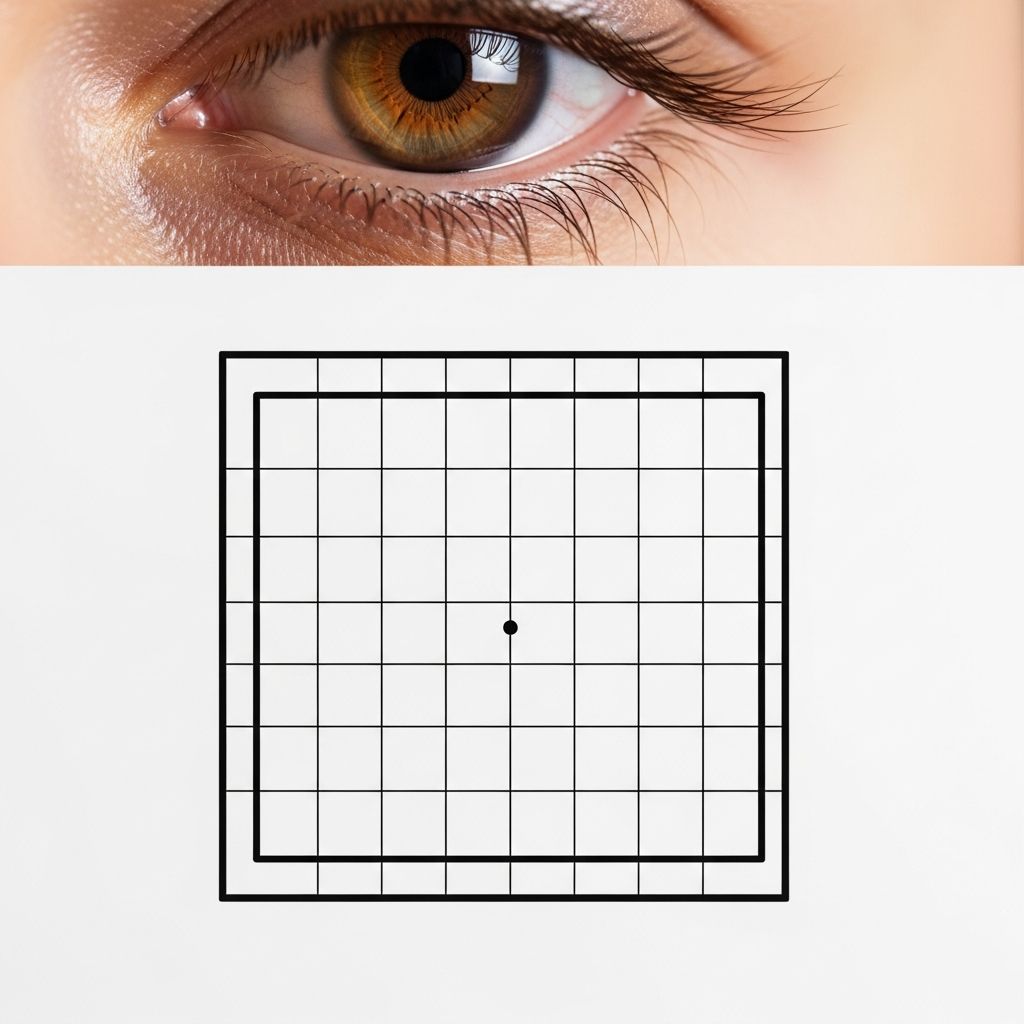
The Amsler grid serves as a straightforward diagnostic aid designed to identify subtle alterations in central vision, particularly those stemming from retinal disorders. This grid-patterned chart enables individuals to perform regular self-assessments, facilitating timely detection of potential issues that could threaten visual acuity.19
Understanding the Design and Purpose of the Amsler Grid
Comprising a square divided into uniform smaller squares by horizontal and vertical lines, with a prominent central dot, the Amsler grid mimics the structure of graph paper scaled to about 10 centimeters per side. Developed decades ago by ophthalmologist Marc Amsler, it targets the macula—the retina’s central region responsible for sharp, detailed sight used in reading, driving, and recognizing faces.3
Its primary role lies in revealing
metamorphopsia
, where straight lines warp or bend, andscotomas
, appearing as blind or faded spots. These symptoms often signal early stages of conditions affecting macular function, allowing users to note changes before they escalate.19Who Benefits Most from Regular Amsler Grid Testing
Certain groups stand to gain significantly from incorporating this test into their routine. Patients diagnosed with age-related macular degeneration (AMD), especially the dry form, receive strong recommendations to check daily. This practice aids in spotting transitions to wet AMD, characterized by fluid leakage and rapid deterioration.13
- Individuals with intermediate or advanced dry AMD monitoring for wet conversion.
- Those with a family history of retinal diseases seeking proactive vigilance.
- People experiencing unexplained central vision fluctuations.
- Post-treatment patients tracking macular stability after interventions like injections.
Beyond AMD, it proves useful for conditions such as retinal vein occlusions or macular edema, where central distortions manifest prominently.3
Step-by-Step Instructions for Accurate Testing
Performing the test correctly ensures reliable outcomes. Begin in a well-lit space, wearing your usual corrective lenses if applicable. Print or display the grid at eye level, positioning yourself roughly 14 to 30 centimeters away.14
- Print a standard Amsler grid from a reputable source.
- Hold or mount it at reading distance in bright, even lighting.
- Cover one eye completely with your palm or an occluder.
- Fixate steadily on the central dot without shifting gaze.
- Examine the entire grid: note line straightness, uniformity of squares, visibility of all edges, and any fading or darkening.
- Repeat for the other eye.
- Record observations, perhaps sketching anomalies on a copy.
Consistency matters—test under identical conditions daily to establish your baseline “normal.”24
Interpreting Your Test Results Effectively
Normal results show all lines as crisp, parallel, and evenly spaced, with the full grid visible including corners, and no alterations around the fixation point. Deviations demand attention.17
| Observation | Possible Indication | Action Required |
|---|---|---|
| Wavy or bent lines | Metamorphopsia from macular swelling or wet AMD | Contact specialist immediately |
| Blurry, faded, or missing sections | Scotoma suggesting retinal damage | Schedule urgent exam |
| Enlarged/shrunk squares | Distortion in central field | Professional evaluation |
| Invisible edges/corners | Peripheral field loss (non-macular) | Consult for full field test |
| All straight and clear | Stable central vision | Continue monitoring |
Related Stories



Track changes over time; even subtle shifts from your personal norm warrant follow-up.3
Conditions Detected Beyond Macular Degeneration
While optimized for AMD, the grid flags other pathologies. Retinal vein occlusions may produce central blurring from edema. Optic nerve issues or epiretinal membranes can distort lines similarly. It serves as a sentinel for any central visual pathway disruption.39
- **Wet AMD**: Sudden waviness signals vessel leakage.
- **Diabetic macular edema**: Blurring from metabolic control lapses.
- **Central serous retinopathy**: Temporary distortions resolving with management.
- **Myopic degeneration**: Progressive changes in high myopia cases.
Limitations and Best Practices for Reliable Use
This tool excels at change detection but lacks diagnostic specificity. It misses peripheral defects and requires professional validation via OCT imaging or fundus exams.15 Avoid testing if fatigued, in dim light, or without correction.
Enhance accuracy by:
- Maintaining a log of results with dates.
- Using the same grid copy for continuity.
- Comparing both eyes separately.
- Seeking confirmation if prior mild distortions exist as baseline.
Integrating Amsler Grid into Broader Eye Care Strategies
Pair with scheduled ophthalmology visits, lifestyle measures like UV protection, antioxidant-rich diets, and smoking cessation to bolster retinal health. For AMD patients, it complements AREDS supplements and anti-VEGF therapies.1
Early intervention via grid alerts can preserve function; studies underscore its value in delaying vision loss progression.9
Frequently Asked Questions
How often should I use the Amsler grid?
Daily for at-risk individuals, or as advised by your eye doctor, to catch evolving changes promptly.1
What if I see changes in only one eye?
Unilateral findings are significant; test both eyes independently and report asymmetry to your provider.2
Can children or young adults use it?
Primarily for adults with macular risks, but useful for anyone suspecting central vision issues.9
Is a digital Amsler grid app equivalent?
Apps offer convenience but printed versions minimize screen glare artifacts; validate with your specialist.4
What confirms grid findings?
Dilated exams, OCT scans, and angiography provide definitive insights.5
References
- Amsler Grid Eye Test: What It Is, Types & Uses — Cleveland Clinic. 2023-05-15. https://my.clevelandclinic.org/health/diagnostics/amsler-grid-eye-test
- How to Use the Amsler Grid to Check Your Vision — YouTube (American Academy of Ophthalmology reference). 2022-10-12. https://www.youtube.com/watch?v=k_y06QCLUz4
- Amsler Grid Eye Test: A Simple Tool to Protect Your Vision — West Texas Eye Associates. 2024-01-08. https://www.westtexaseye.com/blog/amsler-grid-eye-test-a-simple-tool-to-protect-your-vision/
- How to Use an Amsler Grid to Check Vision Changes — YouTube. 2023-03-20. https://www.youtube.com/watch?v=ObGJItsVCg8
- Amsler Grid Test: Spotting Early Macular Degeneration — Vantage Eye Center. 2024-02-14. https://www.vantageeye.com/blog/amsler-grid-test/
- Amsler Grid — Academy Vision. 2023-11-05. https://www.academyvisionnj.com/Content2/services/amslergrid/index.aspx
- Home vision tests — UCSF Health. 2024-06-10. https://www.ucsfhealth.org/medical-tests/home-vision-tests
- Amsler Grid Eye Test — BrightFocus Foundation. 2023-09-18. https://www.brightfocus.org/resource/amsler-grid-eye-test/
- Amsler Grid — StatPearls, NCBI Bookshelf. 2023-07-03. https://www.ncbi.nlm.nih.gov/sites/books/NBK538141/
Similar Articles








Read full bio of Sneha Tete