Anatomy and Development of the Mouth and Teeth
Understanding oral structures: From tooth formation to functional maturity and lifelong health.
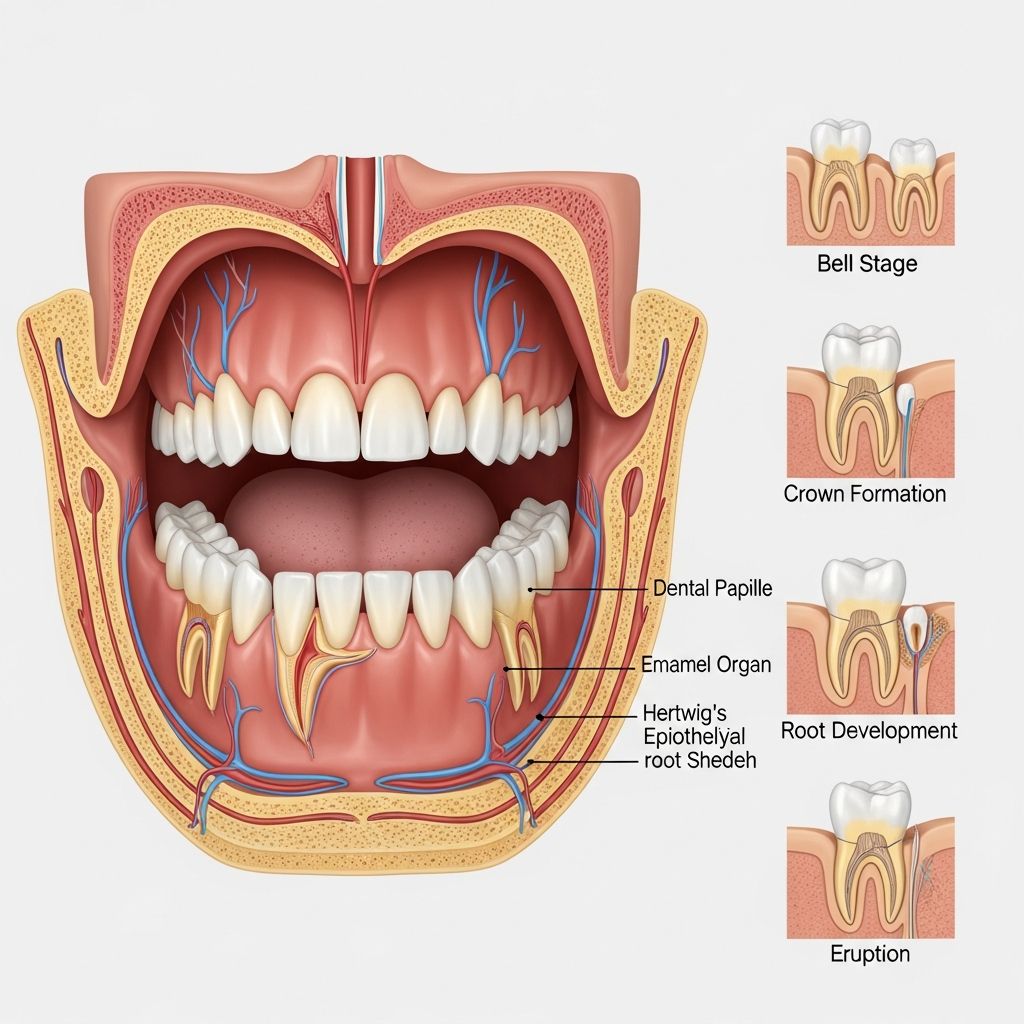
The mouth and teeth represent one of the most complex and fascinating systems in the human body. Understanding the anatomy of these structures and how they develop is fundamental to maintaining lifelong oral health and recognizing potential dental concerns. From the moment teeth begin forming in utero to their eventual eruption in the mouth, each stage of development follows a precise biological process. This comprehensive guide explores the intricate anatomy of the mouth, the detailed structure of individual teeth, and the developmental timeline that shapes our dentition throughout life.
Basic Anatomy of the Mouth
The mouth, or oral cavity, serves as the gateway to the digestive and respiratory systems. It is bounded by the lips anteriorly, the oropharynx posteriorly, the hard and soft palates superiorly, and the floor of the mouth inferiorly. The oral cavity contains numerous specialized structures that work in concert to enable eating, speaking, and swallowing.
The Lips and Oral Mucosa
The lips form the anterior boundary of the mouth and consist of a thin, highly vascular layer of tissue rich in sensory nerves. The oral mucosa, or lining of the mouth, is a specialized tissue that protects the underlying structures while maintaining moisture and allowing for sensation. This mucous membrane contains minor salivary glands that contribute to oral lubrication and the initial stages of digestion.
The Palate
The palate forms the roof of the mouth and consists of two distinct regions: the hard palate and the soft palate. The hard palate, located anteriorly, is composed of bone covered with mucosa and serves as an anchor for muscles involved in swallowing and speech. The soft palate, or velum, is located posteriorly and consists primarily of muscle tissue. During swallowing, the soft palate elevates to prevent food and liquids from entering the nasal cavity, ensuring that these substances proceed down the esophagus rather than the airway.
The Tongue
The tongue is a muscular organ that plays a crucial role in mastication, swallowing, speech, and taste sensation. Composed of intrinsic and extrinsic muscles, the tongue allows for remarkable mobility and precision in oral functions. The dorsal surface of the tongue contains numerous taste buds and papillae, which are small projections that enhance grip during chewing and swallowing. The lingual frenum, a thin fold of tissue underneath the tongue, connects the tongue to the floor of the mouth and helps control tongue movement.
Salivary Glands
Salivary glands distributed throughout the mouth produce saliva, an essential secretion that lubricates food, initiates chemical digestion through the enzyme amylase, and provides antimicrobial protection. The three major salivary glands are the parotid glands, located in front of the ears; the submandibular glands, situated beneath the jaw; and the sublingual glands, positioned under the tongue. Additionally, numerous minor salivary glands are scattered throughout the oral mucosa.
Tooth Anatomy and Structure
Each tooth is a specialized structure composed of multiple layers, each serving distinct functions in mastication and protection. Understanding these components is essential for comprehending how teeth develop and function throughout life.
Enamel
Enamel is the hardest and most mineralized tissue in the human body, composed primarily of hydroxyapatite crystals. This translucent, whitish outer layer covers the crown of the tooth and provides protection against physical wear and chemical erosion. Although enamel is extremely hard, it is also brittle and can crack or chip under excessive force. Unlike bone, enamel does not contain living cells and cannot repair itself once damaged, making its preservation paramount to long-term oral health.
Related Stories



Dentin
Beneath the enamel lies dentin, a yellowish tissue that is softer than enamel but harder than bone. Dentin contains microscopic tubules that extend from the outer surface to the inner pulp chamber. These tubules house extensions of odontoblasts, specialized cells that produce and maintain dentin throughout life. When enamel is compromised, these tubules can become exposed, leading to tooth sensitivity when exposed to temperature changes, acidic foods, or physical stimulation.
The Pulp Chamber
At the center of each tooth lies the pulp chamber, a space containing the dental pulp. The pulp is composed of blood vessels, nerves, and connective tissue that nourish and provide sensation to the tooth during development and throughout life. The pulp chamber extends from the crown of the tooth down through root canals to the apex (tip) of the root, where the apical foramen allows blood vessels and nerves to enter and exit the tooth.
Cementum and the Periodontal Ligament
The root of the tooth is covered with cementum, a bone-like tissue that is softer than enamel but serves to anchor the tooth to surrounding structures. The periodontal ligament is a specialized connective tissue that suspends the tooth in its socket, or alveolus, in the jawbone. This ligament serves as a shock absorber, distributing forces exerted during chewing throughout the jaw. The periodontal ligament also contains proprioceptive nerve endings that allow us to sense bite force and tooth position, and it contains cells capable of remodeling bone in response to the forces placed upon it.
Root Structure
The root anchors the tooth within the jawbone and varies in complexity depending on tooth type. Incisors typically have single roots, canines have single roots, premolars may have one or two roots, and molars generally have two or three roots. The root’s surface area provides the attachment interface between the periodontal ligament and the tooth, distributing occlusal forces more efficiently throughout the jaw.
Types of Teeth and Their Functions
The human dentition consists of four types of teeth, each adapted for specific functions in the mastication process.
Incisors
Located at the front of the mouth, incisors have a flat, sharp biting edge and are designed for cutting and slicing food. There are four incisors in the maxilla (upper jaw) and four in the mandible (lower jaw). These teeth have thin, single roots and are typically the first teeth to erupt and the first to be shed during the transition from primary to permanent dentition.
Canines
The canines, also called cuspids, are pointed teeth located immediately adjacent to the lateral incisors. With their prominent, cone-shaped cusps, canines are specialized for tearing and gripping food. There is one canine in each quadrant of the mouth. These teeth have the longest roots relative to tooth size and are remarkably stable in the dental arch.
Premolars
Premolars, also termed bicuspids, are located between the canines and molars. These teeth have two cusps on their biting surface and function to crush and tear food. There are two premolars in each quadrant of the mouth in the permanent dentition. The first premolar typically has two roots, while the second premolar often has one root.
Molars
Molars are the largest teeth and are specialized for grinding and crushing food. Located at the back of the mouth, molars typically have three cusps and broader occlusal (biting) surfaces than premolars. There are three molars in each quadrant of the permanent dentition: the first molar, second molar, and third molar (wisdom tooth). Molars in the maxilla typically have three roots, while mandibular molars usually have two roots.
Stages of Tooth Development
Tooth development, or odontogenesis, is a complex process that begins long before teeth become visible in the mouth. This process can be divided into several distinct stages, each characterized by specific cellular and molecular events.
The Initiation Stage
Tooth development begins during the sixth week of fetal life when oral epithelium thickens to form the dental lamina, a horseshoe-shaped band of tissue that will give rise to all primary teeth. At approximately 8 weeks in utero, the dental lamina develops small buds, known as the bud stage, which represent the beginnings of individual teeth. During this stage, enamel organ begins to form from the epithelium, while ectomesenchymal tissue from neural crest cells condenses around it to form the dental papilla.
The Bud, Cap, and Bell Stages
Following the initiation stage, tooth development progresses through three morphological stages. During the cap stage (approximately 10-12 weeks in utero), the developing tooth structure begins to resemble a cap, with the enamel organ surrounding the dental papilla. The bell stage (approximately 12-16 weeks in utero) follows, during which the enamel organ, dental papilla, and dental follicle become more distinctly organized. At this stage, the epithelium of the enamel organ differentiates into inner enamel epithelium, outer enamel epithelium, and stratum intermedium. The dental papilla begins to show signs of differentiation into odontoblasts, the cells that will produce dentin.
Ameloblast and Odontoblast Differentiation
As the bell stage progresses, cells within the inner enamel epithelium differentiate into ameloblasts, specialized cells that secrete enamel matrix proteins and minerals. Simultaneously, cells within the outer portion of the dental papilla differentiate into odontoblasts, which begin to secrete predentin and dentin. This stage marks the beginning of actual hard tissue formation, or histodifferentiation, and is crucial for determining the final morphology of the tooth.
Matrix Formation and Mineralization
Once ameloblasts and odontoblasts have differentiated, they begin secreting the organic matrix of their respective tissues. Odontoblasts secrete predentin and dentin, beginning at the cusp tips of the developing tooth and progressing toward the root apex. Ameloblasts secrete enamel matrix proteins, which are later replaced by mineral ions to form the mature crystalline structure of enamel. The rate and pattern of mineralization influence the final microstructure and properties of both dentin and enamel, affecting the tooth’s resistance to decay and wear.
Primary Dentition Development
The primary dentition, consisting of 20 teeth (10 in each jaw), begins developing in utero and completes its eruption by approximately age three. The development of primary teeth follows the same general stages as permanent teeth but occurs earlier in life. Primary incisors typically begin calcifying around 3-4 months of age, while primary molars calcify around 10 months. Primary canines calcify at approximately 4-5 months of age.
The eruption of primary teeth begins at approximately 6 months of age, with lower central incisors typically emerging first. By age two, the child has erupted approximately 16 teeth, and by age three, all 20 primary teeth have usually emerged. The roots of primary teeth are shorter and more divergent than those of permanent teeth, and the enamel and dentin layers are thinner. These structural differences make primary teeth more susceptible to decay but also allow them to be shed more easily when permanent teeth begin erupting.
Permanent Dentition Development and Eruption
The permanent dentition consists of 32 teeth (16 in each jaw), including the four wisdom teeth. Development of permanent teeth begins in infancy and continues throughout childhood and into young adulthood.
Calcification Timeline
Permanent first molars begin calcifying at birth and are typically the first permanent teeth to erupt at around age 6. Permanent central incisors begin calcifying at approximately 3-4 months of age and erupt at 7-8 years. Lateral incisors calcify at 10-12 months and erupt at 8-9 years. Canines calcify at 4-5 months and erupt at 11-12 years in the maxilla and 9-10 years in the mandible. Premolars calcify at 1.5-2 years and erupt at 10-12 years. Second molars calcify at 2.5-3 years and erupt at 11-13 years. Third molars begin calcifying at 7-10 years and erupt at 17-21 years or may not erupt at all.
Eruption Process
Tooth eruption is the process by which a developed tooth moves from its position within the bone into the oral cavity. The precise mechanisms driving eruption remain incompletely understood but involve bone remodeling, pressure from the erupting tooth, and activity of the periodontal ligament. As the permanent tooth develops and increases in size, it gradually moves occlusally (toward the biting surface) and eventually breaks through the oral mucosa. As permanent teeth erupt, the roots of primary teeth are resorbed, causing the primary teeth to loosen and eventually shed.
Root Development and Completion
Following crown completion and eruption, tooth development continues with root formation. Root development typically requires several years after the crown has erupted. For most permanent teeth, root formation is completed 2-3 years after eruption. Once roots are fully developed, the apical foramen (the opening at the root tip) becomes increasingly narrow, eventually closing as the tooth reaches full maturity. Complete root development marks the end of the active developmental period for that tooth.
Variations in Development
While the developmental timeline described above represents typical development, variations are common and often normal. Some individuals may experience delayed eruption, where teeth erupt later than average but follow a normal pattern. Conversely, some individuals experience accelerated eruption. Some people may be missing one or more teeth due to congenital absence, a condition called hypodontia. Other individuals may have extra teeth, a condition called hyperdontia or supernumerary teeth. Ectopic eruption, where teeth erupt in an abnormal position, may also occur. Understanding these variations helps dental professionals distinguish between normal variation and conditions requiring treatment.
Frequently Asked Questions
Q: At what age do primary teeth typically start to erupt?
A: Primary teeth typically begin erupting at approximately 6 months of age, with lower central incisors usually appearing first. However, the timing can vary, and eruption as early as 3 months or as late as 12 months may still be considered normal.
Q: Why do primary teeth have thinner enamel than permanent teeth?
A: Primary teeth have thinner enamel and dentin layers as part of their biological design. These thinner layers allow primary teeth to be shed more easily as permanent teeth develop, facilitating the natural transition from primary to permanent dentition.
Q: At what age are all permanent teeth typically erupted?
A: Most permanent teeth have erupted by age 13, with the exception of wisdom teeth (third molars). Wisdom teeth typically erupt between ages 17 and 21, though some individuals may experience eruption later or may never have wisdom teeth erupt.
Q: Can baby teeth affect the development of permanent teeth?
A: Yes, primary teeth serve as guides for permanent tooth eruption. Premature loss of primary teeth can lead to space loss and impaction of permanent teeth. Additionally, infection or trauma affecting primary teeth can potentially impact the development of underlying permanent teeth.
Q: What are supernumerary teeth?
A: Supernumerary teeth are extra teeth beyond the normal number of 20 primary or 32 permanent teeth. These extra teeth may remain impacted (embedded in bone) or may erupt in abnormal positions, potentially causing crowding or other orthodontic concerns.
Q: How long does it take for permanent teeth roots to fully develop?
A: Root development typically requires 2-3 years after a tooth has erupted into the mouth. Once roots are fully formed and the apical foramen closes, the tooth has reached full maturity and completion of development.
References
- Development, Function and Evolution of Teeth — Mark F. Teaford, Moya Meredith Smith (Johns Hopkins University), 2000. Scholarly work on dental morphology, genetics, and evolutionary biology.
- Oral Anatomy, Histology and Embryology — Rajesh H. Bhatt, Elsevier, 2011. Primary resource on oral tissue anatomy and tooth development.
- Essential Oral Histology and Embryology — James K. Avery, Paul F. Steele, Mosby/Elsevier, 2016. Comprehensive guide to oral development and tooth histology.
- Advancing the Global Oral Health Agenda — Johns Hopkins Bloomberg School of Public Health, 2023. Symposium emphasizing oral-medical integration and the importance of oral health education.
- Dental Anatomy and Physiology — International Association of Dental Research, published through peer-reviewed journals, 2024. Current standards for understanding tooth structure and function.
Similar Articles








Read full bio of Sneha Tete