Anatomy of the Hand & Wrist: Bones, Muscles & Ligaments
Complete guide to hand and wrist anatomy: bones, muscles, nerves, and connective tissues explained.
Understanding Hand and Wrist Anatomy
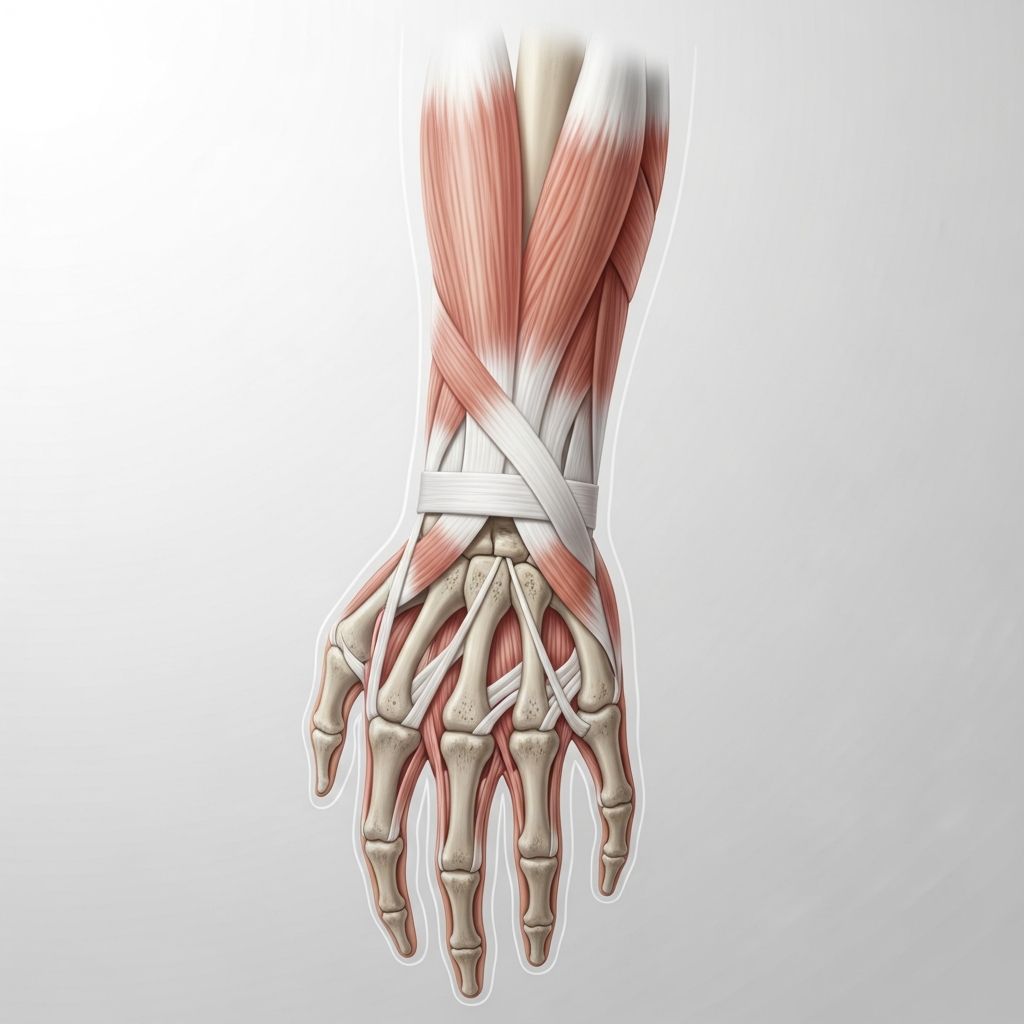
Your hands and wrists are remarkably complex structures that enable you to interact with the world around you every day. These sophisticated anatomical systems represent some of the most intricate biological engineering in the human body, comprising a carefully organized network of bones, muscles, nerves, tendons, ligaments, and blood vessels working in perfect coordination. The hand and wrist are probably the first body parts that come to mind when you think about your sense of touch. They help you perform everything throughout your day that involves touching, holding, or using something with your fingers.
Your wrist serves as the joint at the end of your forearm, functioning as a hinge between your arm and hand that allows you to reposition your hand in countless directions. Your hand begins where your wrist ends, encompassing your palm, fingers, and thumb. Together, these structures work seamlessly to provide both strength and precision, making them essential for daily functioning and quality of life.
The Skeletal Foundation: Bones of the Hand and Wrist
Bones provide the main structural support in your hand and wrist, giving them their shape and serving as anchors for other anatomical structures. Understanding the bone anatomy is fundamental to comprehending how your hand and wrist function.
Total Bone Count and Distribution
There are 27 bones total in each of your hands, distributed strategically throughout the hand and wrist to provide optimal support and flexibility. These bones are grouped together by their location and function, creating three main regions:
| Region | Bone Count | Description |
|---|---|---|
| Wrist (Carpal Bones) | 8 bones | Arranged in two rows for complex movement and rotation |
| Palm (Metacarpals) | 5 bones | Bridge between wrist and fingers, creating palm shape |
| Fingers & Thumb (Phalanges) | 14 bones | Enable gripping, pinching, and fine motor control |
Carpal Bones: The Wrist’s Complex Joint
Your wrist is a complex joint made of eight bones arranged into two distinct rows. The proximal row, located on the back of your hand closest to your forearm, includes the scaphoid, lunate, triquetrum, and pisiform bones. The distal row, positioned on the underside of your wrist closest to your palm, includes the trapezium, trapezoid, capitate, and hamate bones.
Your radius, the larger of the two bones in your forearm, forms a joint with your scaphoid and lunate bones to create the part of your wrist that enables movement and rotation. This connection allows your wrist to function as a versatile pivot point that can move in almost any direction as you reach and flex your hand.
The Carpal Tunnel
A particularly important anatomical feature is the carpal tunnel, a rounded space between your pisiform, hamate, scaphoid, and trapezium bones. This literal tunnel in your wrist lets nine tendons, four ligaments, and one nerve pass through to reach the rest of your hand. Think of the carpal tunnel like fiber optic cables buried underground to deliver internet or cable television service to your home—it’s a protective passageway for critical structures.
Related Stories



Muscular System: Strength and Dexterity
Muscles are soft tissue made of stretchy fiber, and they work in sophisticated coordination to give your hand its incredible strength and dexterity. There are 34 muscles in each of your hands, and healthcare providers categorize them into specific groups based on their location and function.
Intrinsic and Extrinsic Muscles
Intrinsic muscles are located inside your hand and work with extrinsic muscles near the outside of your hand and in your forearm. This collaborative system enables fine motor control and powerful gripping. The intrinsic muscles provide the precision needed for delicate tasks, while extrinsic muscles contribute the power for forceful gripping and manipulation.
Types of Grip
Your muscles and all their possible movements perform two types of grip. Precision grip involves using your thumb and fingers to hold objects with accuracy, essential for activities like writing or picking up small items. Power grip involves using your entire hand to grasp and hold larger or heavier objects with force.
Forearm Muscles
Your wrist shares muscles with your forearm, which includes flexor muscles that bend your wrist and fingers, and extensor muscles that straighten them. These forearm muscle groups work in coordination with hand muscles to provide comprehensive control of hand and wrist movements.
The Nervous System: Sensation and Control
Nerves control your muscles and help you feel and process sensations, including touch, temperature, and pain. Three main nerves give your hand and wrist sensation: the median nerve, the ulnar nerve, and the radial nerve. All three of these nerves are connected to many branches of smaller nerves that spread out into your hand and wrist, creating a comprehensive sensory network.
The median nerve is particularly important, running through the carpal tunnel where compression can lead to carpal tunnel syndrome. The ulnar nerve provides sensation to the pinky side of your hand, while the radial nerve supplies the thumb side. Together, these nerves enable the remarkable sensitivity that makes your hands so valuable for interacting with your environment.
Connective Tissues: Tendons and Ligaments
Tendons: Linking Muscles to Bones
Tendons link your muscles to your bones and function like strong, flexible ropes. Your hand and wrist have two groups of tendons. Flexor tendons bend your fingers and wrist, while extensor tendons straighten them. These tendons are organized within protective sheaths that keep them lubricated and allow them to slide smoothly without friction, enabling you to make a tight fist or extend your fingers with ease.
Ligaments: Providing Stability
Ligaments are the other type of connective tissue in your hand. If tendons are like ropes, ligaments are more like thick rubber bands. Their main functions include stabilizing joints, preventing excessive movement, and providing structural support. There are numerous ligaments throughout your hand, including the collateral ligaments that stabilize your finger joints.
Ligaments in your wrist include the scapholunate ligament, which connects the scaphoid and lunate bones, and the triangular fibrocartilage complex, which provides stability on the ulnar side of your wrist. The radial collateral ligament on the thumb side of the wrist starts on the outer edge of the radius on a small bump called the radial styloid.
Vascular System: Blood Supply and Circulation
Your hand and wrist receive blood from two primary arteries. The radial artery runs along your radius, positioned closer to your thumb, while the ulnar artery runs along your ulna, closer to your pinkie finger. These arteries communicate with each other in “arches” that form in your hand—there’s a superficial arch and a deep arch. Vessels branch off these arches and supply blood to your fingers, ensuring that every part of your hand receives adequate oxygen and nutrients for optimal function.
How It All Works Together: Integrated Function
Your hand and wrist are structured to allow you to move, flex, and rotate your wrist joint and to use your hand to grab and touch objects with precision. Think about your hand and wrist like a crane game at an arcade: your hand is the claw that grabs and holds prizes, and your wrist is the mechanical joint that lets the claw move up and down and side to side.
The parts that make up your hand and wrist are layered upon each other to form a three-dimensional shape that gives them the ability to move and function with remarkable versatility. This intricate coordination between bones, muscles, nerves, tendons, ligaments, and blood vessels creates a system capable of both powerful gripping and delicate precision.
Common Hand and Wrist Conditions
When any component of this complex system becomes damaged or dysfunctional, it can significantly impact your quality of life. Common conditions affecting the hand and wrist include arthritis, carpal tunnel syndrome, sports injuries, work-related injuries, and congenital disorders. When hand and wrist pain becomes disabling or persistent, it’s important to seek medical advice from a qualified healthcare provider who can properly diagnose and treat your condition.
If you experience hand or wrist pain, especially if it’s getting worse over time, talk to a healthcare provider for proper evaluation and treatment recommendations. Early intervention can often prevent more serious complications and restore optimal function.
Frequently Asked Questions
Q: How many bones are in the human hand?
A: There are 27 bones total in each hand, consisting of 8 carpal bones in the wrist, 5 metacarpal bones in the palm, and 14 phalanges (finger and thumb bones).
Q: What is the carpal tunnel?
A: The carpal tunnel is a rounded passageway formed by carpal bones and a ligament that allows nine tendons, four ligaments, and the median nerve to pass through to reach the rest of the hand. Compression of the median nerve in this tunnel can cause carpal tunnel syndrome.
Q: How many muscles are in the hand?
A: There are 34 muscles in each hand, categorized as intrinsic muscles located inside the hand and extrinsic muscles in the forearm that control hand and wrist movements.
Q: What are the three main nerves of the hand and wrist?
A: The three main nerves are the median nerve, ulnar nerve, and radial nerve. These nerves provide sensation and motor control to different regions of the hand and wrist.
Q: What is the difference between tendons and ligaments?
A: Tendons are fibrous cords that connect muscles to bones and enable movement, while ligaments connect bones to other bones and provide stability to joints.
Q: What blood vessels supply the hand?
A: The radial artery and ulnar artery supply blood to the hand, forming superficial and deep arches that branch off to supply blood to the fingers and tissues.
References
- Anatomy of the Hand & Wrist: Bones, Muscles & Ligaments — Cleveland Clinic. 2025. https://my.clevelandclinic.org/health/body/25060-anatomy-of-the-hand-and-wrist
- Radius (Bone): Anatomy, Location & Function — Cleveland Clinic. 2025. https://my.clevelandclinic.org/health/body/24528-radius
- What Are Metacarpals? — Cleveland Clinic. 2025. https://my.clevelandclinic.org/health/body/metacarpals-metacarpal-bones
- Median Nerve: What Is It, Branches, Anatomy & Function — Cleveland Clinic. 2025. https://my.clevelandclinic.org/health/body/21889-median-nerve
- Wrist X-Ray: Anatomy, Procedure & What to Expect — Cleveland Clinic. 2025. https://my.clevelandclinic.org/health/diagnostics/22328-wrist-x-ray
- Hand, Wrist, Elbow & Shoulder Surgery — Cleveland Clinic Department of Orthopaedics & Rheumatology. 2025. https://my.clevelandclinic.org/departments/orthopaedics-rheumatology/depts/hand-wrist-elbow-shoulder-surgery
Similar Articles








Read full bio of medha deb