Androgenic Alopecia In Transgender Men: Expert Guide
Exploring the impact of testosterone therapy on hair loss in transgender men and effective treatment strategies.
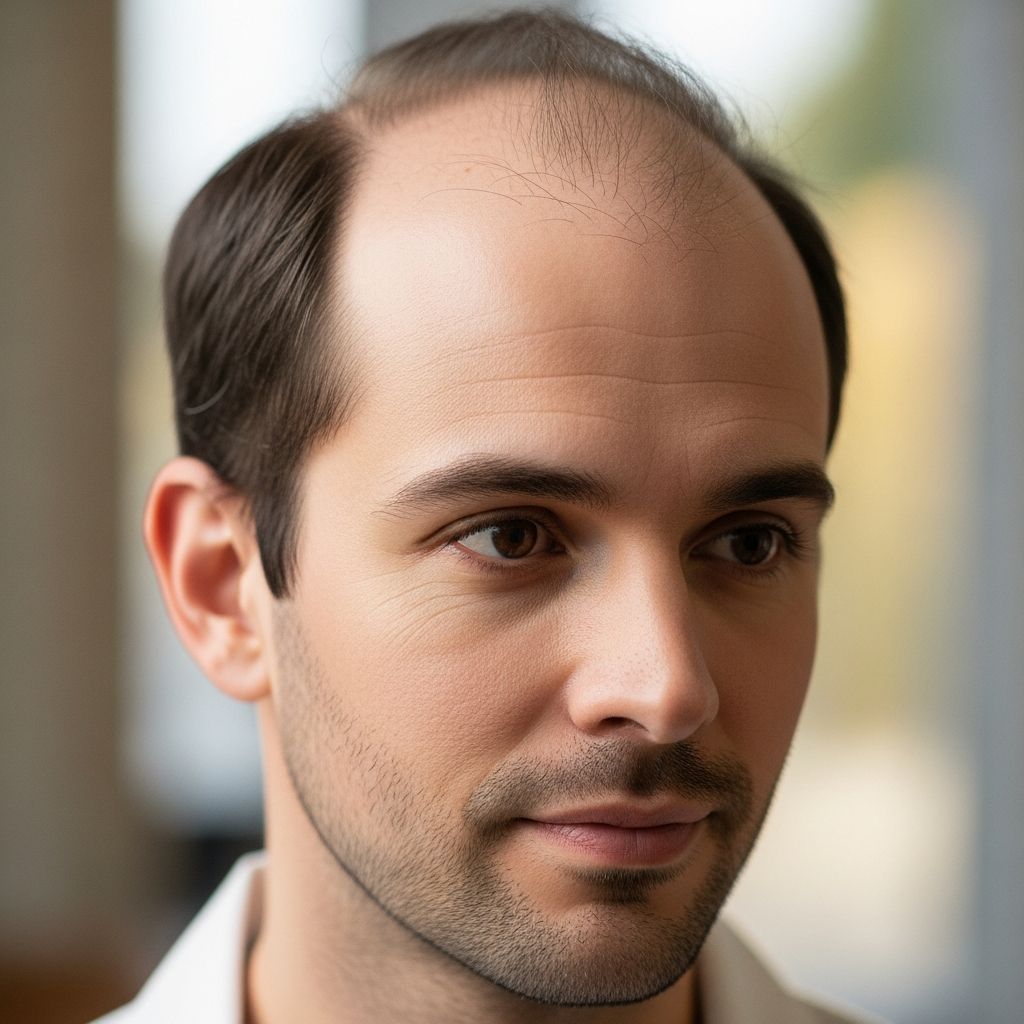
Androgenic alopecia, commonly known as male pattern baldness, is a frequent concern for transgender men undergoing masculinizing hormone therapy with testosterone. This condition arises from the interplay of genetics, hormones, and follicle sensitivity, accelerated by exogenous testosterone.
What is androgenic alopecia?
Androgenic alopecia (AGA) is the most prevalent form of hair loss, characterized by progressive thinning in androgen-sensitive scalp regions. It affects hair follicles via dihydrotestosterone (DHT), a potent metabolite of testosterone produced by the enzyme 5-alpha-reductase. Follicles miniaturize over time, shortening the anagen (growth) phase and extending telogen (resting), resulting in visible balding.
In cisgender men, AGA typically manifests post-puberty, with patterns including bitemporal recession, crown thinning, or diffuse loss. Transgender men on testosterone experience similar patterns, often accelerated due to supraphysiological hormone levels.
Who gets androgenic alopecia?
AGA has a strong genetic basis, with polygenic inheritance influencing follicle sensitivity to androgens. Family history, particularly paternal, is a key risk factor. In the general population, it impacts over 50% of men by age 50.
For transgender men (female-to-male, FTM), risk escalates with testosterone therapy. A study in the Journal of the American Academy of Dermatology reported AGA prevalence 2.5 times higher in trans men on masculinizing hormones compared to cisgender women, and 1.3 times higher than cisgender men. This is attributed to elevated testosterone converting to DHT, targeting genetically susceptible follicles.
- Key risk factors:
- Genetic predisposition (androgen-sensitive follicles)
- Testosterone hormone therapy duration and dosage
- Age at therapy initiation (earlier onset may accelerate loss)
- Pre-existing mild thinning or family history of baldness
- Smoking, stress, and poor scalp health as modifiers
History in transgender men
Hair loss often emerges 6-12 months after starting testosterone, coinciding with other masculinizing effects like voice deepening and body hair growth. Initial shedding may mimic telogen effluvium but transitions to patterned AGA.
Progression mirrors Norwood scale stages: starting with frontal recession, advancing to vertex thinning. Unlike cis men, trans men may note rapid onset due to higher DHT spikes from therapy. Untreated, it can reach advanced Norwood stages (IV-VI) within 5-10 years.
Clinical features
Classic signs include:
- M-shaped frontal hairline recession
- Circular thinning at the crown/vertex
- Increased scalp visibility in affected areas
- Preserved hair at occipital and temporal sides (stable zones)
- Fine, short vellus hairs replacing terminal scalp hair
Scalp may appear shiny from reduced follicle density. No significant inflammation or scarring occurs in pure AGA, distinguishing it from alopecia areata or scarring alopecias.
| Norwood Stage | Description | Prevalence in Trans Men on T |
|---|---|---|
| 1-2 | Mild recession | Early, 1-2 years |
| 3-4 | Moderate recession + vertex thinning | Common, 2-5 years |
| 5+ | Advanced balding | Long-term, 5+ years |
Diagnosis
Diagnosis relies on clinical history, examination, and exclusion of differentials. Key steps:
- History: Onset timing relative to testosterone start, family baldness, therapy details.
- Examination: Trichoscopy reveals yellow dots, perifollicular pigmentation, vellus hairs ratio >20%.
- Scalp biopsy (if atypical): Confirms follicle miniaturization, DHT effects.
- Exclusion: Thyroid issues, iron deficiency, medications.
No routine hormone levels needed if pattern is classic.
Related Stories



Treatment of androgenic alopecia in transgender men
Managing AGA in trans men balances hair preservation with gender-affirming goals. Testosterone continuation is prioritized; treatments target DHT locally or stimulate growth.
Minoxidil
Topical minoxidil 5% (once/twice daily) is first-line, FDA-approved for AGA. It vasodilates follicles, prolongs anagen, thickens hair. Efficacy: 40-60% stabilization/regrowth in 6-12 months. Safe with testosterone; no systemic anti-androgen effects.
- Pros: Over-the-counter, visible results in 3-6 months
- Cons: Shedding phase initially, lifelong use, scalp irritation
Finasteride and alternatives
Oral finasteride 1mg daily inhibits 5-alpha-reductase II, reducing scalp DHT by 60-70%. Effective but risks libido reduction, gynecomastia—concerning for trans men.
Preferred alternatives:
- Topical finasteride 0.25% (with/without minoxidil): Local DHT reduction, minimal systemic absorption, fewer side effects.
- Dutasteride mesotherapy: Blocks both reductase types (90% DHT drop), injected for targeted action.
Other options
- Low-level laser therapy (LLLT): FDA-cleared devices stimulate mitochondria, increase growth factors. Home use 3x/week.
- Oral minoxidil (low-dose): 2.5mg daily for transmasculine; hypertrichosis possible but effective.
- PRP therapy: Autologous plasma injections rich in growth factors; 3-6 sessions, hormone-neutral.
- Hair transplantation: FUE/FUT from stable donor areas once stabilized.
| Treatment | Mechanism | Suitability for Trans Men | Efficacy |
|---|---|---|---|
| Topical Minoxidil 5% | Vasodilation, anagen prolongation | High (first-line) | Moderate-High |
| Topical Finasteride | Local DHT inhibition | High (avoids systemic effects) | High |
| PRP | Growth factor stimulation | High (natural) | Moderate |
| LLLT | Photobiomodulation | High | Moderate |
Combination therapy
Best outcomes from multimodal approaches: minoxidil + topical finasteride + LLLT. Monitor every 3-6 months; adjust based on response.
Prevention
Early intervention key: Start minoxidil at testosterone initiation if family history present. Maintain scalp health (gentle shampoos, avoid traction). Ketoconazole shampoo may adjunctively reduce scalp DHT. Lifestyle: Quit smoking, balanced diet with biotin/iron.
Support resources
- World Professional Association for Transgender Health (WPATH): Guidelines on hormone-related side effects.
- American Academy of Dermatology (AAD): AGA resources.
- Trans-specific clinics (e.g., FOLX Health, UCSF Transcare): Integrated care.
- Support groups: r/ftm, TransHairLoss forums for peer experiences.
Frequently Asked Questions (FAQs)
Does testosterone always cause hair loss in trans men?
No, it depends on genetics. About 30-50% experience noticeable AGA, accelerated vs. cis men.
Can I stop testosterone to reverse hair loss?
Discontinuation may slow progression but won’t regrow lost hair; discuss with provider.
Is finasteride safe on testosterone?
Oral form risks feminizing sides; prefer topical to minimize interference.
How long until I see treatment results?
3-6 months for stabilization, 12+ for regrowth. Consistency essential.
Are hair transplants viable?
Yes, after 1-2 years stabilization; excellent for advanced cases.
References
- Gender Affirming Treatment Related Hair Loss — Medi Tresse. 2023. https://www.meditresse.com/womens-hair-loss-treatments/gender-affirming-treatment-related-hair-loss/
- Treatment of alopecia in transgender men — Centrum Kierach. 2024. https://centrumkierach.pl/en/treatment-of-alopecia-in-transgender-men/
- Androgenetic alopecia in transgender and gender diverse populations — PubMed (J Am Acad Dermatol). 2021-10-01. https://pubmed.ncbi.nlm.nih.gov/34756934/
- Hair Loss Considerations and Treatments for Transgender Patients — Medi Tresse. 2023. https://www.meditresse.com/blog/mtf-hairloss-ftm-hair-loss/
- Navigating The Complexities Of Transgender Hair & Hormones — Fulham Scalp Hair Clinic. 2024. https://fulhamscalphairclinic.com/news/navigating-the-complexities-of-transgender-hair-care-and-hormones/
- Overview of masculinizing hormone therapy — UCSF Transcare. 2023. https://transcare.ucsf.edu/guidelines/masculinizing-therapy
Similar Articles








Read full bio of medha deb