Angina Bullosa Haemorrhagica: Complete Guide For 2025
Benign oral blood blisters that rupture spontaneously, often triggered by trauma or hot foods, requiring no specific treatment.
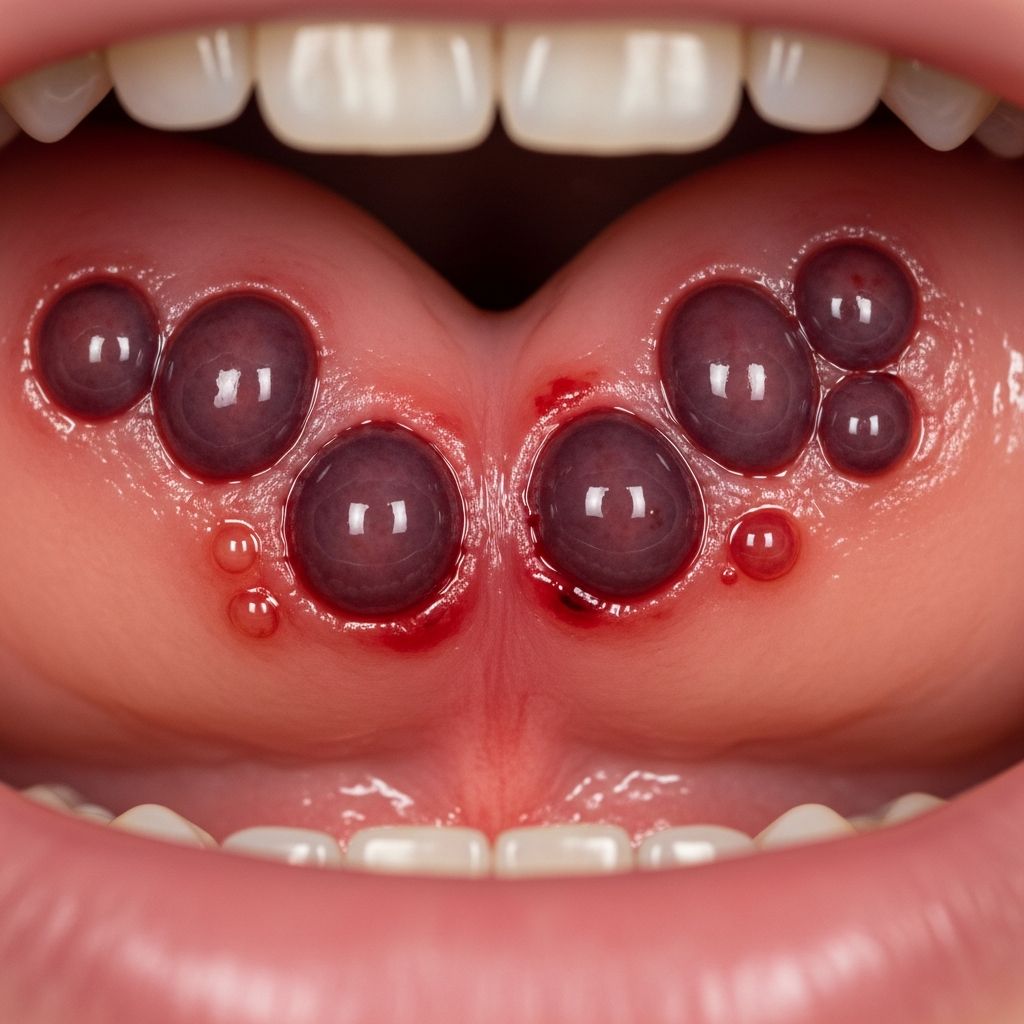
What is angina bullosa haemorrhagica?
Angina bullosa haemorrhagica (ABH) is a benign, underrecognized condition of the oral mucosa characterized by the sudden appearance of one or more blood-filled blisters (bullae) within the mouth. These lesions typically develop rapidly, often without significant pain, and contain blood as the primary fluid, distinguishing them from serous blisters. The term ‘angina’ refers to the sensation of discomfort or choking some patients experience, though it rarely leads to true airway obstruction.
ABH predominantly affects middle-aged and elderly adults, with a higher prevalence in those over 40 years. It is not associated with systemic diseases or haemostatic disorders in most cases, making it a diagnosis of exclusion. The blisters usually rupture spontaneously within hours to days, healing without scarring or complications. However, large bullae in the oropharynx can pose a risk of airway compromise if they fail to rupture promptly.
The condition was first described in the medical literature in the 1930s, but gained wider recognition in the 1980s through case series highlighting its idiopathic nature and traumatic triggers. Recent studies emphasize its self-limiting course, with recurrence possible in up to 30-50% of patients.
Who gets angina bullosa haemorrhagica?
ABH most commonly occurs in adults over the age of 40, with peak incidence in the 50-70 age group. There is no strong gender predilection, though some reports suggest a slight female predominance. Patients with type 2 diabetes mellitus, hypertension, or those using inhaled corticosteroids (e.g., for asthma) appear at higher risk, potentially due to mucosal fragility.
- Age: Primarily middle-aged to elderly (40+ years).
- Medical history: Diabetes, hypertension, long-term steroid inhaler use.
- Hereditary factors: Possible familial predisposition in rare cases.
- Prevalence: Exact incidence unknown; considered uncommon but likely underdiagnosed.
In younger patients, such as those in their 20s, ABH is rare but has been reported, often linked to diabetes or trauma. No racial or ethnic predispositions are established.
What causes angina bullosa haemorrhagica?
The precise aetiology of ABH remains idiopathic in approximately 50% of cases, with no identifiable trigger. However, local trauma is the most frequently implicated factor, accounting for 50-100% of attributable cases.
Common triggers include:
- Hot foods or beverages causing thermal injury to the mucosa.
- Hard or sharp foods (e.g., crisps, nuts) leading to mechanical trauma.
- Dental procedures: restorative work (fillings, crowns), periodontal therapy, or anaesthetic injections.
- Inhaled or topical corticosteroids, which may weaken mucosal integrity over time.
- Other associations: Diabetes-induced microvascular changes, hypertension-related vessel fragility.
Histologically, ABH involves subepithelial haemorrhage without significant inflammation, suggesting a localized vascular fragility rather than an immune-mediated process. No coagulopathy or platelet disorders are typically found on blood testing.
What are the clinical features of angina bullosa haemorrhagica?
Lesions appear abruptly, often during or immediately after eating. Patients may notice a ‘bubble’ or blister that feels tense and may cause mild discomfort, burning, or a choking sensation.
| Feature | Description |
|---|---|
| Appearance | Single or multiple domed, blood-filled blisters (1-3 cm diameter), dark red to purple. |
| Location | Soft palate (most common, 70-80%), oropharynx, buccal mucosa, tongue, gingivae. |
| Symptoms | Often asymptomatic; possible pain, dysphagia, or ‘angina-like’ suffocation feeling. |
| Duration | Ruptures within 1-24 hours; ulcer heals in 7-14 days without scarring. |
Related Stories



Rarely, large pharyngeal bullae can expand rapidly, risking airway obstruction, necessitating urgent drainage. Recurrence is common at new sites.
How is angina bullosa haemorrhagica diagnosed?
Diagnosis is clinical, based on characteristic history and appearance: sudden haemorrhagic bulla rupturing quickly without systemic signs. It is a diagnosis of exclusion.
- Blood tests: Full blood count, coagulation profile, glucose to rule out thrombocytopenia, coagulopathy, or diabetes.
- Biopsy: Rarely needed; shows subepithelial haemorrhage with red blood cells, minimal inflammation.
- Imaging: Flexible nasolaryngoscopy for pharyngeal lesions to assess airway patency.
Skin immunofluorescence may be considered if bullous diseases are suspected, but is typically negative in ABH.
What is the differential diagnosis for angina bullosa haemorrhagica?
Several conditions mimic ABH; differentiation relies on history, multiplicity, scarring, and systemic features.
- Mucous membrane pemphigoid: Recurrent blisters with scarring, positive immunofluorescence.
- Bullous pemphigoid: Widespread skin and mucosal blisters, autoantibodies.
- Epidermolysis bullosa: Trauma-induced blisters from birth, skin fragility.
- Dermatitis herpetiformis: Itchy vesicles, gluten sensitivity.
- Linear IgA disease: Tense blisters, IgA deposits on biopsy.
- Pemphigus vulgaris: Flaccid blisters, acantholysis.
- Oral amyloidosis: Macroglossia, systemic involvement.
- Haematological disorders: Leukemia, thrombocytopenia (abnormal bloods).
Unlike ABH, these often cause desquamative gingivitis or skin lesions.
What is the treatment for angina bullosa haemorrhagica?
Most cases require no treatment; blisters rupture spontaneously and heal uneventfully.
- Symptomatic relief: Analgesics (paracetamol), benzydamine mouthwash/spray (Difflam™) for pain.
- Antiseptic: Chlorhexidine gluconate (0.12-0.2%) mouthwash twice daily to prevent secondary infection.
- Urgent intervention: Incision and drainage for large, non-rupturing pharyngeal bullae to secure airway.
- Advice: Avoid hot/spicy/hard foods, soft diet during healing; reassure on benign prognosis.
Steroid gels or antibiotics are unnecessary unless infection occurs. Address risk factors like steroid inhaler technique.
What is the outcome for angina bullosa haemorrhagica?
Excellent prognosis: Complete healing without scarring in 1-2 weeks. Recurrence in 10-50% at new sites, unrelated to initial trigger. Rare complications include secondary infection or airway obstruction (soft palate/pharynx). Long-term follow-up unnecessary unless recurrent or atypical.
Frequently asked questions about angina bullosa haemorrhagica
Is angina bullosa haemorrhagica dangerous?
Rarely; most blisters rupture harmlessly. Large oropharyngeal ones may obstruct airway—seek urgent care if breathing difficulty occurs.
Does ABH indicate cancer or a blood disorder?
No; normal blood tests confirm. Biopsy rarely needed, shows no malignancy.
Can ABH recur?
Yes, in up to 50% of cases, often at different sites. Manage triggers.
Should I pop the blister myself?
Avoid if possible; it ruptures naturally. Use antiseptic rinse post-rupture.
Is treatment with antibiotics required?
No, unless infected (rare). Chlorhexidine suffices.
Related topics
- Bullous diseases of the oral mucosa
- Oral ulcers
- Mouth ulcers
References
- Angina bullosa haemorrhagica — DermNet NZ. 2021. https://dermnetnz.org/topics/angina-bullosa-haemorrhagica
- Angina bullosa haemorrhagica (oral blood blister) — University Hospitals Coventry & Warwickshire NHS Trust. 2020. https://www.uhcw.nhs.uk/download/clientfiles/files/Patient%20Information%20Leaflets/Surgical%20Services/Oral%20and%20Maxillo%20Facial/Angina%20bullosa%20haemorrhagica%20(oral%20blood%20blister).pdf
- Spontaneous oral hematoma diagnosed as angina bullosa hemorrhagica — Cleveland Clinic Journal of Medicine. 2021-11-01. https://www.ccjm.org/content/89/11/615
- Trauma-related oral lesions; Angina bullosa haemorrhagica — National Library of Medicine (PMC). 2022. https://pmc.ncbi.nlm.nih.gov/articles/PMC9641610/
- Angina bullosa haemorrhagica — Wikipedia (sourced from primary refs). 2023. https://en.wikipedia.org/wiki/Angina_bullosa_haemorrhagica
- Angina Bullosa Hemorrhagica — JMA Journal. 2022. https://www.jmaj.jp/detail.php?id=10.31662/jmaj.2022-0108
Similar Articles








Read full bio of medha deb