Angiofibroma Pathology: Histology, Syndromes, And Treatment Guide
Comprehensive pathology guide to angiofibromas: clinical features, histopathology, and syndromic associations in dermatology.
Author: Dr. Harriet Cheng, Dermatopathologist, Reviewed: Dr. Sujata Nikam, Dermatopathologist
Introduction
Angiofibromas, also known as fibrous papules, are benign dermal tumours characterised by a proliferation of thin-walled blood vessels and fibrous tissue. These lesions typically present as small, firm papules on the face, particularly the nose, and are common in middle-aged adults. While solitary angiofibromas are incidental findings, multiple lesions raise suspicion for underlying genetic syndromes such as tuberous sclerosis complex (TSC).
The pathology of angiofibromas reveals a distinctive ‘onion skin’ pattern of collagen fibres surrounding vascular structures and adnexal elements, distinguishing them from other papular lesions. This article delves into the histopathological features, clinical correlations, and syndromic associations of angiofibromas, providing a comprehensive resource for dermatologists and pathologists.
Clinical features
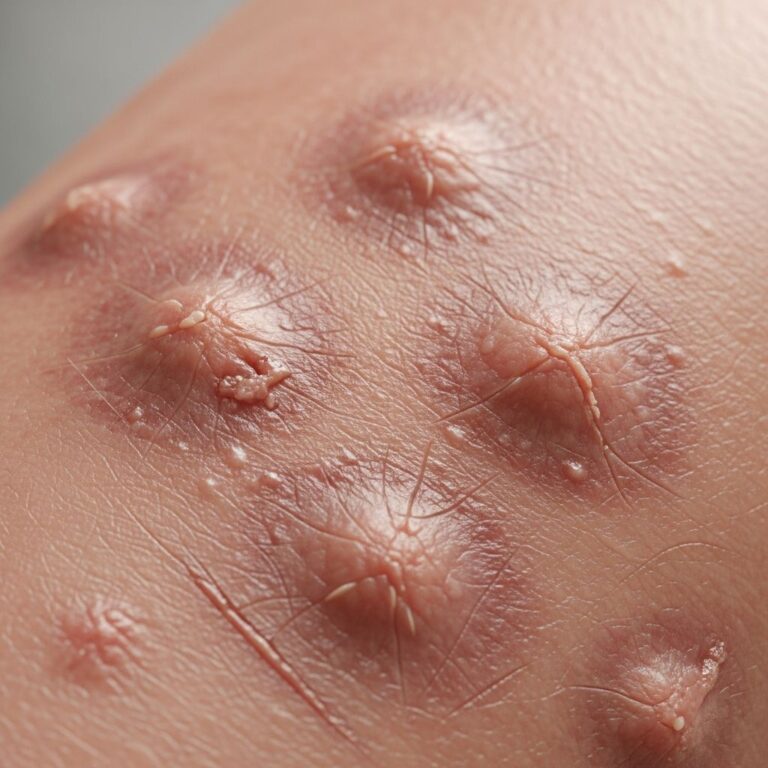
Angiofibromas manifest as asymptomatic, dome-shaped papules ranging from 1-5 mm in diameter. They are usually skin-coloured to red or pink, firm to the touch, and most frequently located on the nasal ala or other central facial areas. Solitary lesions are benign and require no intervention unless cosmetically bothersome.
Multiple facial angiofibromas, often appearing in childhood or adolescence, form a key diagnostic criterion for TSC, presenting as reddish papules in a malar distribution resembling acne. These may itch, bleed upon trauma, or cause psychosocial distress due to facial disfigurement. In TSC, they emerge between ages 2-5, evolving from flat red spots to thicker, fibrous nodules.
- Solitary angiofibroma: Single dome-shaped papule on nose, <5 mm, middle-aged adults.
- Multiple angiofibromas: Central face (nose, cheeks, chin), butterfly pattern in TSC.
- Syndromic features: Associated with TSC (major criterion), MEN1, Birt-Hogg-Dubé.
Pathogenesis
The pathogenesis of angiofibromas involves dysregulated fibroblast proliferation and abnormal vascular development within the dermis. In sporadic cases, the exact trigger remains unclear, but genetic syndromes provide insight through specific mutations.
In TSC, mutations in TSC1 (hamartin) or TSC2 (tuberin) genes lead to mTOR pathway hyperactivation, promoting unchecked cell growth in skin, brain, kidneys, and other organs. This results in fibrovascular lesions like angiofibromas, shagreen patches, and ungual fibromas. Similarly, MEN1 mutations affect menin protein, contributing to multiple endocrine neoplasia with cutaneous angiofibromas. Birt-Hogg-Dubé syndrome involves FLCN mutations, linking angiofibromas to renal tumours and lung cysts.
Histogenetically, angiofibromas derive from specialised fibroblasts around hair follicles and vessels, showing stellate or spindle morphology with collagen trapping.
Main locations
Angiofibromas predominantly affect the face, with over 90% occurring on the nose. Other sites include cheeks, chin, and perioral areas, especially in syndromic cases. Nasal cavity angiofibromas (juvenile nasopharyngeal) are distinct, aggressive tumours in adolescent males, causing epistaxis and obstruction.
| Location | Frequency | Associations |
|---|---|---|
| Nasal ala/bridge | Most common (solitary) | Sporadic fibrous papule |
| Malar cheeks, nasolabial folds | Common in multiples | TSC adenoma sebaceum |
| Chin, perioral | Less common | MEN1, BHD |
| Nasopharynx | Rare, juvenile type | Non-syndromic |
Syndromic associations
Multiple angiofibromas warrant systemic evaluation for genetic syndromes.
Tuberous sclerosis complex (TSC)
TSC is the most common association, where facial angiofibromas (adenoma sebaceum) are a major diagnostic criterion alongside hypomelanotic macules, shagreen patches, and ungual fibromas. Lesions appear early, progress with age, and may bleed during shaving. TSC affects multiple organs, necessitating neuroimaging, renal ultrasound, and genetic testing.
Related Stories



Multiple endocrine neoplasia type 1 (MEN1)
Angiofibromas in MEN1 are fewer than in TSC, accompanied by collagenomas, lipomas, and café-au-lait spots. Endocrine tumours (parathyroid, pituitary, pancreas) dominate, with genetic testing confirmatory.
Birt-Hogg-Dubé syndrome (BHD)
Rarely, angiofibromas associate with fibrofolliculomas and trichodiscomas in BHD, featuring renal cancers and pneumothoraces.
Differential diagnosis
Solitary angiofibromas mimic basal cell carcinoma, intradermal naevus, or pyogenic granuloma. Multiple lesions differential includes acne vulgaris, rosacea, trichoepithelioma, or folliculitis.
- Acne: Comedones, inflammation absent in angiofibromas.
- Basal cell carcinoma: Pearly border, telangiectasia; biopsy differentiates.
- Other papules: Syringoma (translucent), sebaceous hyperplasia (central dell).
In children, TSC angiofibromas must be distinguished from early acne.
Pathology
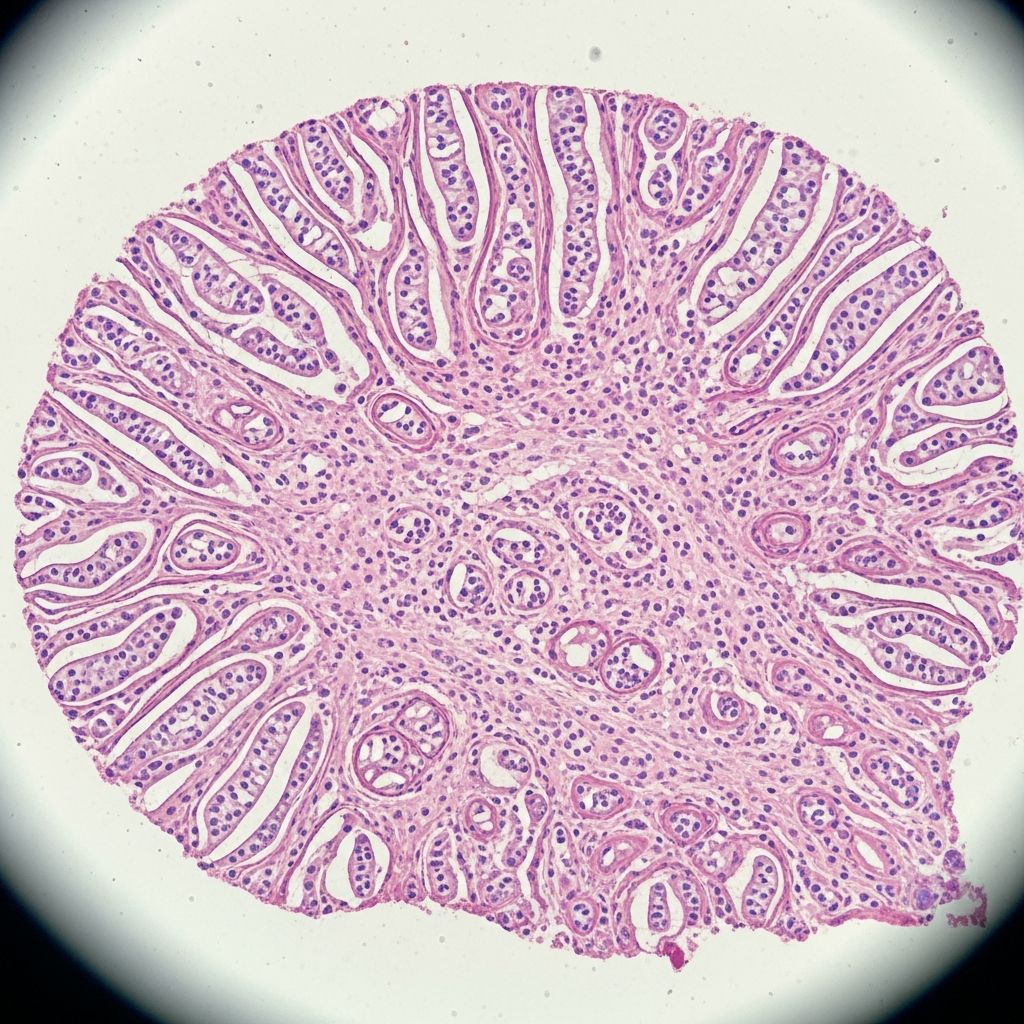
Histopathology is diagnostic, showing a well-circumscribed dermal nodule of spindle and stellate fibroblasts amid coarse collagen bundles. Dilated, thin-walled vessels exhibit perivascular ‘onion skin’ collagen whorling.
Epidermis is acanthotic with hyperkeratosis and flattened rete ridges; melanocytic hyperplasia may occur. No atypia or mitoses; occasional multinucleate fibroblasts and lymphocytes.
- Low power: Dome-shaped papule, fibrovascular stroma.
- Medium power: Stellate cells, hyalinized collagen trapping.
- High power: Onion-skin vessels, CD34+ fibroblasts.
Histopathology images
(Description: Low-power view shows expanded dermis with vascular proliferation and fibrous bands. High-power reveals concentric collagen around ectatic vessels.)
Histological variants
Variants include hypercellular (pleomorphic fibroblasts), hyalinized (CD34+ stellate cells), and epithelioid types, all sharing fibrovascular cores. TSC lesions show more inflammation and follicular involvement.
Electron microscopy
Ultrastructurally, fibroblasts contain prominent rough endoplasmic reticulum, confirming synthetic activity; vessels show continuous basal lamina without atypia.
Immunohistochemistry
Key markers: CD34 and factor XIIIa positive in stromal cells; vessels highlight with CD31/34; negative for S100, SMA, desmin. Fascin and podoplanin may accentuate variants.
| Marker | Pattern | Utility |
|---|---|---|
| CD34 | Stellate fibroblasts, vessels | Highlights stroma |
| Factor XIIIa | Dermal dendrocytes | Supports fibrohistiocytic nature |
| CD31 | Endothelium | Vascular delineation |
Treatment
Solitary lesions may be excised, electrocauterized, or lasered for cosmesis. TSC angiofibromas respond to topical mTOR inhibitors (sirolimus), timolol, or pulsed dye/vascular lasers. Podophyllin 25% applied monthly showed clearance in cases.
- Laser: PDL for vascular component.
- Topical: Rapamycin cream reduces size.
- Surgical: Shave excision, curettage.
Frequently asked questions
Are angiofibromas cancerous?
No, angiofibromas are benign with no malignant potential.
Do angiofibromas in children indicate TSC?
Multiple facial angiofibromas before age 5 are a major TSC criterion; evaluate systemically.
Can angiofibromas be removed permanently?
Treatment reduces appearance, but recurrence is possible, especially in syndromes; lasers offer good cosmesis.
How is angiofibroma diagnosed?
Clinically for solitary; biopsy confirms with onion-skin vessels. Syndrome workup for multiples.
What syndromes link to angiofibromas?
TSC, MEN1, Birt-Hogg-Dubé; screen for organ involvement.
References
- How TSC Affects the Skin — Mass General Hospital. 2023. https://www.massgeneral.org/neurology/tsc/patient-education/how-tsc-affects-skin
- Angiofibroma: Types, Appearances and Causes — DermNet NZ. 2024. https://dermnetnz.org/topics/angiofibroma
- Angiofibroma — Dermatology Advisor. 2024. https://www.dermatologyadvisor.com/home/decision-support-in-medicine/dermatology/angiofibroma/
- Angiofibromas Treatment — Palmdale Dermatology. 2023. https://palmdaledermatology.com/medical-dermatology/angiofibromas/
- Fibrous Papule of the Nose — Cleveland Clinic. 2024. https://my.clevelandclinic.org/health/diseases/fibrous-papule-of-the-nose
- Angiofibroma — Toronto Dermatology Centre. 2023. https://torontodermatologycentre.com/angiofibroma/
Similar Articles








Read full bio of Sneha Tete