Angiokeratoma: Causes, Signs, Diagnosis, Treatment 2025
Benign vascular skin lesions: types, causes, diagnosis, and management of angiokeratomas.
What is angiokeratoma?
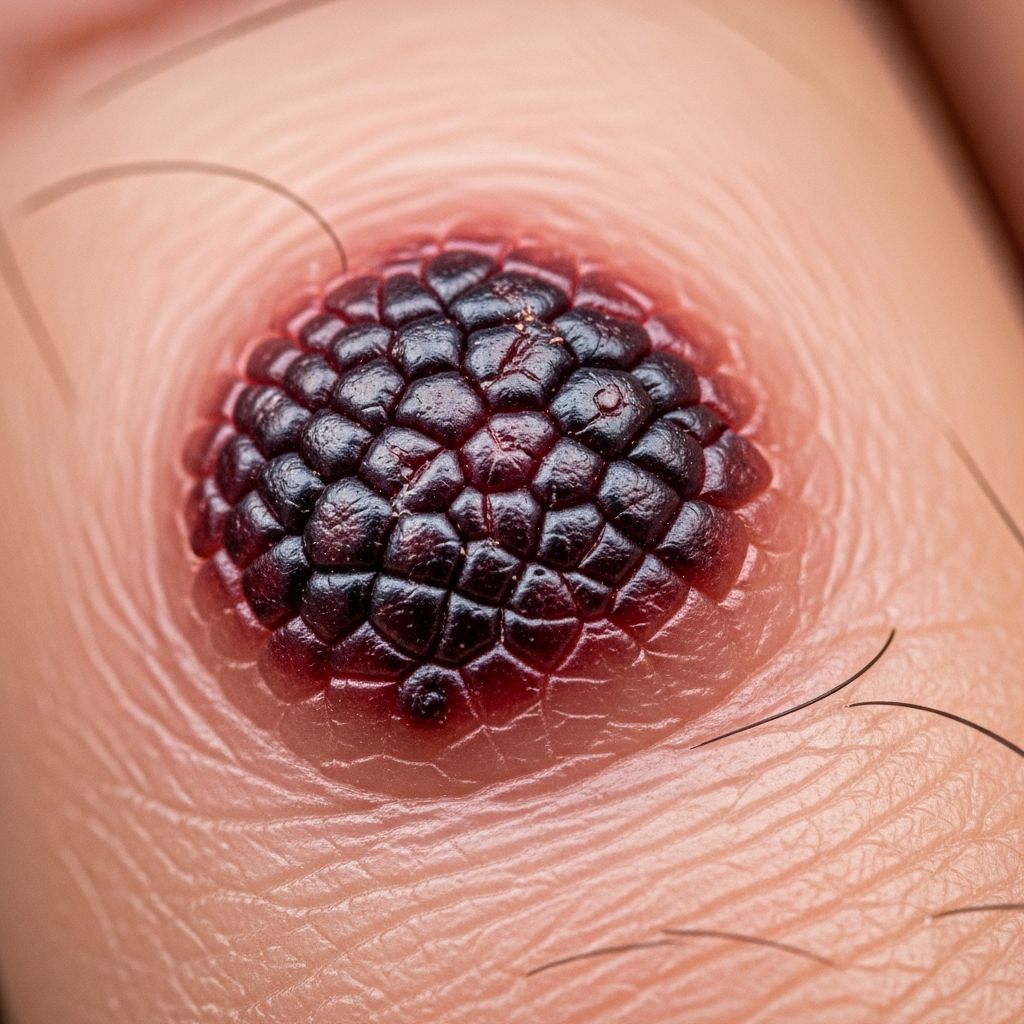
Angiokeratoma encompasses a spectrum of benign skin lesions characterised by superficial ectatic dermal blood vessels with overlying epidermal acanthosis and hyperkeratosis, resulting in a warty or verrucous surface. These lesions arise from dilation of capillaries in the papillary dermis, often accompanied by thrombosis or haemorrhage, leading to their distinctive dark red, purple, or black appearance. While typically asymptomatic and harmless, angiokeratomas can bleed easily upon trauma and may mimic more serious conditions such as melanoma or genital warts.
The term ‘angiokeratoma’ reflects the dual pathology: ‘angio’ denoting the vascular component and ‘keratoma’ the hyperkeratotic epidermis. Lesions vary in size from 1-5 mm, presenting as small papules, plaques, or clusters with a rough, scaly surface. They do not resolve spontaneously and may darken or become more verrucous over time. Prevalence increases with age, particularly in types like angiokeratoma of Fordyce on genital skin.
Who gets angiokeratoma?
Angiokeratomas affect individuals across all ages and skin types, though certain subtypes have specific demographics. Angiokeratoma of Fordyce predominantly occurs in men over 50 years, presenting on the scrotum, though it can appear on the vulva in women. It is often multiple and bilateral.
Angiokeratoma corporis diffusum is linked to Fabry disease, a rare X-linked lysosomal storage disorder due to alpha-galactosidase A deficiency, primarily affecting males but females can be carriers with milder symptoms. Other rare associations include fucosidosis and sialidosis. Angiokeratoma circumscriptum typically manifests at birth or early childhood, often solitary or localised to the lower limbs.
In darker skin types, lesions may appear less conspicuous due to hyperpigmentation. Risk factors include advancing age, venous hypertension in solitary forms, and genetic mutations in systemic types.
What causes angiokeratoma?
Pathogenesis varies by subtype. In most cases, angiokeratomas result from ectasia of superficial dermal vessels secondary to chronic venous stasis, trauma, or unknown factors. The overlying epidermis reacts with acanthosis (thickening) and hyperkeratosis, forming the characteristic warty surface.
In angiokeratoma corporis diffusum due to Fabry disease, globotriaosylceramide (Gb3) accumulation in lysosomes damages vascular endothelium, leading to widespread ectasia, particularly in the ‘bathing trunk’ distribution (abdomen, buttocks, thighs). Similar lysosomal dysfunction occurs in other storage disorders.
Solitary angiokeratomas may arise from local trauma or vascular malformation. No malignant potential exists, but lesions can thrombose, causing pain.
What are the clinical features of angiokeratoma?
Angiokeratomas present as 1-5 mm dark red, purple, blue, or black papules with a rough, verrucous surface, often resembling warts. They may occur singly or in clusters and are usually asymptomatic but prone to bleeding on minor trauma.
- Size and shape: Dome-shaped or flat-topped; jagged or warty contours.
- Colour: Fresh lesions red; older ones darken to purple/black due to thrombosis.
- Surface: Hyperkeratotic, scaly; may itch or burn rarely.
- Distribution: Varies by type (see below).
Related Stories



In genital areas (Fordyce), scrotal lesions may show diffuse erythema and bleed profusely. Systemic types accompany Fabry symptoms like acroparesthesia, anhidrosis, renal failure.
Skin biopsy pathology
Histology reveals dilated thin-walled vessels in the superficial dermis with epidermal acanthosis, papillomatosis, and hyperkeratosis. Thrombosis, haemorrhage, or vacuolated keratinocytes may be seen in Fabry-associated cases.
Types of angiokeratoma
Several subtypes exist based on distribution and associations:
| Type | Location | Features | Associations |
|---|---|---|---|
| Angiokeratoma of Fordyce | Scrotum, vulva | Multiple, bilateral, post-50s | None |
| Angiokeratoma corporis diffusum | Bathing trunk area | Clusters, symmetric | Fabry disease, lysosomal disorders |
| Angiokeratoma circumscriptum | Lower limbs, solitary/plaque | Congenital/progressive | None |
| Angiokeratoma of Mibelli | Extremities, acral | Children/adolescents, painful | None |
| Solitary angiokeratoma | Legs, any site | Single lesion | Trauma/venous insufficiency |
Angiokeratoma of Fordyce: Commonest genital type, resembling warts. Corporis diffusum: Hallmark of Fabry. Others rarer.
Diagnosis of angiokeratoma
Diagnosis is clinical based on characteristic morphology, supported by dermoscopy showing red lacunae with hyperkeratosis. Biopsy confirms via vascular ectasia and epidermal changes; essential to exclude melanoma.
For suspected Fabry, measure alpha-galactosidase A activity (males) or GLA gene analysis. Dried blood spot testing screens efficiently. Lesions mimic warts, melanoma, or haemangiomas.
What is the treatment for angiokeratoma?
Most require no treatment as benign. Indications: bleeding, cosmetics, symptoms.
- Physical treatments: Cryotherapy (freezing), electrocautery/ED&C, pulsed dye/vascular laser (e.g., for clusters).
- Surgical: Excision for solitary/suspicious lesions.
- Fabry-specific: Enzyme replacement (agalsidase beta), chaperone therapy (migalastat), pain management (gabapentin).
- Emerging: Topical sirolimus for APACHE variant.
Treatments carry scarring risk; lasers preferred for cosmetics. No spontaneous resolution.
Complications of angiokeratoma
- Bleeding/erosion from trauma.
- Thrombosis causing pain.
- Cosmetic distress, anxiety.
- Fabry progression: renal/heart disease.
Prevention of angiokeratoma
No specific prevention; avoid trauma to genital/lower limb skin. Early Fabry screening in families.
Related topics
- Fabry disease
- Vascular malformations
- Genital warts
- Melanoma
Frequently asked questions
Are angiokeratomas dangerous?
No, benign; rarely indicate Fabry disease needing management.
Do angiokeratomas go away?
No, persistent; may worsen.
Can angiokeratomas be removed?
Yes, via laser, cryo, cautery if symptomatic/cosmetic.
Is angiokeratoma contagious?
No, not an STI despite genital resemblance.
How is Fabry disease diagnosed?
Enzyme assay/GLA gene test.
References
- Angiokeratoma: Of Fordyce, Treatment, Causes, Pregnancy, and More — Healthline. 2023. https://www.healthline.com/health/angiokeratoma
- Angiokeratoma: Types and Appearances — DermNet NZ. 2024. https://dermnetnz.org/topics/angiokeratoma
- Angiokeratoma — Cleveland Clinic. 2024. https://my.clevelandclinic.org/health/diseases/23278-angiokeratoma
Similar Articles








Read full bio of Sneha Tete