Angioleiomyoma Pathology: 3 Subtypes And Management Guide
Detailed histological analysis of angioleiomyoma, a rare benign smooth muscle tumour from vascular walls.
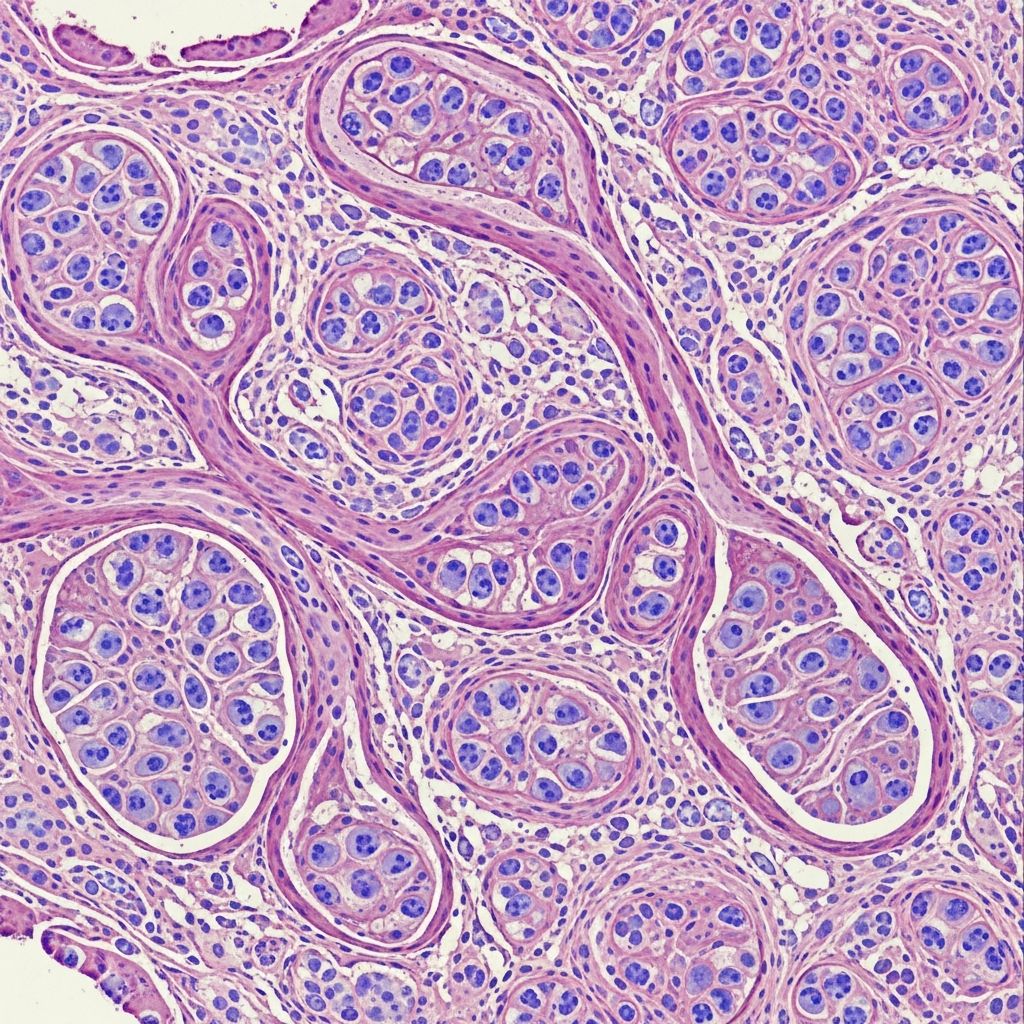
Angioleiomyoma, also known as vascular leiomyoma or angiomyoma, is a rare benign neoplasm originating from the smooth muscle cells of blood vessel walls, specifically the tunica media. This subcutaneous or dermal tumour is characterized by interlacing bundles of smooth muscle surrounding vascular channels, often presenting as a painful nodule in adults.
Introduction
Angioleiomyoma represents approximately 25% of all superficial leiomyomas and arises from the vascular smooth muscle. It is an uncommon entity, accounting for a notable subset of benign soft tissue tumours as per World Health Organization classifications, with an incidence around 74% among specific leiomyoma variants. These tumours are typically solitary, well-circumscribed, and measure less than 2 cm in diameter. They commonly affect individuals between 30 and 60 years of age, showing a female predominance, particularly in the lower extremities, while males more often present with lesions on the head, neck, or upper extremities.
Clinically, angioleiomyomas manifest as firm, mobile, tender nodules that may appear bluish, purple, reddish, or skin-coloured. Pain is a hallmark feature, reported in 45-70% of cases, attributed to nerve entrapment within the tumour or vascular contraction leading to local ischemia. Lesions may increase in size with physical activity, especially in the extremities. Although generally benign, malignant transformation to leiomyosarcoma is exceptionally rare, occurring in about 7% of soft tissue sarcomas derived from such origins.
Histopathological examination is crucial for definitive diagnosis, as preoperative clinical differentiation from other nodular lesions is challenging. Ultrasound or MRI may aid in preoperative assessment, revealing a well-defined mass. Complete surgical excision is curative, with low recurrence rates due to the tumour’s circumscribed nature.
Clinical Features
Angioleiomyomas predominantly occur in the dermis or subcutis of the lower legs in women and upper extremities or head/neck in men. Peak incidence is in the 40-60 age group, though cases span all ages. The tumour presents as a slowly growing, painful subcutaneous nodule, often exacerbated by cold or pressure. Subtypes include:
- Venous type (most common, ~67%): Solid smooth muscle with slit-like vascular lumina.
- Cavernous type (~11%): Dilated vascular spaces with thin muscular walls, more common in upper extremities or head.
- Solid type: Dense smooth muscle with compressed vessels.
These subtypes lack distinct clinical correlations but influence histological appearance. Pain mechanisms involve perineural entrapment or mast cell mediator release. Multiple lesions are rare, unlike piloleiomyomas.
Histology
At low magnification, angioleiomyoma appears as a well-circumscribed dermal or subcutaneous nodule composed of densely packed, interlacing bundles of mature smooth muscle cells radiating around central vascular channels (Figure 1). The vessels have thick, hyalinized walls, with smooth muscle fascicles extending peripherally in a concentric or whorled pattern.
Higher power reveals uniform spindle cells with abundant eosinophilic cytoplasm, elongated blunt-ended nuclei, and minimal atypia or mitoses. Vascular lumina are often compressed or slit-like in the venous and solid subtypes, while cavernous variants show ectatic spaces. No necrosis or significant pleomorphism is seen, distinguishing it from malignancy.
Macroscopically, the lesion is a tan-white, firm nodule, sometimes with a thin rim of adipose tissue, easily shelled out during excision. Intralesional fibrin thrombi or entrapped nerves may be evident, explaining paroxysmal pain.
Related Stories





Special Studies
Immunohistochemistry confirms the diagnosis with strong positivity for smooth muscle markers: smooth muscle actin (SMA) and desmin (Figure 4). SMA highlights the vascular walls and surrounding muscle bundles vividly. H-caldesmon may also be positive, supporting smooth muscle differentiation. Tumour cells are negative for desmoplakin, S100, or HMB45, aiding differentiation from neural or adipocytic lesions.
Electron microscopy, if performed, shows smooth muscle features like pinocytotic vesicles, dense bodies, and external lamina. No specific genetic abnormalities are identified, consistent with its hamartomatous or reactive nature in some views, though neoplastic origin is accepted.

Differential Diagnoses
Angioleiomyoma must be distinguished from other painful subcutaneous nodules. Key differentials include:
| Entity | Key Features | Distinguishing Immunohistochemistry |
|---|---|---|
| Myopericytoma | Perivascular myoid cells with onion-skinning; more cellular, less organized vessels | Positive for SMA; lacks prominent thick-walled vessels |
| Leiomyoma (piloleiomyoma) | Arises from arrector pili; less vascular component | SMA+, desmin+; no central vessels |
| Angiolipoma | Mature fat with capillary proliferation; often multiple | CD34+ capillaries; fat present |
| Leiomyosarcoma | Atypia, mitoses >5/10 HPF, necrosis | SMA+ but with Ki67 proliferation |
| Glomus tumour | Small round cells around capillaries; painful | SMA+, collagen type IV+ |
Intracranial or oral lesions require separation from haemangioma, mucocoele, or arteriovenous malformations. Clinical history of pain and leg predominance favours angioleiomyoma over lipomas or cysts.
Management and Prognosis
Surgical excision is the treatment of choice, with excellent outcomes and minimal morbidity. The circumscribed nature allows complete removal. Recurrence is rare unless incomplete excision occurs. Pain relief is prompt post-excision. For unresectable or multiple lesions (rare), calcium channel blockers like nifedipine may alleviate symptoms, borrowed from cutaneous leiomyoma management. Malignant transformation warrants wide excision and oncological follow-up.
Frequently Asked Questions (FAQs)
What causes angioleiomyoma?
The exact aetiology is unknown, but it arises from vascular smooth muscle proliferation, possibly reactive or neoplastic without specific genetic drivers.
Is angioleiomyoma painful?
Yes, in 45-70% of cases due to nerve compression or vascular spasm.
How is it diagnosed?
By histopathology post-excision; IHC with SMA confirms smooth muscle origin.
Does it recur?
Rarely, if completely excised; recurrence rate low (~5%).
Can it become cancerous?
Extremely rare (<1%); monitor for rapid growth or atypia.
What are treatment options?
Surgical excision is curative; symptomatic relief with nifedipine if needed.
References
- Angioleiomyoma pathology — DermNet NZ (Dr Ben Tallon). 2016-12. https://dermnetnz.org/topics/angioleiomyoma-pathology
- Angioleiomyoma: Clinicopathological Study — Journal of Clinical Images and Medical Case Reports (Anubha Bajaj). 2020. https://jcimcr.org/articles/JCIMCR-v1-1003.html
- Angioleiomyoma: a clinical, pathological and radiological review — PubMed (NCBI). 2004-07-26. https://pubmed.ncbi.nlm.nih.gov/15311559/
- Angioleiomyoma — Basic Medical Key (Cyril Fisher). N/A. https://basicmedicalkey.com/angioleiomyoma/
- Leiomyoma — DermNet NZ. N/A. https://dermnetnz.org/topics/leiomyoma
Similar Articles








Read full bio of medha deb