Angiosarcoma: Guide To Causes, Diagnosis, And Treatment In 2025
Rare aggressive vascular cancer affecting skin and soft tissues: symptoms, causes, diagnosis, and treatment options.
What is angiosarcoma?
Angiosarcoma is a rare and aggressive malignant tumour originating from endothelial cells lining blood or lymphatic vessels. It belongs to the sarcoma family of cancers, which arise from connective tissues, and represents less than 2% of all sarcomas. These tumours can develop in any organ but are most frequently found in the skin and soft tissues, particularly the scalp and face in older adults. Cutaneous angiosarcoma, the skin form, often presents insidiously as bruise-like patches that fail to resolve, making early recognition challenging. Despite advances in multimodal therapy, prognosis remains poor due to high rates of local recurrence and distant metastasis, with 5-year survival rates typically ranging from 10-35% depending on stage and location.
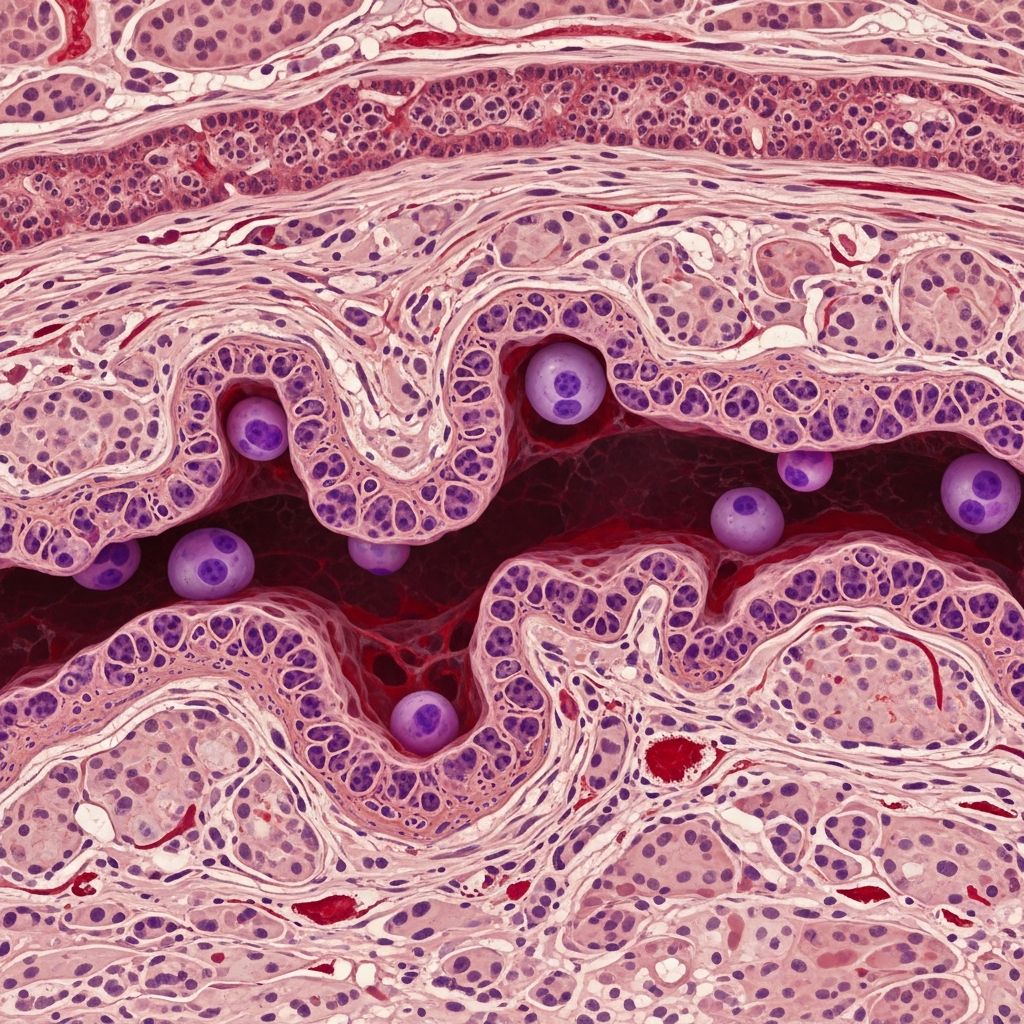
Angiosarcomas are histologically characterized by irregular vascular channels lined by atypical endothelial cells, often showing high mitotic activity and necrosis. They exhibit multifocal growth patterns, infiltrating widely before becoming clinically apparent, which complicates complete surgical resection.
Who gets angiosarcoma?
Angiosarcoma predominantly affects individuals over 60 years of age, with a male predominance (2:1 ratio). Incidence is approximately 2 cases per million people annually, underscoring its rarity. Cutaneous forms are almost exclusively seen in elderly Caucasians on sun-exposed areas like the scalp, forehead, or upper face.
Risk factors include:
- Prior radiation therapy: Secondary angiosarcomas arise 5-10 years post-radiotherapy, commonly in breast tissue after conservative surgery for breast cancer.
- Chronic lymphedema: Stewart-Treves syndrome describes angiosarcoma developing in long-standing lymphedema, often post-mastectomy.
- Chemical exposure: Vinyl chloride exposure links to hepatic angiosarcoma; thorotrast (historical contrast agent) also implicated.
- Genetic predispositions: Rare associations with neurofibromatosis type 1 or familial syndromes.
- Immunosuppression: Increased risk in transplant recipients or HIV patients.
What causes angiosarcoma?
The precise aetiology remains unclear, but cytogenetic studies reveal complex karyotypes with MYC gene amplification in up to 100% of radiation-associated cases and 40% of primary cutaneous angiosarcomas. UV radiation likely contributes to primary scalp lesions via p53 mutations. Chronic inflammation and lymphatic stasis in lymphedema promote angiogenesis dysregulation, fostering malignant transformation.
Pathogenesis involves aberrant VEGF signaling and endothelial proliferation, leading to disorganized vessel formation. Hepatic forms correlate strongly with environmental toxins disrupting hepatic sinusoidal endothelium.
What are the clinical features of angiosarcoma?
Clinical presentation varies by site but shares aggressive behaviour.
Cutaneous angiosarcoma
Most common form (60% of cases), typically on scalp/forehead. Initial lesions mimic bruises, ecchymoses, or telangiectasias—ill-defined violaceous patches or plaques that slowly expand. Progression yields nodular thickening, ulceration, bleeding, and satellite lesions, often spanning large areas by diagnosis. Painless initially but may become tender.
- Bruise-like purple/red macules/patches
- Telangiectatic mats
- Firm nodules or plaques
- Areas of haemorrhage or necrosis
- Lymphoedema in advanced disease
Breast angiosarcoma
Post-radiation or primary. Presents as rapidly growing, tender mass with peau d’orange, erythema, or diffuse thickening. May ulcerate.
Other sites
- Deep soft tissue: Painless enlarging mass, e.g., thigh or retroperitoneum.
- Visceral: Liver (abdominal pain, jaundice); heart (pericardial effusion, arrhythmias); bone (pathological fractures).
Systemic symptoms like weight loss or fatigue indicate metastasis.
Diagnosis of angiosarcoma
Diagnosis requires high clinical suspicion given nonspecific early features. Steps include:
- History and examination: Assess risk factors, lesion evolution, multifocality.
- Biopsy: Essential. Punch, incisional, or excisional biopsy from indurated edge. Avoid central necrosis.
- Histopathology: Slit-like vascular channels dissecting collagen, lined by hobnail endothelial cells with atypia, mitoses, necrosis. Immunohistochemistry: CD31+, CD34+, ERG+, FLI-1+; Ki-67 high proliferation index.
- Imaging: MRI for local extent/soft tissue; CT/PET-CT for staging/metastases; mammography/ultrasound for breast.
- Staging: AJCC system considers size, depth, lymphovascular invasion, nodes, metastases.
Related Stories



| Stage | Criteria | 5-Year Survival |
|---|---|---|
| IA | <5cm, superficial, no nodes/met | ~50% |
| III | Any size, skin involvement beyond 5cm | ~20% |
| IV | Metastatic | <10% |
Treatment of angiosarcoma
No standardized protocol due to rarity; multidisciplinary approach essential. Treatment hinges on site, size, stage, patient fitness.
Surgery
Mainstay for localized disease. Wide local excision (WLE) with 2-3cm margins preferred, but multifocality often precludes clear margins. Mohs micrographic surgery (MMS) emerging for head/neck to maximize clearance while preserving cosmesis.
- Scalp: Often requires extensive resection, reconstruction.
- Extremities: Amputation rare, if unresectable.
- Breast: Mastectomy for post-radiation cases.
Radiotherapy
Adjuvant post-resection improves local control (reduces recurrence from 70% to 40%). Definitive RT for inoperable tumours, hypofractionated regimens (e.g., 60-70Gy). Challenges: scalp dose constraints.
Systemic therapy
For advanced/metastatic disease or unresectable locals.
- Chemotherapy: First-line: Weekly paclitaxel (anti-angiogenic, response rates 40-60%, median PFS 6 months). Alternatives: doxorubicin, gemcitabine/docetaxel.
- Targeted therapy: Pazopanib (VEGF/PDGFR inhibitor), sorafenib.
- Immunotherapy: Promising; pembrolizumab for PD-L1+ tumours (case reports show responses).
What is the prognosis for angiosarcoma?
Poor overall; scalp/face worst (12-25% 5-year survival) due to late detection, extensive subclinical spread. Smaller (<5cm), superficial tumours fare better (~50%). Metastases (lungs, liver, nodes) at diagnosis in 30-50%; median survival 1-2 years for metastatic disease. Multimodal therapy improves local control but distant failure common.
Emerging therapies and clinical trials
Ongoing trials explore immunotherapy (anti-PD-1/PD-L1), anti-angiogenics (bevacizumab), and MYC-targeted agents. Beta-blockers (propranolol) show anecdotal benefit in lymphedema-associated cases.
Frequently asked questions
What does angiosarcoma look like on the skin?
Often bruise-like violaceous patches on scalp, progressing to nodules/ulcers.
Is angiosarcoma hereditary?
Rarely; mostly sporadic, linked to radiation/chemicals.
Can angiosarcoma be cured?
Possible in early localized cases with aggressive surgery/RT; advanced incurable.
How quickly does angiosarcoma spread?
Rapidly; local recurrence in months, metastases within 1 year.
What is the best treatment for scalp angiosarcoma?
Wide excision + adjuvant RT; systemic therapy for advanced.
References
- Angiosarcoma: Symptoms, Diagnosis, Treatment & FAQs — Allegheny Health Network. 2024. https://www.ahn.org/services/cancer/types/angiosarcoma
- Angiosarcoma – DermNet — DermNet NZ. 2024. https://dermnetnz.org/topics/angiosarcoma
- Cutaneous angiosarcoma: A review of current evidence for immunotherapy — NIH/PMC. 2023-03-15. https://pmc.ncbi.nlm.nih.gov/articles/PMC10040781/
- Treatment of Angiosarcoma of the Head and Neck – Systematic Review — The Hospitalist. 2023. https://blogs.the-hospitalist.org/content/treatment-angiosarcoma-head-and-neck-systematic-review
- Angiosarcoma – Symptoms & causes — Mayo Clinic. 2024. https://www.mayoclinic.org/diseases-conditions/angiosarcoma/symptoms-causes/syc-20350244
- S1-Guideline Cutaneous Angiosarcomas – Update 2021 — Wiley Online Library. 2021. https://onlinelibrary.wiley.com/doi/10.1111/ddg.14524
Similar Articles








Read full bio of Sneha Tete