Five Freedoms Of Animal Welfare: A Practical Guide
Understanding the Five Freedoms framework to ensure ethical treatment and optimal well-being for farm animals in food production.
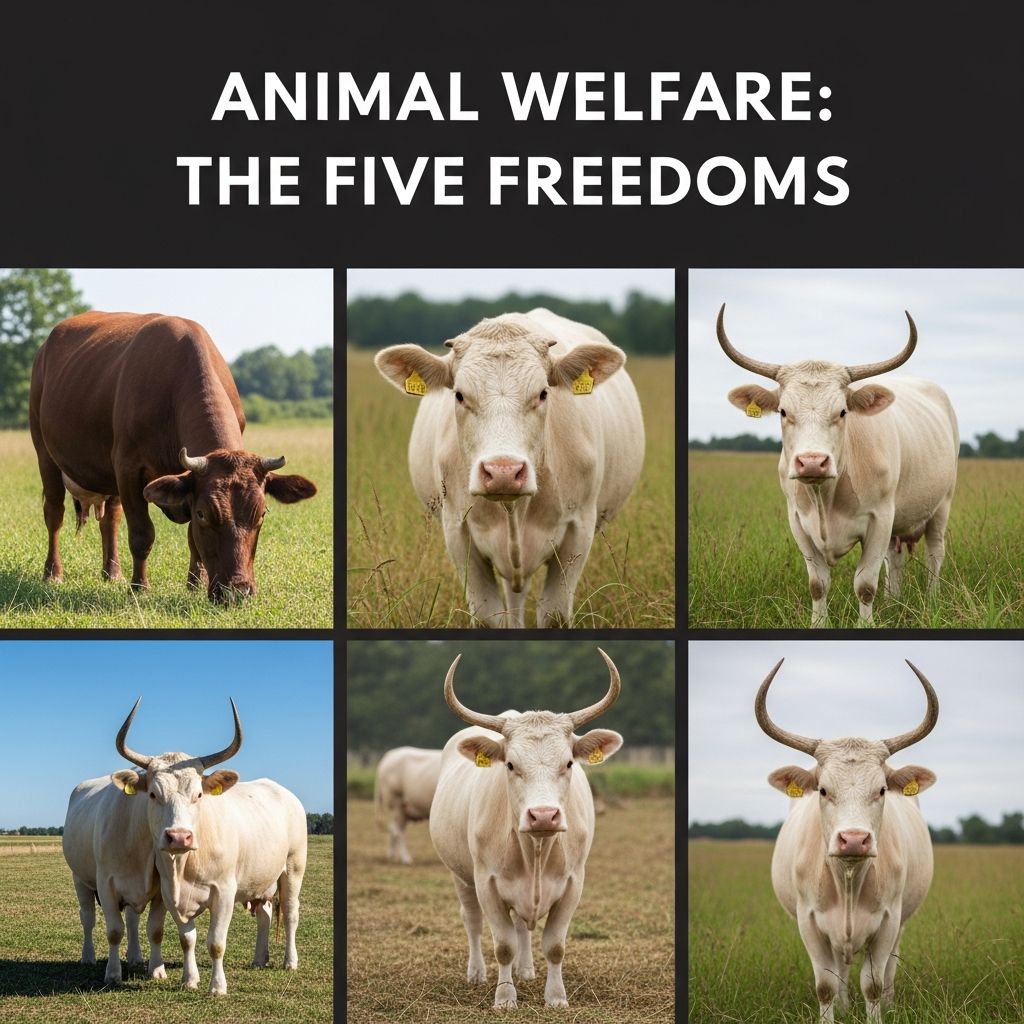
The Five Freedoms represent a foundational framework for evaluating and promoting animal welfare, originally developed for livestock but now applied broadly to farmed animals, pets, and captive wildlife. This model outlines five essential states that animals should experience under human care to achieve physical and mental well-being.
What Are the Five Freedoms?
Established in 1979 by the UK’s Farm Animal Welfare Council (FAWC), the Five Freedoms provide a comprehensive checklist for assessing animal welfare. They emphasize prevention of negative experiences rather than just reacting to suffering, influencing global standards from veterinary practices to farm audits.
- Freedom 1: From hunger and thirst, by ready access to fresh water and a diet to maintain full health and vigor.
- Freedom 2: From discomfort, by providing an appropriate environment including shelter and a comfortable resting area.
- Freedom 3: From pain, injury, or disease, by prevention or rapid diagnosis and treatment.
- Freedom 4: To express (most) normal behavior, by providing sufficient space, proper facilities, and company of the animal’s own kind.
- Freedom 5: From fear and distress, by ensuring conditions and treatment which avoid mental suffering.
These freedoms are not absolute rights but ideal aspirations, guiding compromises in practical settings like intensive farming while prioritizing welfare.
History of the Five Freedoms
The origins trace back to 1965, when the UK government commissioned the Brambell Report in response to concerns over intensive livestock farming highlighted in Ruth Harrison’s book Animal Machines. Professor Roger Brambell’s committee recommended basic freedoms for animals to turn around, groom, stand, lie down, and stretch limbs—forming the seed of the Five Freedoms.
In 1967, the Farm Animal Welfare Advisory Committee was formed to oversee implementation. By 1979, it evolved into the FAWC, which formalized the five points in a press statement. This model gained international traction, adopted by organizations like the World Organisation for Animal Health (WOAH) and the American Veterinary Medical Association (AVMA).
Today, the Five Freedoms underpin welfare audits in farms, processing facilities, shelters, and veterinary hospitals worldwide, ensuring ethical standards in food production and beyond.
Freedom from Hunger and Thirst
This first freedom ensures animals have constant access to fresh, clean water and a nutritionally balanced diet suited to their species, age, and physiological state—such as lactation or growth phases.
In farm settings, this means automated waterers that deliver cool, uncontaminated water and feed rations formulated by nutritionists to prevent deficiencies. For example, dairy cows require high-fiber diets to maintain rumen health, while broiler chickens need starter feeds rich in proteins for rapid growth. Neglect here leads to dehydration, malnutrition, and weakened immunity, impacting meat, milk, and egg quality.
Pet owners apply this by providing measured kibble or fresh meals daily, avoiding obesity from overfeeding. Veterinary guidelines stress monitoring water intake, as reduced consumption signals illness. High-welfare farms use enrichment like foraging substrates to make feeding instinctive and enjoyable.
Freedom from Discomfort
Related Stories



Animals must have environments that protect against extreme weather, provide dry bedding, and allow rest without disturbance. This includes adequate ventilation, temperature control, and space to thermoregulate naturally.
For pigs, this translates to deep straw bedding for rooting and lounging; for poultry, perches and dust baths mimic natural habits. In hot climates, shade, misters, and fans prevent heat stress, a major welfare issue in intensive systems. Poor housing causes chronic stress, reducing growth rates and increasing disease susceptibility.
| Animal Type | Key Comfort Provisions | Benefits |
|---|---|---|
| Cattle | Loose housing with cubicles, fans | Reduces lameness, improves milk yield |
| Poultry | Litter flooring, nesting boxes | Lowers feather pecking, better egg production |
| Pigs | Straw-bedded arcs, cooling pads | Prevents tail biting, enhances growth |
Such measures not only boost welfare but also farm economics through healthier livestock.
Freedom from Pain, Injury, or Disease
Proactive health management—vaccinations, parasite control, biosecurity, and prompt veterinary intervention—is core. Pain mitigation during procedures like castration or dehorning uses analgesics.
Farms implement herd health plans with regular check-ups, foot bathing for dairy cows to prevent lameness, and early culling of sick animals. In pets, annual exams catch issues like dental disease or arthritis early. The WOAH stresses rapid treatment to minimize suffering, integrating this into global standards.
Statistics show well-managed herds have 20-30% lower mortality, underscoring welfare’s link to productivity.
Freedom to Express Normal Behaviour
Species-specific needs for movement, social interaction, and environmental enrichment prevent stereotypic behaviors like pacing or feather-plucking.
- Social needs: Herdmates for cattle, flocks for birds.
- Space: Enough to graze, root, or perch.
- Enrichment: Toys for pigs, substrates for scratching.
Group housing reduces aggression; outdoor access allows foraging. Restricted systems like battery cages historically violated this, prompting welfare reforms. Modern free-range systems exemplify compliance.
Freedom from Fear and Distress
Mental health requires calm handling, predictable routines, and positive human-animal interactions. Gentle stockmanship, low-noise environments, and separation from stressors like predators are key.
Training programs desensitize animals to handling, reducing cortisol levels. In shelters, quiet zones and pheromones ease distress. Chronic fear impairs immunity and reproduction.
Applications in Modern Animal Care
Beyond farms, the Five Freedoms guide pet care, zoos, and labs. Veterinary hospitals use them for stress-free environments; trainers incorporate behavioral freedoms. Welfare audits score farms on these criteria, certifying labels like “RSPCA Assured.”
Consumers choosing certified products support higher standards, linking welfare to sustainable food systems.
Five Freedoms vs. Five Domains Model
The Five Domains—Nutrition, Environment, Health, Behaviour, Mental State—build on the Freedoms by adding positive experiences. Developed post-2012, it shifts from avoiding negatives to promoting positives.
| Five Freedoms | Five Domains Equivalent |
|---|---|
| Hunger/Thirst | Nutrition |
| Discomfort | Environment |
| Pain/Disease | Health |
| Normal Behaviour | Behaviour |
| Fear/Distress | Mental State |
Both complement each other; Domains offer a holistic upgrade.
Frequently Asked Questions (FAQs)
What is the origin of the Five Freedoms?
They stem from the 1965 Brambell Report on UK livestock welfare, formalized in 1979 by FAWC.
Do the Five Freedoms apply only to farm animals?
No, they guide care for pets, zoo animals, and more, adopted globally by WOAH and AVMA.
How do farms implement the Five Freedoms?
Through welfare audits, health plans, enriched housing, and certified schemes.
What is the difference between Five Freedoms and Five Domains?
Freedoms focus on negatives to avoid; Domains add positive states for comprehensive welfare.
Why is animal welfare important for food security?
Healthy animals produce safer, higher-quality food sustainably, reducing disease outbreaks.
References
- Five Freedoms — Wikipedia. 2023-10-15. https://en.wikipedia.org/wiki/Five_Freedoms
- Building Better Lives for Our Pets: The Five Freedoms, Provisions and Domains — CattleDog Publishing. 2023. https://cattledogpublishing.com/blog/building-better-lives-for-our-pets-the-five-freedoms-provisions-and-domains/
- An Animal Welfare History Lesson on the Five Freedoms — Michigan State University Extension (CANR). 2015-05-28. https://www.canr.msu.edu/news/an_animal_welfare_history_lesson_on_the_five_freedoms
- What is the Difference Between Five Domains Model and Five Freedoms of Animal Welfare? — World Animal Protection. 2023. https://www.worldanimalprotection.ca/blogs/what-difference-between-five-domains-model-and-five-freedoms-animal-welfare/
- Updating Animal Welfare Thinking: Moving beyond the “Five Freedoms” — PMC (NIH). 2016-03-23. https://pmc.ncbi.nlm.nih.gov/articles/PMC4810049/
- Animal Welfare — World Organisation for Animal Health (WOAH). 2024. https://www.woah.org/en/what-we-do/animal-health-and-welfare/animal-welfare/
Similar Articles








Read full bio of medha deb