Animal Welfare: The Five Freedoms Explained
Explore the essential Five Freedoms guiding animal welfare standards for farm animals and beyond, ensuring health, comfort, and natural behaviors.
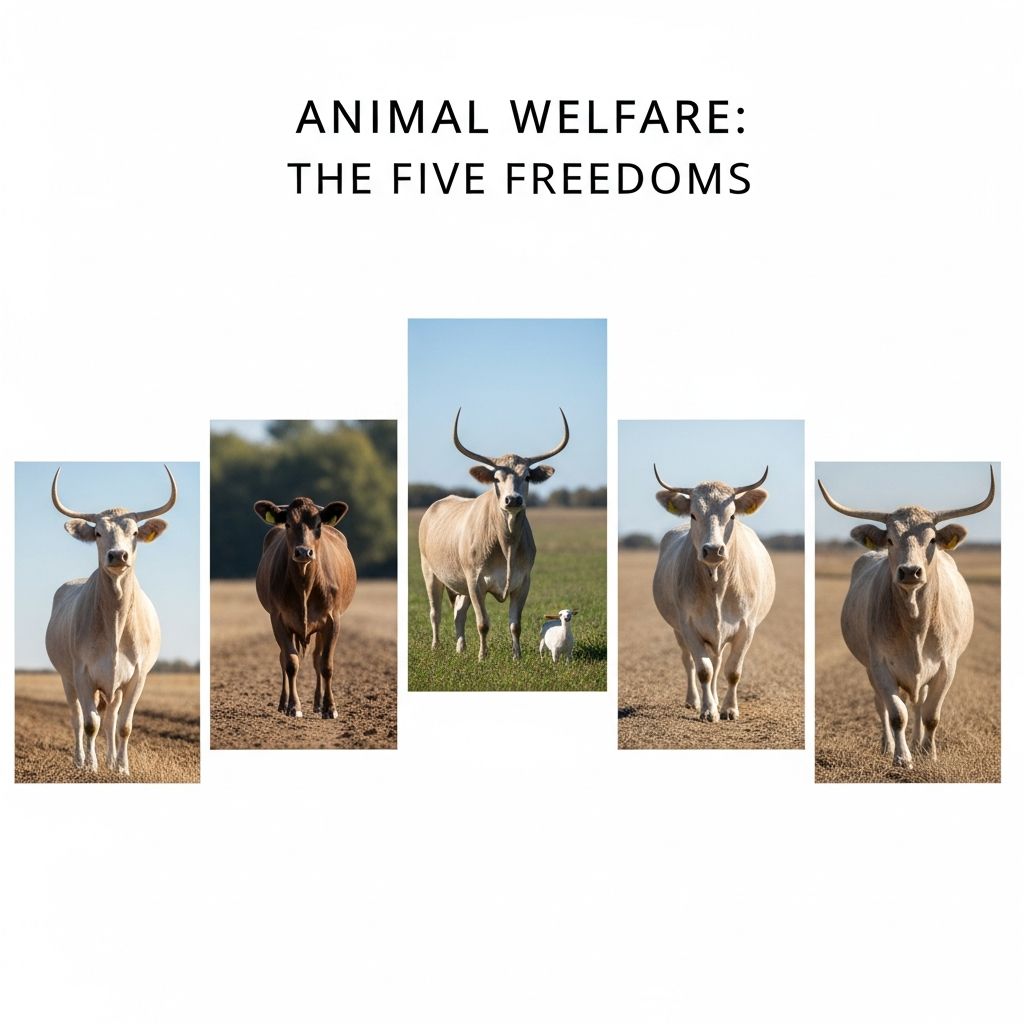
The Five Freedoms represent a cornerstone of modern animal welfare, providing a framework to ensure animals under human care experience conditions that support their physical and mental well-being. Originating from a 1965 British government report, these principles have been adopted globally by organizations, governments, and industries to set standards for livestock, companion animals, and those in captivity.
Five Freedoms of Animal Welfare
The concept of the Five Freedoms traces back to the Brambell Report, commissioned by the UK government in 1965 to investigate intensive livestock farming practices. The report emphasized that animals should have the ability to ‘stand up, lie down, turn around, groom themselves, and stretch their limbs,’ laying the groundwork for more comprehensive welfare guidelines. This was later refined by the Farm Animal Welfare Council (now the Animal Welfare Committee) into the Five Freedoms, which minimize negative states and promote positive welfare.
Recognized internationally, the Five Freedoms are endorsed by bodies like the World Organisation for Animal Health (WOAH), ASPCA, and various NGOs. They apply to all animals under human control, including farm animals raised for food, pets, and those in zoos or labs. The principles state that animals should have:
- Freedom from hunger or thirst by ready access to fresh water and a diet to maintain full health and vigor.
- Freedom from discomfort, by providing an appropriate environment including shelter and a comfortable resting area.
- Freedom from pain, injury, or disease, by prevention or rapid diagnosis and treatment.
- Freedom to express normal behavior, by providing sufficient space, proper facilities, and company of the animal’s own kind.
- Freedom from fear and distress, by ensuring conditions and treatment which avoid mental suffering.
These freedoms are not absolute rights but aspirational goals, guiding legislation, codes of practice, and quality assurance programs worldwide.
Freedom from Hunger and Thirst
Ensuring animals have constant access to fresh water and a balanced diet is foundational to welfare. For farm animals like cattle, pigs, and poultry, this means feeders and waterers that prevent competition and contamination. Malnutrition leads to weakened immunity, reduced productivity, and suffering. Studies show that deprived animals exhibit behaviors like increased aggression or lethargy.
In practice, farmers implement automatic watering systems and nutritionally complete feeds tailored to species needs. For dairy cows, this includes high-forage diets to support milk production without health compromises. Global standards from WOAH emphasize this freedom to prevent dehydration in hot climates or transport. Regular monitoring ensures intake meets requirements, promoting vigor and longevity.
Freedom from Discomfort
Discomfort arises from inadequate housing, extreme temperatures, or poor bedding. Animals require shelter from weather, ventilation to reduce humidity, and resting areas that allow natural postures. Battery cages for hens or gestation crates for sows have been criticized for violating this by restricting movement.
Modern alternatives include aviaries for poultry with perches and nests, or group housing for pigs with straw bedding. Temperature control via fans, misters, or heaters prevents heat stress, a major issue in intensive systems. The Five Domains model, an evolution of the Freedoms, links physical comfort to positive mental states like contentment.
| Animal Type | Discomfort Risks | Solutions |
|---|---|---|
| Poultry | High ammonia from litter | Ventilation, deep litter systems |
| Pigs | Cold concrete floors | Insulated slats, straw yards |
| Cattle | Heat stress | Shade, sprinklers |
Related Stories



Freedom from Pain, Injury, or Disease
Preventative veterinary care is key, including vaccinations, parasite control, and routine checks. Pain from procedures like dehorning or castration must be managed with anesthesia or analgesics. Early disease detection via biosecurity reduces outbreaks.
The AVMA supports rapid treatment protocols, noting that untreated injuries lead to chronic pain and welfare compromise. In egg production, beak trimming is controversial; non-surgical alternatives like lighting management are preferred. Foot health in dairy herds, often from lameness, requires foot baths and hoof trimming.
Freedom to Express Normal Behavior
Animals are motivated to perform species-specific behaviors: rooting for pigs, dust bathing for chickens, grazing for ruminants. Confinement prevents this, causing frustration and stereotypic behaviors like bar-biting.
Solutions include environmental enrichment: toys for pigs, perches for birds, pasture access for cows. Group housing allows social interactions, vital for herd animals. Space allowances vary: EU directives mandate minimum square footage per animal. Research confirms enriched environments reduce stress hormones.
- Pigs: Substrate for foraging
- Chickens: Nest boxes, litter for scratching
- Sheep: Space for flocking
Freedom from Fear and Distress
Mental suffering stems from handling, novelty, or isolation. Gentle stockmanship, low-noise environments, and familiar groupings minimize fear. Transport and slaughter require humane practices to avoid distress.
Positive human-animal interactions build trust; fearful animals show elevated cortisol. Training handlers in low-stress methods improves outcomes. For slaughter, stunning prevents conscious suffering, as per OIE standards.
Frequently Asked Questions (FAQs)
Q: What is the origin of the Five Freedoms?
A: They stem from the 1965 Brambell Report in the UK, refined by the Farm Animal Welfare Council.
Q: Do the Five Freedoms apply only to farm animals?
A: No, they guide welfare for all animals under human care, including pets and zoo animals.
Q: How do the Five Domains differ from the Five Freedoms?
A: Domains expand to include positive experiences like pleasure, balancing negatives.
Q: Are the Five Freedoms legally binding?
A: They influence laws and codes but are aspirational; some countries incorporate them into regulations.
Q: Can factory farms meet the Five Freedoms?
A: Many do not fully, due to space and social restrictions, prompting welfare certifications.
Implementing the Five Freedoms in Food Production
As consumers demand ethical sourcing, certifications like Global Animal Partnership or Certified Humane verify compliance. These audits check housing, nutrition, and handling. Sustainable farming integrates welfare with environmental goals, like rotational grazing for behavior expression.
Challenges persist in intensive systems, but innovations like precision feeding and AI monitoring advance standards. Educating producers ensures economic viability alongside welfare.
The Five Freedoms remind us that welfare encompasses both body and mind, influencing food quality—stress-free animals yield tender meat and nutritious products. Policymakers use them for trade agreements, harmonizing global standards.
Consumers can support by choosing labels aligned with these principles, driving industry change. Research continues evolving the model, incorporating affective states for holistic assessment.
References
- Animal welfare – the Five Freedoms and the Five Domains explained — SPCA Certified. 2023. https://www.spcacertified.nz/learn-more/article/animal-welfare-the-five-freedoms-and-the-five-domains-explained
- Five Freedoms of Animal Welfare: What They Are & Why They Aren’t Enough — The Humane League. 2023-10-01. https://thehumaneleague.org/article/the-five-freedoms-of-animal-welfare
- Animal Welfare: The Five Freedoms — Academy of Nutrition and Dietetics. 2024. https://www.eatright.org/food/planning/food-security-and-sustainability/animal-welfare-the-five-freedoms
- Updating Animal Welfare Thinking: Moving beyond the “Five Freedoms” — National Center for Biotechnology Information (PMC). 2016-03-25. https://pmc.ncbi.nlm.nih.gov/articles/PMC4810049/
- Understanding the Five Domains Model of Animal Welfare — University of Edinburgh Veterinary. 2024-09. https://vet.ed.ac.uk/sites/default/files/2024-09/5%20Domains%20Model.pdf
- Animal Welfare — World Organisation for Animal Health (WOAH). 2024. https://www.woah.org/en/what-we-do/animal-health-and-welfare/animal-welfare/
Similar Articles








Read full bio of medha deb