Ankle Fracture Open Reduction Internal Fixation
Comprehensive guide to ORIF surgery for ankle fractures and recovery outcomes.
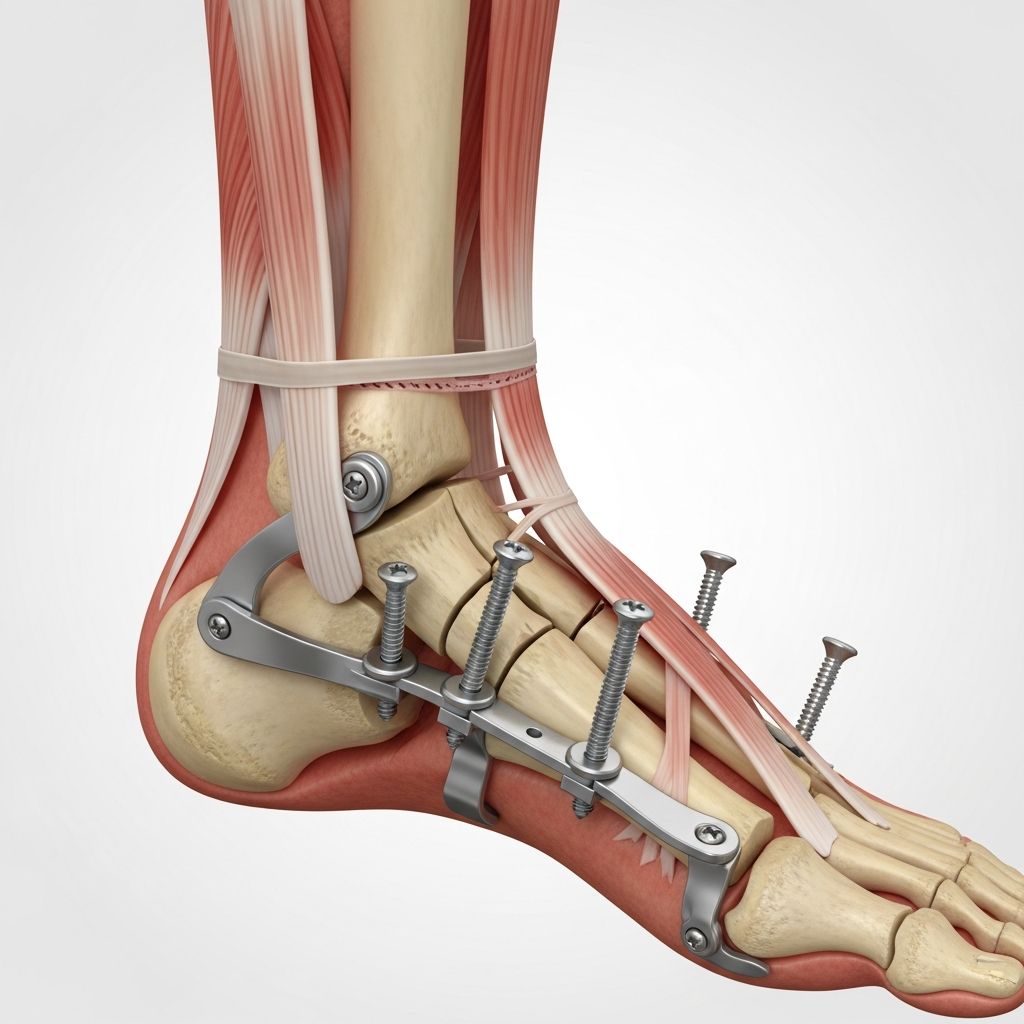
Ankle Fracture Open Reduction and Internal Fixation
Ankle fracture is a break in one or more of the bones that make up the ankle joint. The ankle is composed of three bones: the tibia (shinbone), fibula (smaller bone in the lower leg), and talus (bone in the foot that connects to the leg). When any of these bones break, it can affect the stability and function of the ankle joint. Open reduction and internal fixation (ORIF) is a surgical procedure that is often used to treat complex ankle fractures, particularly when the fracture is displaced, unstable, or involves multiple bones.
What is Open Reduction and Internal Fixation?
Open reduction and internal fixation is a surgical technique used to treat ankle fractures by realigning the broken bone fragments and securing them with metal hardware such as plates, screws, and wires. The procedure involves making an incision over the fracture site to directly visualize and manipulate the bone fragments into their correct anatomical position. Once properly aligned, the fragments are held in place with internal fixation devices, which allow the bone to heal in the correct position.
The term “open reduction” refers to the surgical exposure and direct visualization of the fracture site, while “internal fixation” refers to the use of metal implants to maintain alignment during the healing process. This approach differs from closed reduction, where the bone is realigned without surgery through manipulation and external support such as casting.
Indications for ORIF in Ankle Fractures
ORIF is typically indicated for patients with unstable ankle fractures who are fit for surgery and have favorable soft tissue conditions. The procedure is an appropriate treatment for several types of ankle fractures, including:
- Unimalleolar fractures with talar shift observed on weight-bearing ankle X-rays
- Bimalleolar ankle fractures (fractures involving two of the three ankle bones)
- Trimalleolar ankle fractures (fractures involving all three ankle bones)
- Pilon fractures (fractures of the distal tibia extending into the ankle joint)
- Maisonneuve fractures (fractures involving the fibula with syndesmotic injury)
The decision to proceed with ORIF depends on several factors, including fracture displacement, ankle stability, the presence of syndesmotic injury, and the patient’s overall health status. Operative treatment of complex ankle fractures is the method of choice in most industrialized countries according to current literature, as high mal- and non-union rates have been reported in unstable ankle fractures managed conservatively.
Preoperative Evaluation and Planning
Before undergoing ORIF surgery, patients undergo a comprehensive evaluation to assess their fitness for surgery and to plan the surgical approach. This evaluation typically includes imaging studies such as plain radiographs and computed tomography (CT) scans to determine the exact nature and location of the fracture.
Imaging is critical for surgical planning, as it allows the surgeon to identify all fracture fragments, assess the degree of comminution (fragmentation), and determine the optimal surgical approach. In cases of complex fractures involving the posterior malleolus, CT imaging provides detailed visualization of the fracture pattern and helps guide the surgical strategy.
Related Stories



The surgeon must also consider the timing of surgery. Surgical fixation is usually performed within 24 hours of injury but can wait a few days if soft tissue swelling is present, as delaying surgery allows the swelling to subside and reduces the risk of wound complications such as dehiscence. Research suggests that in low-energy ankle fractures with involvement of the posterior malleolus, clinical outcomes are superior in patients who undergo surgery within the first 24 to 48 hours compared to those who undergo surgery after 7 days.
Surgical Technique and Approaches
The surgical approach for ORIF depends on the location and configuration of the fracture fragments. Multiple approaches may be used depending on which bones are fractured:
Fibular Fracture Fixation
Fibular fractures can be stabilized using plates and screws or fibular nails. Fibular nails are particularly suitable for comminuted fractures with poor bone quality. The fibula is typically fixed first, as it provides a reference point for reducing the other fracture fragments and restoring the normal geometry of the ankle mortise.
Medial Malleolus Fixation
Transverse medial malleolus fractures can be fixed using partially threaded screws or tension band wiring to create compression at the fracture site. In contrast, vertical medial malleolus fractures require buttressing fixation with an anti-glide plate. The choice of fixation method depends on the fracture pattern and the quality of the bone.
Posterior Malleolus Fixation
The posterior malleolus is an important component of ankle stability, and fixation of posterior malleolus fractures has been shown to improve functional outcomes. In cases of complex multifragmentary posterior malleolus fractures, a posterolateral approach may be used to allow direct visualization of the articular surface and the posterior malleolus for optimal reduction and fixation.
Fixation techniques do not vary significantly from the well-known techniques used for intraarticular, multifragmentary fractures, with K-wires, lag screws, buttress plating, and combinations of these techniques commonly employed.
Minimally Invasive Approaches
In recent years, minimally invasive techniques and approaches have come into focus, particularly in distal tibial fractures. Minimally invasive osteosynthesis (MIO) and minimally invasive plate osteosynthesis (MIPO) techniques use smaller incisions to place fixation devices, which reduces iatrogenic soft tissue damage and preserves blood supply at the fracture site.
Good results with outcomes similar to ORIF have been achieved with minimally invasive techniques, but these methods are most effectively used on non-displaced and non-comminuted fractures. However, MIPO has shown a higher rate of non-union, delayed union, and soft tissue impingement than standard ORIF. Therefore, minimally invasive approaches are typically reserved for less complex fracture patterns.
Alternative Treatment Options
While ORIF is the surgical approach of choice for most ankle fractures, alternative options may be considered in specific clinical scenarios.
External Fixation
External fixation is often indicated as a temporary stabilization technique for unstable ankle fractures, particularly in cases of severe soft tissue injury, open fractures, or impending compartment syndrome. External fixation can also be used as definitive treatment in select cases, such as highly comminuted Gustillo type III-open ankle fractures with significantly impacted soft tissue or in geriatric patients with high surgical risk.
The main advantages of external fixation compared to ORIF are the minimally invasive incisions used to place K-wires and pins, which reduce soft tissue complications. Additionally, immediate weight bearing after surgery, which is possible with Ilizarov ring external fixation, can lessen complications related to prolonged immobilization, particularly in elderly patients. Ilizarov external fixation can also be used for distraction osteogenesis when severe bone loss is present.
However, a major disadvantage of external fixation is the lack of anatomical reduction of the articular surface, which is associated with lower overall functional outcomes. Despite this limitation, in patients with extremely severe type AO C3 tibial pilon fractures with badly impacted soft tissue, the functional outcome after external fixation and ORIF are similar.
K-Wire Stabilization
Percutaneous K-wire fixation has emerged as a less invasive alternative for temporary stabilization of ankle fracture dislocations before definitive internal fixation. Studies have demonstrated that K-wire stabilization is safe and effective, with complication rates and clinical outcomes comparable to external fixation. The main advantage of K-wire stabilization over external fixation is the reduction in pin-site infections and improved patient compliance, as external fixators often present compliance and patient satisfaction issues.
Ankle Arthrodesis
Because of the high complication rate associated with standard ORIF and conservative treatment in elderly patients, alternative methods are often utilized. Primary ankle arthrodesis using tibiotalocalcaneal retrograde nailing has become increasingly popular in recent years for select patients. Although ankle arthrodesis has traditionally been used as a salvage technique for severe osteoarthritis or after failed ORIF, recent studies have presented good results when using ankle arthrodesis as a primary treatment option in elderly patients or those with significant comorbidities.
Postoperative Care and Recovery
Following ORIF surgery, patients undergo a structured rehabilitation program to promote bone healing and restore ankle function. The initial postoperative period typically involves immobilization of the ankle with a splint or cast to protect the surgical site and allow soft tissues to heal. Pain management and swelling control are important during this phase.
As healing progresses, patients gradually transition to weight bearing and begin active range-of-motion exercises under the guidance of a physical therapist. The timeline for progression depends on the complexity of the fracture and the patient’s healing response. Most patients can begin partial weight bearing within a few weeks of surgery, progressing to full weight bearing as tolerated.
Physical therapy is essential to restore ankle strength, flexibility, and proprioception. Exercises typically progress from passive range-of-motion to active assisted range-of-motion, and eventually to active resistance exercises. Functional activities such as walking, balance training, and sport-specific exercises are gradually incorporated as the patient’s condition improves.
Potential Complications
While ORIF is generally a safe and effective procedure, complications can occur. Potential complications include wound infection, wound dehiscence, hardware irritation, malunion or nonunion of the fracture, and post-traumatic ankle arthritis. The risk of complications increases with the severity of the initial injury, poor soft tissue conditions, and patient factors such as age and comorbidities.
One of the long-term concerns following severe ankle fractures is the development of post-traumatic osteoarthritis, which occurs in over one third of all patients with severe ankle fractures. This highlights the importance of anatomically precise reduction and fixation to minimize the risk of joint degeneration.
Expected Outcomes and Prognosis
The functional outcome after ankle fracture ORIF is generally favorable when anatomically precise reduction is achieved and complications are avoided. Most patients can expect to return to normal activities and weight bearing within 8 to 12 weeks following surgery, although full functional recovery may take several months.
The prognosis depends on several factors, including the complexity of the fracture, the quality of the surgical reduction, the patient’s compliance with rehabilitation, and the presence of any postoperative complications. Patients with simple fracture patterns and good soft tissue conditions typically have better outcomes than those with complex comminuted fractures.
Frequently Asked Questions
Q: How long does ankle fracture ORIF surgery take?
A: The duration of ankle fracture ORIF surgery varies depending on the complexity of the fracture and the number of bones involved. Simple fractures may take 45 minutes to 1 hour, while more complex fractures can take 2 to 3 hours or longer.
Q: Will I need crutches after ankle fracture surgery?
A: Yes, most patients will need crutches or a walker for the first few weeks after surgery while the initial healing occurs and swelling decreases. Weight bearing is typically progressed gradually under the guidance of your surgeon and physical therapist.
Q: How long is the recovery period after ankle fracture ORIF?
A: The recovery period typically ranges from 8 to 12 weeks for partial return to normal activities. However, full functional recovery, including return to sports or high-impact activities, may take several months.
Q: When can I return to sports after ankle fracture surgery?
A: Return to sports should be individualized based on the complexity of the fracture, the quality of healing, and the demands of the sport. Most patients can begin light recreational activities within 12 to 16 weeks, with gradual progression to more demanding activities over the following months.
Q: Will the metal hardware need to be removed?
A: Metal hardware used in ankle fracture ORIF is typically left in place permanently unless it causes irritation or complications. Removal of hardware is not routinely recommended and is only considered if the patient experiences specific problems related to the implants.
Q: Can I develop arthritis after an ankle fracture?
A: Yes, post-traumatic ankle arthritis can develop in a significant proportion of patients following ankle fractures. However, anatomically precise reduction and fixation, along with proper rehabilitation, can help minimize this risk.
References
- Treatment strategies for complex ankle fractures—current perspectives — Annals of Translational Medicine. 2023-12-01. https://atm.amegroups.org/article/view/116511/html
- Comparison of Temporary External and Percutaneous K-Wire Fixations for Treatment of Ankle Fracture — American College of Foot and Ankle Surgeons. https://www.acfas.org/comparison-of-temporary-external-and-percutaneous-k-wire-fixations-for-treatment-of-ankle-fracture
- Ankle Fracture — StatPearls, National Center for Biotechnology Information. 2025-01-01. https://www.ncbi.nlm.nih.gov/books/NBK542324/
- Operative vs Nonoperative Management of Unstable Medial Malleolar Fractures — JAMA Network Open. 2024-01-01. https://jamanetwork.com/journals/jamanetworkopen/fullarticle/2814057
Similar Articles








Read full bio of medha deb