Ankle Replacement Surgery: Treatment Options
Comprehensive guide to ankle replacement surgery for advanced arthritis relief.
Ankle Replacement Surgery: What You Need to Know
Ankle replacement surgery, also known as total ankle arthroplasty (TAR), is a surgical procedure designed to address severe ankle arthritis and restore mobility in patients who have exhausted conservative treatment options. This innovative procedure represents a significant advancement in orthopedic medicine, offering patients an alternative to ankle fusion that preserves joint motion and reduces stress on adjacent joints.
Understanding Ankle Arthritis
Ankle arthritis, particularly osteoarthritis, occurs when the protective cartilage lining the ankle joint deteriorates over time. This degeneration can result from previous ankle injuries, chronic wear and tear, or inflammatory conditions. When arthritis becomes advanced, it can severely limit mobility, cause chronic pain, and significantly impact quality of life. The condition often progresses to a point where conservative treatments such as physical therapy, medications, and activity modifications no longer provide adequate relief.
Common causes of ankle arthritis include previous traumatic injuries such as fractures or severe ankle sprains, rheumatoid arthritis, and post-traumatic arthritis that develops years after an initial injury. Patients experiencing advanced ankle arthritis typically report difficulty walking, persistent pain even at rest, stiffness that worsens in the morning, and swelling that doesn’t respond to standard treatments.
What is Ankle Replacement Surgery?
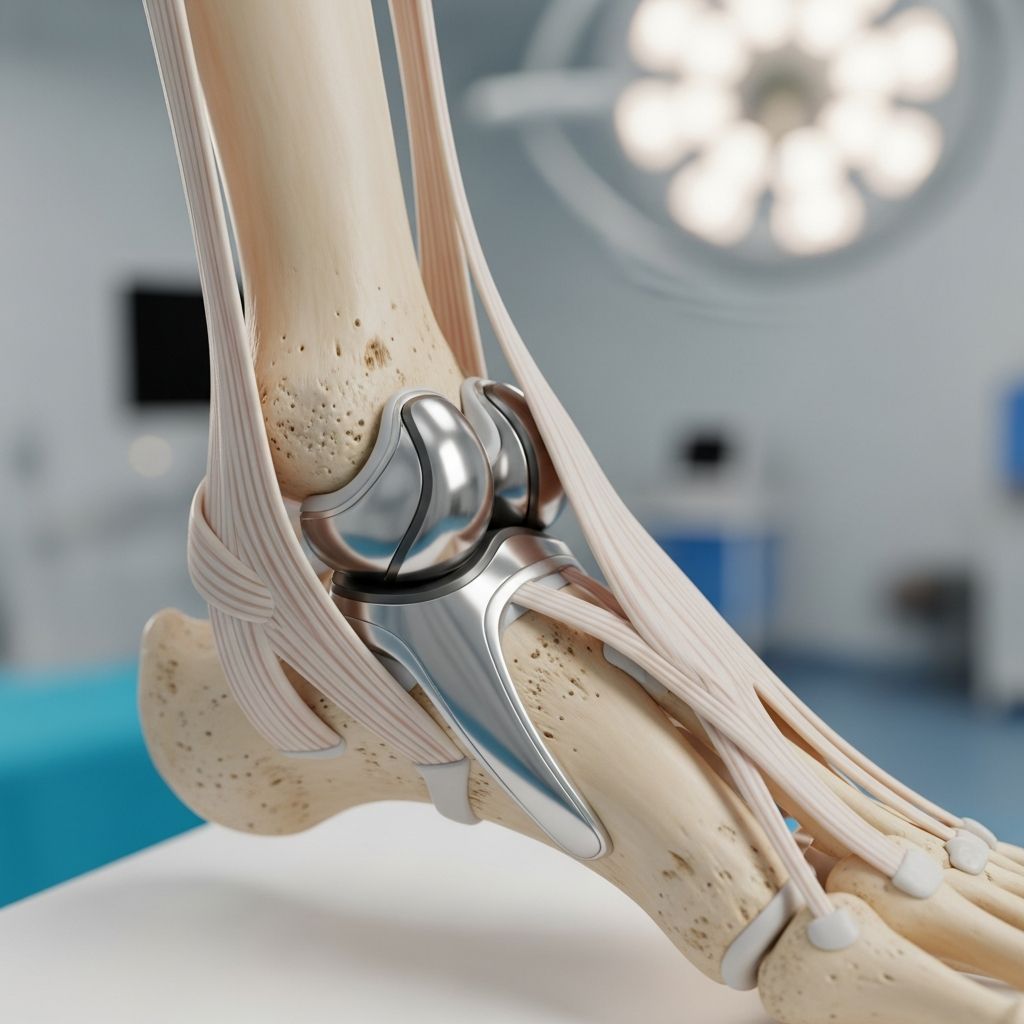
Ankle replacement surgery involves removing the damaged portions of bone and cartilage from the ankle joint and replacing them with artificial implants made of metal alloys and polyethylene plastic. The prosthetic ankle joint is designed to mimic the natural movement of the ankle, allowing patients to maintain a more normal range of motion compared to fusion procedures.
The procedure typically involves three main components: a tibial (shinbone) component, a talar (ankle bone) component, and an insert made of polyethylene plastic that serves as a spacer between the metal components. These components work together to create a functional artificial joint that can withstand normal walking and daily activities.
Advantages of Ankle Replacement Surgery
Ankle replacement offers several significant benefits compared to traditional ankle fusion surgery, which permanently stiffens the ankle joint. Key advantages include:
Preserved Joint Motion
Unlike ankle fusion, which eliminates all movement in the ankle joint, replacement surgery preserves the ability to move the ankle through a functional range of motion. This preservation of motion helps maintain normal walking patterns and reduces compensatory stress on other joints in the foot and ankle.
Faster Rehabilitation
Patients undergoing ankle replacement typically achieve mobility within approximately two weeks after surgery, compared to eight weeks or more for those undergoing ankle fusion. This accelerated recovery allows patients to return to daily activities and work more quickly.
Reduced Adjacent Joint Stress
By maintaining ankle joint mobility, replacement surgery reduces the abnormal stress and strain placed on neighboring joints in the foot. This helps prevent premature arthritis development in adjacent joints, which commonly occurs after ankle fusion procedures.
Improved Quality of Life
Patients report improved comfort, better walking mechanics, and greater ability to participate in recreational activities compared to fusion alternatives. The maintained motion allows for more natural gait patterns and reduces the likelihood of developing compensatory pain in the knee, hip, or lower back.
Patient Selection and Candidacy
Not all patients with ankle arthritis are candidates for ankle replacement surgery. Successful outcomes depend on several factors including bone quality, overall health status, and patient commitment to rehabilitation. Ideal candidates typically have:
- Advanced ankle arthritis that has failed conservative treatment
- Adequate bone stock and bone quality to support the prosthetic components
- Realistic expectations about recovery and functional outcomes
- Good overall health without significant comorbidities that would complicate surgery
- Age typically over 50, though younger patients may be considered on a case-by-case basis
- Ability to follow post-operative weight-bearing restrictions
- No active infections in the ankle or surrounding tissues
Related Stories



Patients with poor bone quality, significant ankle deformity, or those with active infections may not be suitable candidates and may instead be recommended for ankle fusion or other alternative procedures.
Pre-Operative Evaluation
Before undergoing ankle replacement surgery, patients undergo comprehensive evaluation to ensure they are appropriate surgical candidates. This evaluation typically includes:
Physical Examination
Your orthopedic surgeon will perform a thorough physical examination of both ankles, assessing range of motion, stability, and pain levels. The examination helps identify any additional problems that might affect surgical planning.
Imaging Studies
X-rays provide detailed images of the ankle joint and help assess the degree of arthritis and bone quality. Advanced imaging such as CT scans or MRI may be ordered to evaluate bone structure, determine implant sizing, and plan the surgical approach more precisely.
Medical Optimization
Patients with significant medical conditions such as diabetes or cardiovascular disease may require additional testing and clearance from their primary care physician or medical specialists. Blood work and other laboratory tests may be performed to ensure the patient is fit for surgery.
The Surgical Procedure
Ankle replacement surgery typically requires general anesthesia and usually takes between one and three hours to complete. The procedure is often performed with advanced minimally-invasive techniques when appropriate, reducing tissue trauma and potentially improving recovery times.
Surgical Steps
The surgeon makes an incision over the front of the ankle joint to access the damaged surfaces. The damaged cartilage and bone are carefully removed from the tibia and talus bones. The prepared bone surfaces are then fitted with the prosthetic components, which may be fixed in place using bone cement or with cementless designs that rely on bone ingrowth for fixation. The polyethylene spacer is inserted between the metal components to create the artificial joint surface. The incision is then closed in layers.
Surgical Expertise Requirements
Ankle replacement is a complex procedure that requires highly specialized training and expertise. It is primarily performed by foot and ankle specialists with fellowship training in orthopedic foot and ankle surgery. The complexity of the procedure demands surgeons with extensive experience and technical skill to achieve optimal outcomes.
Post-Operative Recovery Timeline
Recovery from ankle replacement surgery typically follows a progressive timeline with specific milestones and restrictions:
| Time Period | Activity Level | Weight-Bearing Status | Expected Outcomes |
|---|---|---|---|
| Weeks 0-2 | Minimal activity, bed rest primarily | Non-weight bearing | Swelling management, pain control, initial mobility exercises |
| Weeks 2-6 | Gradual increase in movement | Partial weight-bearing with assistive devices | Progressive range of motion, beginning physical therapy |
| Weeks 6-12 | Increased daily activities | Gradual transition to full weight-bearing | Strengthening exercises, walking without assistive devices |
| Months 3-6 | Return to light activities | Full weight-bearing established | Return to daily activities, possible return to work |
| Months 6-12 | Progressive activity increase | Full unrestricted weight-bearing | Possible return to recreational activities, maximum functional improvement |
Physical Therapy and Rehabilitation
Physical therapy is essential for achieving optimal outcomes after ankle replacement surgery. A structured rehabilitation program typically includes:
Early Phase Therapy
During the first few weeks, therapy focuses on managing swelling, reducing pain, and initiating gentle range-of-motion exercises. Ice elevation, compression, and prescribed medications help control post-operative swelling. Gentle ankle movements begin as early as one to two days after surgery to prevent stiffness.
Intermediate Phase Rehabilitation
As weight-bearing progresses, therapy emphasizes strengthening the muscles surrounding the ankle and improving balance and proprioception. Resistance exercises help restore ankle stability and functional strength necessary for walking and daily activities.
Late Phase Conditioning
During months three through six, rehabilitation focuses on advanced strengthening, improved agility, and functional training for returning to work and recreational activities. Sport-specific training may be introduced for appropriate patients.
Risks and Complications
While ankle replacement surgery is generally safe when performed by experienced surgeons, all surgeries carry potential risks. Possible complications include:
- Infection at the surgical site or deep within the wound
- Blood clots (deep vein thrombosis) in the leg
- Excessive bleeding or hematoma formation
- Nerve or blood vessel injury during surgery
- Delayed wound healing
- Prosthetic component loosening or failure
- Persistent pain or stiffness
- Allergic reactions to implant materials
- Need for revision surgery or conversion to ankle fusion
Serious complications are relatively uncommon with modern surgical techniques and proper patient selection. Your surgeon will discuss specific risks based on your individual health status and medical history.
Longevity of Ankle Replacement Implants
The lifespan of ankle replacement implants varies depending on the specific design, patient factors, and activity levels. Most modern ankle prosthetics are designed to function for 15-20 years or longer. However, the lifespan may be shortened by high-impact activities or heavy manual labor that places increased stress on the ankle joint.
While implant technology continues to improve with better materials and designs, some patients may eventually require revision surgery to replace worn or loose components. Revision surgery is generally more complex than the initial procedure and may have longer recovery times.
Alternatives to Ankle Replacement
Patients with advanced ankle arthritis have several treatment options to consider:
Conservative Management
For patients not yet ready for surgery or with mild to moderate arthritis, conservative treatments may provide adequate symptom relief. These include activity modification, weight management, anti-inflammatory medications, corticosteroid injections, and physical therapy.
Ankle Fusion Surgery
Ankle fusion (arthrodesis) has been the traditional surgical treatment for advanced ankle arthritis. This procedure permanently stiffens the ankle joint by fusing the bones together. While fusion is effective at relieving pain, it eliminates ankle motion and increases stress on adjacent joints, potentially leading to premature arthritis in neighboring joints.
Comparison of Surgical Options
| Feature | Ankle Replacement | Ankle Fusion |
|---|---|---|
| Joint Motion Preserved | Yes – maintains natural movement | No – eliminates all motion |
| Recovery Time | ~2 weeks for mobility | ~8 weeks or longer |
| Adjacent Joint Stress | Reduced | Increased |
| Implant Lifespan | 15-20+ years typically | Permanent |
| Revision Surgery Possible | Yes, if needed | Yes, but more complex |
| Surgical Complexity | High – requires specialized training | Moderate |
Frequently Asked Questions
Q: Who is a good candidate for ankle replacement surgery?
A: Ideal candidates have advanced ankle arthritis that hasn’t responded to conservative treatment, adequate bone quality, realistic expectations, good overall health, and are typically over 50 years old. Your surgeon will evaluate your individual circumstances to determine candidacy.
Q: How long does ankle replacement surgery take?
A: The procedure typically takes between one and three hours, depending on the complexity of your case, the presence of additional problems, and the specific surgical technique used.
Q: Will I be able to walk normally after ankle replacement?
A: Most patients achieve functional walking within two weeks after surgery and can return to normal daily activities within three to six months. However, activities should progress gradually under the guidance of your physical therapist.
Q: Can I participate in sports after ankle replacement?
A: This depends on the specific sport and your recovery. Low-impact activities such as swimming and walking are generally encouraged. High-impact sports may not be recommended. Discuss specific activities with your surgeon.
Q: How long do ankle replacement implants last?
A: Modern ankle prosthetics are typically designed to function for 15-20 years or longer. However, implant lifespan may be shortened by high-impact activities or heavy manual labor that places increased stress on the joint.
Q: What is the difference between ankle replacement and ankle fusion?
A: Ankle replacement preserves joint motion and allows faster recovery (approximately 2 weeks for mobility), while fusion permanently stiffens the joint and requires longer recovery (approximately 8 weeks). Replacement reduces stress on adjacent joints, while fusion increases it.
Q: Will I need physical therapy after surgery?
A: Yes, physical therapy is essential for optimal outcomes. A structured rehabilitation program beginning immediately after surgery helps restore strength, motion, balance, and function over several months.
Q: Can I have revision surgery if my implant wears out?
A: Yes, revision surgery is possible if the prosthetic component becomes loose or worn. However, revision surgery is generally more complex than the initial procedure and may have longer recovery times.
Q: How will ankle replacement affect my daily activities?
A: Most patients can return to their normal daily activities and work within three to six months. The maintained joint motion allows for more natural movement patterns compared to fusion, potentially allowing greater activity participation long-term.
Q: What is the success rate of ankle replacement surgery?
A: Ankle replacement has shown excellent results in appropriate candidates, with most patients experiencing significant pain relief and improved function. Success rates continue to improve with advancing implant technology and surgical techniques.
References
- Nigel N. Hsu, M.D. – Orthopaedic Foot and Ankle Surgeon — Johns Hopkins Medicine. 2018-09-17. https://www.hopkinsmedicine.org/profiles/results/directory/profile/10004462/
- Ankle Pain No More: JHAH Orthopedics Performs a Surgical First — Johns Hopkins Aramco Healthcare. 2024. https://www.jhah.com/en/news-events/news-articles/jhah-orthopedics-performs-a-surgical-first/
- John Thompson, M.D. – Orthopaedic Surgeon — Johns Hopkins Medicine. 2020-09-15. https://www.youtube.com/watch?v=n-FQ6wLLRuo
- Ankle Replacement – Johns Hopkins Arthritis Center — Johns Hopkins Medicine. https://www.hopkinsarthritis.org/ask-the-expert/ankle-replacement/
- Total Ankle Replacement Surgery Overview — Accarent Health. https://accarenthealth.com/procedure/list
Similar Articles








Read full bio of medha deb