Annular Elastolytic Giant Cell Granuloma Pathology
Comprehensive histopathological analysis of annular elastolytic giant cell granuloma, a rare granulomatous dermatosis linked to sun exposure.
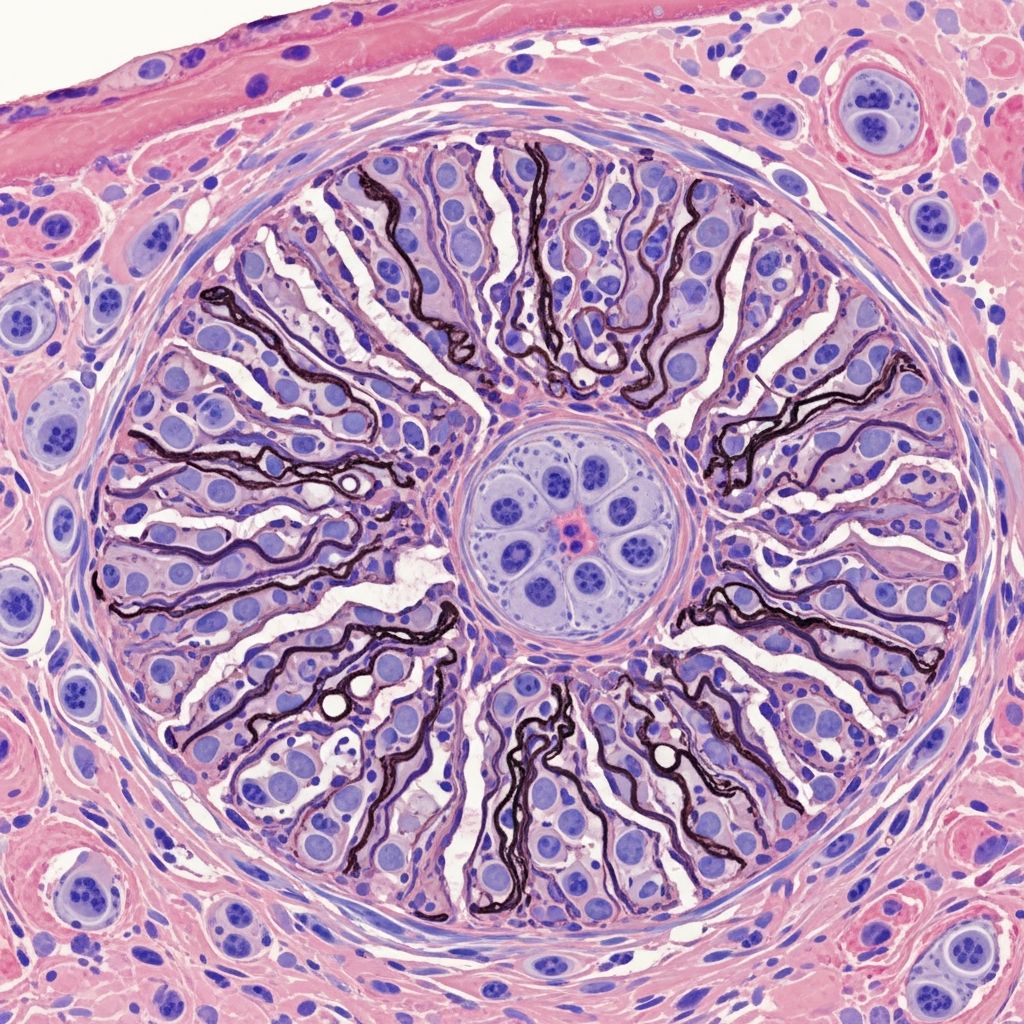
Histopathology
Primary pattern: Granulomatous dermatitis with elastolysis.
| Feature | Present | Absent |
|---|---|---|
| Multinucleated giant cells | Yes (elastophagocytic) | |
| Elastolysis/Reduced elastic fibers | Yes (focal) | |
| Solar elastosis | Often present (background) | |
| Necrobiosis | Yes | |
| Mucin deposition | Yes | |
| Eosinophils | Yes | |
| Palisading | Yes |
Differential diagnosis
| Diagnosis | Key distinguishing features |
|---|---|
| Mid-dermal elastolysis | Band-like loss of mid-dermal elastic fibers; no giant cells or granulomas. |
| Granuloma annulare | Central necrobiosis, mucin, palisading; elastic fibers intact. |
| Actinic granuloma (O’Brien) | Synonymous; some restrict to perifollicular pattern. |
| Cutis laxa | Diffuse elastolysis, no inflammation; clinical laxity. |
| Granulomatous mycosis fungoides | Atypical lymphocytes, epidermotropism; IHC needed. |
| Infectious granulomas (TB, fungi) | Caseation/organisms on special stains; clinical clues. |
Pathogenesis
AEGCG likely represents an exaggerated immune response to photoaged elastic fibers. UV-induced solar elastosis alters elastin antigenicity, triggering CD4+ T-cell mediated inflammation. Macrophages and dendritic cells phagocytose degraded elastin, forming giant cells via fusion. Genetic factors (e.g., HLA associations) and comorbidities like diabetes may predispose, though not universal. No infectious or neoplastic etiology confirmed.
Management
No standardized guidelines; treatments target inflammation and sun protection. Sun avoidance is foundational.
Medical therapies
- First-line: Topical corticosteroids, tacrolimus, or pimecrolimus for localized disease.
- Systemic antimalarials: Hydroxychloroquine (200-400 mg/day) effective in 4-6 months; complete resolution in many cases.
- Other: Pentoxifylline, retinoids (acitretin, isotretinoin), dapsone, cyclosporine for refractory cases.
Physical modalities
- Narrowband UVB or PUVA phototherapy.
- Excision or cautery for small lesions.
Recurrence possible post-therapy; monitor with regular follow-up.
Prognosis
Benign, self-limited in some; chronic progression or recurrence common. No malignant potential. Cosmetic improvement with treatment; residual atrophy/pigmentation may persist.
Frequently asked questions
Q: What causes annular elastolytic giant cell granuloma?
A: Primarily chronic sun exposure leading to elastin damage and granulomatous reaction; exact trigger unknown.
Q: Is AEGCG contagious?
A: No, it is a non-infectious inflammatory dermatosis.
Q: How is the diagnosis confirmed?
A: Skin biopsy with elastic stain showing elastophagocytosis by giant cells.
Q: Does it resolve without treatment?
A: May stabilize but often progresses; treatment accelerates clearance.
Q: Are there associated systemic diseases?
A: Occasional links to diabetes or hypothyroidism; screen as needed.
Expanded case series insights
In a series of 10 patients, all presented with asymptomatic annular lesions on sun-exposed sites, confirmed histologically with giant cell granulomas and elastolysis. Hydroxychloroquine led to resolution in 4-6 months without new lesions. This underscores the efficacy of antimalarials in real-world practice.
Further histopathological nuance: Giant cells are predominantly in the upper dermis, with elastin loss creating clear zones amid preserved deeper fibers. Background solar elastosis is near-universal, supporting actinic etiology.
Differential pitfalls: Distinguish from sarcoidosis (naked granulomas, no elastolysis) or necrobiotic xanthogranuloma (lipids, necrobiosis). IHC (CD68+ histiocytes, CD1a-) aids if mycosis fungoides suspected.
Therapeutic considerations: Antimalarials require ophthalmic screening due to retinopathy risk. Phototherapy suits extensive disease but demands UV protection post-treatment. Emerging options like topical tretinoin show promise in case reports.
References
- Annular elastolytic giant cell granuloma: A report of 10 cases — Indian Journal of Dermatology, Venereology and Leprology (PMC). 2015. https://pmc.ncbi.nlm.nih.gov/articles/PMC4738508/
- Annular elastolytic giant-cell granuloma — Wikipedia (informed by primary sources). Last edited 2023. https://en.wikipedia.org/wiki/Annular_elastolytic_giant-cell_granuloma
- Annular Elastolytic Giant Cell Granuloma — Dermatology Advisor. Updated 2024. https://www.dermatologyadvisor.com/home/decision-support-in-medicine/dermatology/annular-elastolytic-giant-cell-granuloma/
- Elastolytic giant cell granuloma — DermNet NZ. Updated 2023. https://dermnetnz.org/topics/elastolytic-giant-cell-granuloma
- Treatment of Annular Elastolytic Giant Cell Granuloma With Topical Tretinoin — Journal of Drugs in Dermatology. 2017. https://jddonline.com/articles/treatment-of-annular-elastolytic-giant-cell-granuloma-with-topical-tretinoin-S1545961617P0699X
Similar Articles








Read full bio of medha deb