Apixaban Tablets: 3 Main Uses, Dosage & Side Effects
Comprehensive guide to Apixaban (Eliquis): uses, dosage, side effects, and essential patient information for preventing and treating blood clots.
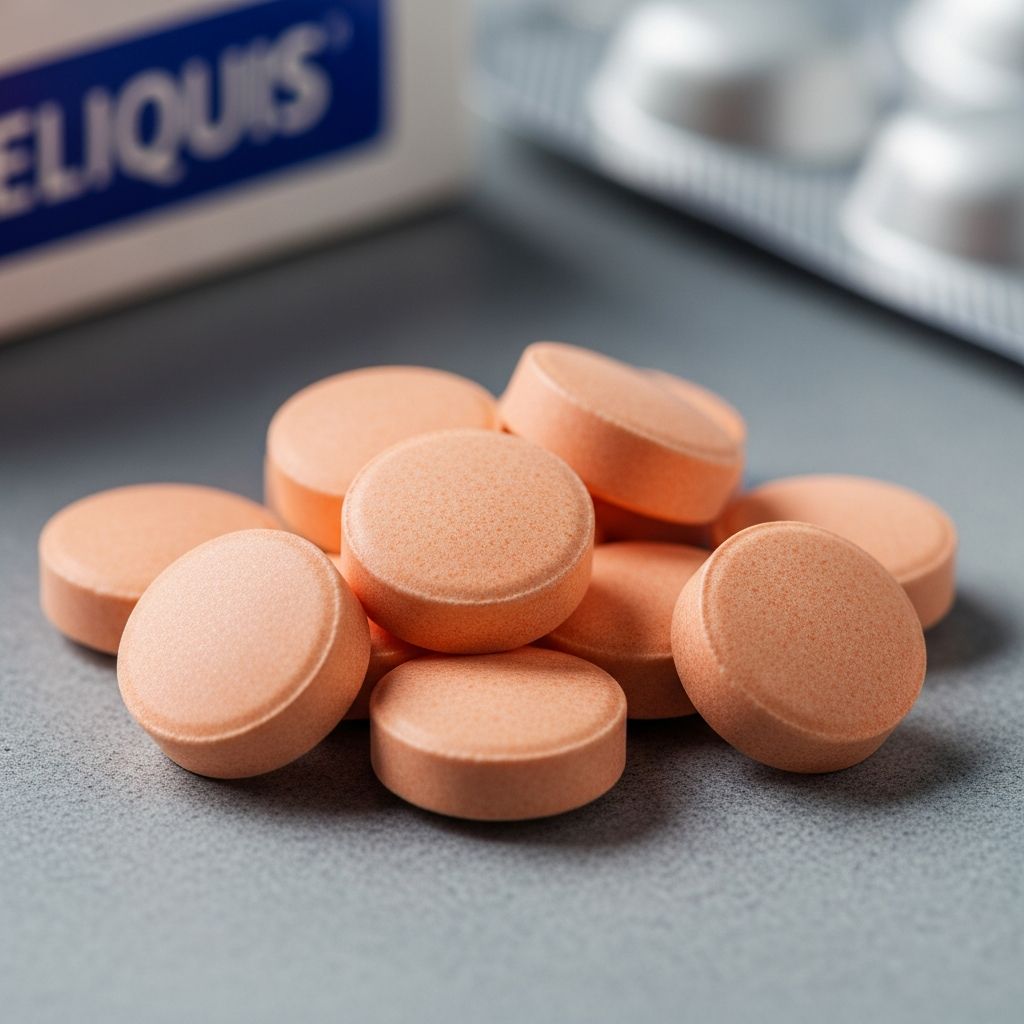
Apixaban, marketed as
Eliquis
, is a direct factor Xa inhibitor anticoagulant designed to prevent your blood from clotting as quickly or effectively as normal. By blocking factor Xa, a key protein in the clotting cascade, it reduces the risk of harmful blood clots that can lead to serious conditions such as stroke, deep vein thrombosis (DVT), or pulmonary embolism (PE).| Type of medicine | Used for | Also called | Available as |
|---|---|---|---|
| A factor Xa inhibitor anticoagulant | To prevent or treat harmful blood clots | Eliquis® (UK and USA) | Tablets |
About apixaban
Apixaban belongs to a class of medications known as novel oral anticoagulants (NOACs) or direct oral anticoagulants (DOACs). Unlike traditional anticoagulants like warfarin, which require frequent blood tests (INR monitoring) to adjust dosing, apixaban works selectively on factor Xa without needing routine laboratory monitoring. This makes it more convenient for long-term use. Clinical trials, such as the ARISTOTLE study, demonstrated that apixaban reduces stroke risk by 21% compared to warfarin in patients with nonvalvular atrial fibrillation (NVAF), with lower rates of major bleeding and mortality.
Apixaban is commonly prescribed for three main purposes:
- Prevention of stroke and systemic embolism in adults with NVAF.
- Treatment and prevention of DVT and PE after initial therapy.
- Prevention of venous thromboembolism (VTE) following hip or knee replacement surgery.
In NVAF patients, the standard dose is 5 mg twice daily, reduced to 2.5 mg twice daily if two or more of the following apply: age ≥80 years, body weight ≤60 kg, or serum creatinine ≥1.5 mg/dL. For VTE prevention post-surgery, it’s 2.5 mg twice daily starting 12-24 hours after surgery, typically for 32-38 days after hip replacement or 10-14 days after knee replacement.
When will your doctor prescribe it?
Your doctor may prescribe apixaban if you have been diagnosed with a condition that increases your risk of blood clots. Common indications include:
- Nonvalvular atrial fibrillation (NVAF): To reduce the risk of stroke and systemic embolism. Apixaban is particularly suitable for high-risk patients unsuitable for warfarin.
- Deep vein thrombosis (DVT) or pulmonary embolism (PE): For treatment after initial parenteral anticoagulation (e.g., heparin), and to prevent recurrence. Recommended duration is at least 3 months for provoked events or longer for unprovoked ones.
- Post-orthopedic surgery: To prevent VTE after elective hip or knee replacement.
Apixaban is not indicated for patients with mechanical heart valves, valvular AF, or those with antiphospholipid syndrome due to increased thrombotic risk.
How and when to take apixaban
The usual adult dose is
one 5 mg tablet taken twice a day
(morning and evening, approximately 12 hours apart), with or without food. Swallow the tablet whole with water; do not crush or chew unless instructed for enteral administration.Dose adjustments
| Indication | Recommended Dose | Notes |
|---|---|---|
| NVAF (stroke prevention) | 5 mg twice daily | Reduce to 2.5 mg if ≥2 of: age ≥80, weight ≤60 kg, Cr ≥1.5 mg/dL |
| DVT/PE treatment | 10 mg twice daily for 7 days, then 5 mg twice daily | Minimum 3 months; assess risk/benefit for extension |
| VTE prevention post-hip/knee surgery | 2.5 mg twice daily | Hip: 32-38 days; Knee: 10-14 days |
| Recurrent DVT/PE prevention | 2.5 mg twice daily | After initial treatment |
Related Stories



Missed dose: Take as soon as remembered on the same day. Do not take double doses. If near the next dose, skip and resume schedule.
For patients with renal impairment (CrCl 15-29 mL/min), dose reduction may be needed; avoid in CrCl <15 mL/min or dialysis. Use caution in mild/moderate hepatic impairment; contraindicated in severe hepatic disease with coagulopathy.
Getting the most from your treatment
To maximize benefits and minimize risks:
- Take at the same times daily for steady blood levels.
- Keep all doctor appointments for progress checks, though no routine blood tests are needed.
- Treatment duration varies: weeks post-surgery, months for DVT/PE, or lifelong for AF.
- Inform all healthcare providers you’re taking apixaban before procedures.
- Report bleeding immediately; carry alert card.
- Avoid alcohol excess; maintain healthy weight and activity.
Side-effects
The most common side effect is
bleeding
, ranging from minor (nosebleeds, bruising) to major (gastrointestinal, intracranial). Apixaban has a lower major bleeding risk than warfarin (one fewer event per 66 patients over 1.8 years) but slightly higher minor bleeding than aspirin.Other effects:
- Anaemia (due to bleeding).
- Nausea (about 7%).
- Skin rash.
- Discontinuation rate: ~6.3%, mainly bleeding.
| Common (>1/100) | Serious (seek help) |
|---|---|
| Bruising, nosebleeds, anaemia | Severe bleeding, black stools, vomiting blood, prolonged bleeding |
| Nausea | Signs of stroke (weakness, confusion), allergic reaction (swelling, breathing difficulty) |
In trials, apixaban showed better tolerability than warfarin or aspirin, with fewer discontinuations.
How to cope with side effects
- Bleeding: Use soft toothbrush, electric razor; avoid contact sports, heavy lifting.
- Nausea: Take with food; small frequent meals.
- Bruising: Protect skin; report if excessive.
- Monitor for serious signs: dizziness, pallor, rapid heartbeat—seek emergency care.
Specific reversal agent: Andexanet alfa for life-threatening bleeds.
Precautions
Discuss with your doctor if you have:
- Recent bleeding, liver/kidney disease, uncontrolled hypertension.
- Upcoming surgery: Stop 24-48 hours prior based on bleed risk.
- Drug interactions: Avoid strong CYP3A4/P-gp inhibitors (ketoconazole, ritonavir); caution with NSAIDs, aspirin.
Contraindicated with: active bleed, hepatic coagulopathy, mechanical valves, pregnancy/breastfeeding.
Pregnancy and breastfeeding
Apixaban is not recommended during pregnancy due to potential fetal harm; use effective contraception. Limited data in breastfeeding—avoid or monitor infant.
Other things to know
- Cost: More expensive than warfarin/aspirin; no monitoring offsets some costs.
- Storage: Room temperature, away from moisture.
- Overdose: Seek immediate help; no routine antidote for minor cases.
- Well-tolerated overall, preferred for nonvalvular AF.
Frequently Asked Questions (FAQs)
Q: Do I need regular blood tests with apixaban?
No, unlike warfarin, apixaban does not require routine INR monitoring.
Q: What if I miss a dose?
Take it as soon as possible that day; do not double up.
Q: Can I take apixaban with other medications?
Check with your doctor; avoid certain antifungals, HIV drugs, NSAIDs.
Q: Is apixaban safe for surgery?
Stop 24-48 hours before based on risk; resume post-procedure.
Q: How does apixaban compare to warfarin?
Similar/better stroke prevention, lower major bleeding, no monitoring needed.
References
- Apixaban (Eliquis) for Stroke Prevention in Atrial Fibrillation — American Academy of Family Physicians. 2014-04-15. https://www.aafp.org/pubs/afp/issues/2014/0415/p672.html
- Eliquis EPAR Product Information — European Medicines Agency. (Latest update prior to 2026). https://www.ema.europa.eu/en/documents/product-information/eliquis-epar-product-information_en.pdf
- Apixaban to prevent blood clots – Eliquis — Patient.info. 2022-10-27. https://patient.info/medicine/apixaban-tablets-eliquis
- What You Should Know About Apixaban (Eliquis) — Banner Health. (Accessed 2026). https://www.bannerhealth.com/healthcareblog/teach-me/apixaban-eliquis-what-you-need-to-know
- Apixaban — StatPearls, NCBI Bookshelf. (Updated 2023 or later). https://www.ncbi.nlm.nih.gov/books/NBK507910/
Similar Articles








Read full bio of medha deb