Apocrine Mixed Tumor Pathology: Complete Guide To Diagnosis
Comprehensive pathology guide to apocrine mixed tumour: clinical features, histopathology, diagnosis and management insights.
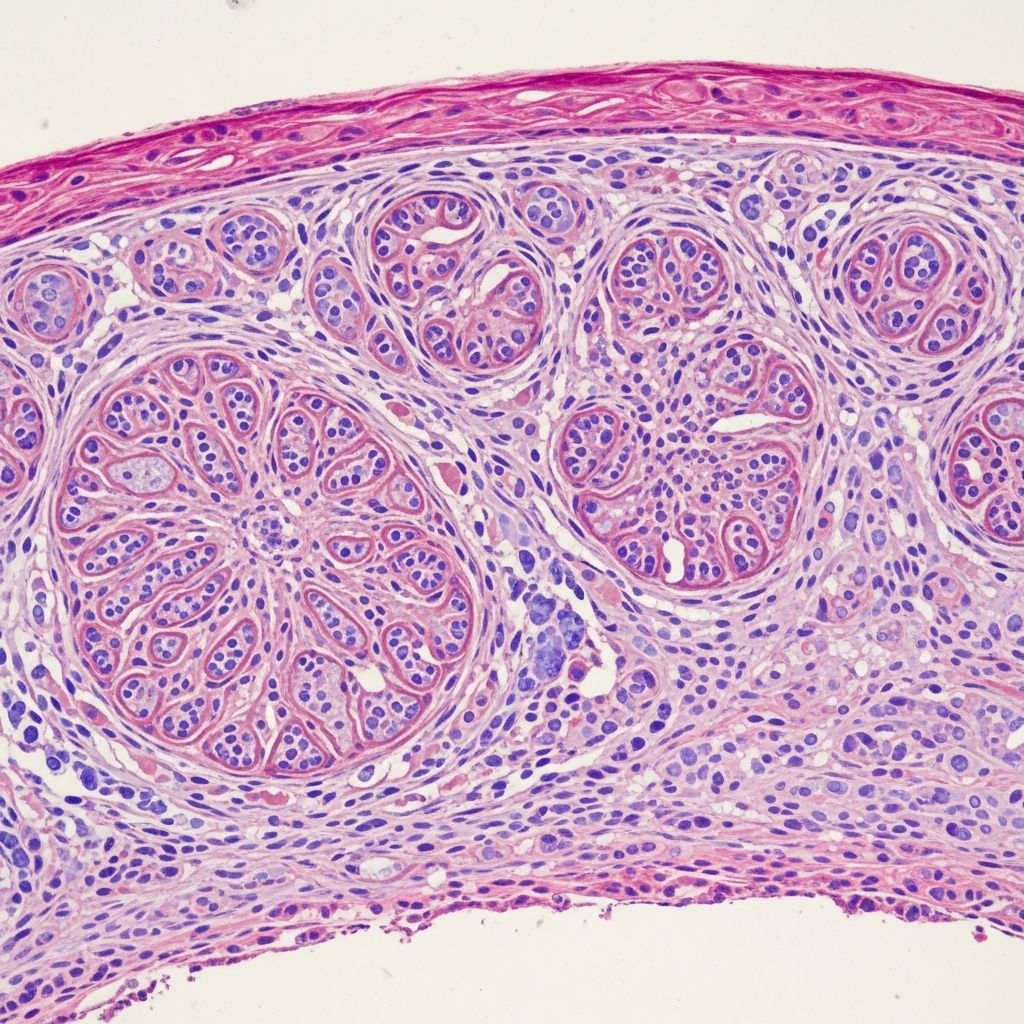
Apocrine mixed tumour, also known as chondroid syringoma of apocrine type, represents a rare benign adnexal neoplasm of the skin characterized by combined epithelial and mesenchymal differentiation, primarily showing apocrine glandular features within a chondromyxoid stroma.
Introduction
Apocrine mixed tumours belong to the family of cutaneous mixed tumours, which exhibit pluripotential differentiation towards folliculosebaceous-apocrine structures. While traditionally classified into apocrine and eccrine subtypes, recent studies emphasize their folliculosebaceous-apocrine origin, with the apocrine variant distinguished by tubular-cystic structures displaying decapitation secretion. These tumours mirror salivary gland pleomorphic adenomas histologically but occur in cutaneous sites, predominantly the head and neck region.
The term ‘mixed tumour’ better reflects their biphasic composition than ‘chondroid syringoma,’ which implies eccrine differentiation. Apocrine mixed tumours constitute approximately 70-80% of cutaneous mixed tumours, presenting diagnostic challenges due to clinical nonspecificity and histological variability.
Clinical features
Apocrine mixed tumours typically manifest as solitary, firm, dermal or subcutaneous nodules measuring 0.5-3 cm in diameter, with a predilection for the head and neck, particularly the scalp, face, and upper lip. Lesions appear skin-coloured to translucent, often mobile over underlying structures, and asymptomatic unless ulcerated or secondarily infected.
- Demographics: Predominantly affects adults aged 20-60 years, with slight male predominance; rare in children.
- Sites: Head and neck (85%), trunk (10%), extremities (5%); upper lip and scalp common for apocrine subtype.
- Morphology: Smooth-surfaced nodule, occasionally multinodular or pedunculated; large variants (>3 cm) or multiple lesions exceptional.
Malignant transformation is exceedingly rare (0.5-2%), typically in longstanding lesions, presenting with rapid growth, pain, or ulceration, and potential for regional lymph node or distant metastases.
Histopathology
Histologically, apocrine mixed tumours display a well-circumscribed, multilobulated dermal or subcutaneous nodule composed of epithelial elements embedded in a characteristic mesenchymal stroma.
Epithelial component
Epithelial structures form tubular, cystic, or duct-like formations lined by two cell layers: inner cuboidal/columnar cells showing apocrine decapitation secretion, and outer myoepithelial cells.
- Apocrine differentiation: Branching tubules with papillary projections, eosinophilic secretions, and ‘decapitation’ droplets.
- Follicular elements: Germinative cells, trichohyalin granules, or matrical differentiation in 60-70% of cases.
- Sebaceous differentiation: Occasional, with lipidized cells or sebocytes.
Stroma
The hallmark
chondromyxoid stroma
is abundant, basophilic, and Alcian blue-positive, ranging from myxoid to chondroid, hyalinized, or rarely osseous/adipocytic.- Myxoid (60%): Loose, mucinous matrix with stellate fibroblasts.
- Chondroid (30%): Cartilaginous nodules with metachromatic matrix.
- Fibrous/hyalinized (10%): Dense collagenous bands.
- Rare metaplasias: Bone, fat, or neural elements.
Myoepithelial cells rim epithelial structures and infiltrate stroma, contributing to the biphasic pattern. Deeper dermal extension shows increased folliculosebaceous differentiation and larger lumina.
Cytology
Cells lack significant atypia, mitoses (<2/10 HPF), or necrosis in benign lesions. Infiltrative borders or satellite nodules raise malignancy concern.

Histochemistry
Mucinous stroma stains positively with Alcian blue (pH 2.5) and PAS, confirming glycosaminoglycan content. Mucicarmine highlights intraluminal secretions. Reticulin stain delineates epithelial clusters.
Immunohistochemistry
IHC confirms biphasic nature and apocrine differentiation.
| Component | Markers | Pattern |
|---|---|---|
| Inner epithelial cells | CK7, CEA, EMA, GCDFP-15 | Luminal |
| Myoepithelial cells | p63, CK5/6, SMA, calponin, S100 | Peripheral/abundant |
| Stromal cells | Vimentin, S100 (focal), PLAG1 | Diffuse |
Related Stories



PLAG1 and HMGA2 rearrangements underlie pathogenesis, detectable by FISH. Negative markers: CK20, ER/PR (distinguishing from salivary counterparts).
Genetics
Cutaneous mixed tumours share PLAG1/HMGA2 fusions with pleomorphic adenoma, supporting hamartomatous origin. Apocrine subtype shows apocrine-specific gene expression profiles.
Differential diagnosis
Clinical mimics include epidermoid cyst, neurofibroma, basal cell carcinoma. Histological differentials:
| Entity | Key Distinguishing Features |
|---|---|
| Eccrine spiradenoma | Painful, swirling epithelial cords, absent chondroid stroma |
| Pleomorphic adenoma (salivary) | Intraductal growth, higher recurrence risk |
| Mucoepidermoid carcinoma | Atypia, mitoses, squamous/mucinous cells |
| Trichoblastoma | Predominant follicular germinative cells, fibrocellular stroma |
| Cylindroma | Jigsaw puzzle pattern, hyaline cylinders |
Management
Complete surgical excision with narrow margins suffices for cure, given rarity of recurrence (<2%). Mohs micrographic surgery recommended for recurrent or high-risk sites. Malignant variants require wide excision and lymph node staging.
Prognosis
Excellent for benign apocrine mixed tumours, with <1% recurrence post-excision. Malignant transformation rare, worse with infiltrative growth or metastases.
Frequently asked questions
What is an apocrine mixed tumour?
A benign skin tumour with apocrine glandular and chondromyxoid stromal elements, akin to salivary pleomorphic adenoma.
Is apocrine mixed tumour cancerous?
Almost always benign; malignant change in <2% of cases, often longstanding lesions.
How is it diagnosed?
Definitive diagnosis requires biopsy showing biphasic pattern with IHC confirmation.
What does it look like under the microscope?
Tubular-cystic apocrine structures in myxochondroid stroma, lined by inner secretory and outer myoepithelial cells.
Where do they commonly occur?
Head and neck (scalp, face, ears); rare on trunk/extremities.
Images
- Clinical: Firm nodule on scalp of 45-year-old male.
- Low power (H&E 20x): Circumscribed dermal nodule.
- Medium power (H&E 100x): Apocrine tubules with decapitation secretion in chondroid stroma.
- High power (H&E 400x): Biphasic cellular pattern.
- IHC: p63 highlights myoepithelial layer; S100 stains stroma.
References
- Mixed tumour of the skin — Altmeyers Encyclopedia. 2024. https://www.altmeyers.org/en/dermatology/mixed-tumour-of-the-skin-121351
- Clinical and Histopathologic Study of Apocrine-Type Mixed Tumor — PubMed (Am J Dermatopathol). 2024-01-01. https://pubmed.ncbi.nlm.nih.gov/38133531/
- Chondroid syringoma (Mixed tumor of the skin) — Dermatology Advisor. 2024. https://www.dermatologyadvisor.com/home/decision-support-in-medicine/dermatology/chondroid-syringoma-mixed-tumor-of-the-skin/
- Mixed tumour of the skin of the lower lip: A case report — Spandidos Publications (Mol Clin Oncol). 2022-01-20. https://www.spandidos-publications.com/10.3892/mco.2022.2502
- Chondroid Syringoma — NCBI StatPearls. 2023-07-17. https://www.ncbi.nlm.nih.gov/books/NBK609089/
Similar Articles








Read full bio of Sneha Tete