Arm Fracture Open Reduction and Internal Fixation
Complete guide to ORIF surgery for broken arms: procedures, recovery, and outcomes.
Understanding Arm Fracture Open Reduction and Internal Fixation
Open reduction and internal fixation (ORIF) is a surgical procedure designed to repair broken bones by repositioning bone fragments and securing them with specialized hardware. This minimally invasive yet effective treatment option has become increasingly popular for managing complex arm fractures, particularly those affecting the humerus (upper arm bone). The procedure allows orthopedic surgeons to restore proper bone alignment and facilitate optimal healing outcomes.
An arm fracture can significantly impact your daily activities, work performance, and overall quality of life. When conservative treatment methods prove insufficient, ORIF offers a reliable surgical solution that promotes faster healing and functional recovery compared to non-operative management.
What Is ORIF?
Open reduction and internal fixation consists of two primary components that work together to stabilize and heal fractured bones. The procedure combines surgical intervention with advanced fixation techniques to ensure proper bone alignment and healing.
Open Reduction
The open reduction component refers to the surgical exposure and repositioning of fractured bone fragments. During this phase, an orthopedic surgeon makes an incision to directly access the fracture site. This direct visualization allows the surgeon to carefully manipulate the bone pieces back into their anatomically correct position. Unlike closed reduction, where bones are repositioned without surgical incision, open reduction provides superior control and visibility, particularly for complex fractures with multiple fragments or significant displacement.
Internal Fixation
Internal fixation refers to the method of permanently securing the repositioned bone fragments using specialized hardware. This stabilization technique prevents the bones from shifting out of alignment during the healing process and eliminates the risk of abnormal healing (malunion). The surgeon selects appropriate fixation devices based on the fracture pattern, bone quality, and individual patient factors.
Why ORIF May Be Necessary
Not all arm fractures require surgical intervention. Your orthopedic surgeon evaluates multiple factors when determining whether ORIF is appropriate for your specific injury. Understanding these decision-making criteria helps clarify why surgery may be recommended in your case.
Fracture Displacement represents one of the primary indicators for ORIF. Fractures are considered displaced when fragments are separated by more than 5 millimeters or when the angle between fragments exceeds 45 degrees. Significantly displaced fractures have reduced potential for successful non-operative healing and typically benefit from surgical realignment.
Fracture Complexity also influences surgical decision-making. Proximal humerus fractures involving multiple fragments, particularly those affecting the rotator cuff tendons or articular surface, frequently require ORIF to restore shoulder function and prevent long-term complications.
Additional factors your surgeon considers include your age, overall health status, bone quality, blood supply to the fracture area, ability to comply with post-operative rehabilitation protocols, and functional demands. Younger, more active patients typically benefit more from ORIF’s superior functional outcomes compared to conservative management.
Related Stories



The ORIF Surgical Procedure
Understanding the surgical process helps you prepare mentally and physically for your procedure. ORIF for arm fractures typically follows a standardized surgical approach designed to minimize tissue trauma while achieving optimal fracture reduction.
Pre-operative Preparation
Before your surgery, you will receive general anesthesia to ensure complete pain control and muscle relaxation throughout the procedure. Your surgical team positions you to optimize access to the fracture site and allow imaging verification from multiple angles. For proximal humerus fractures, surgeons typically utilize the beach-chair position, which facilitates shoulder movement assessment and imaging capability.
Surgical Exposure
The surgeon makes an incision through the anterior and middle sections of the deltoid muscle (shoulder muscle) to access the fracture site. This approach provides excellent visualization of the proximal humerus and rotator cuff structures. Careful tissue handling and identification of vital neurovascular structures, particularly the axillary nerve, ensures minimal soft tissue trauma and preserves shoulder function.
Fracture Reduction
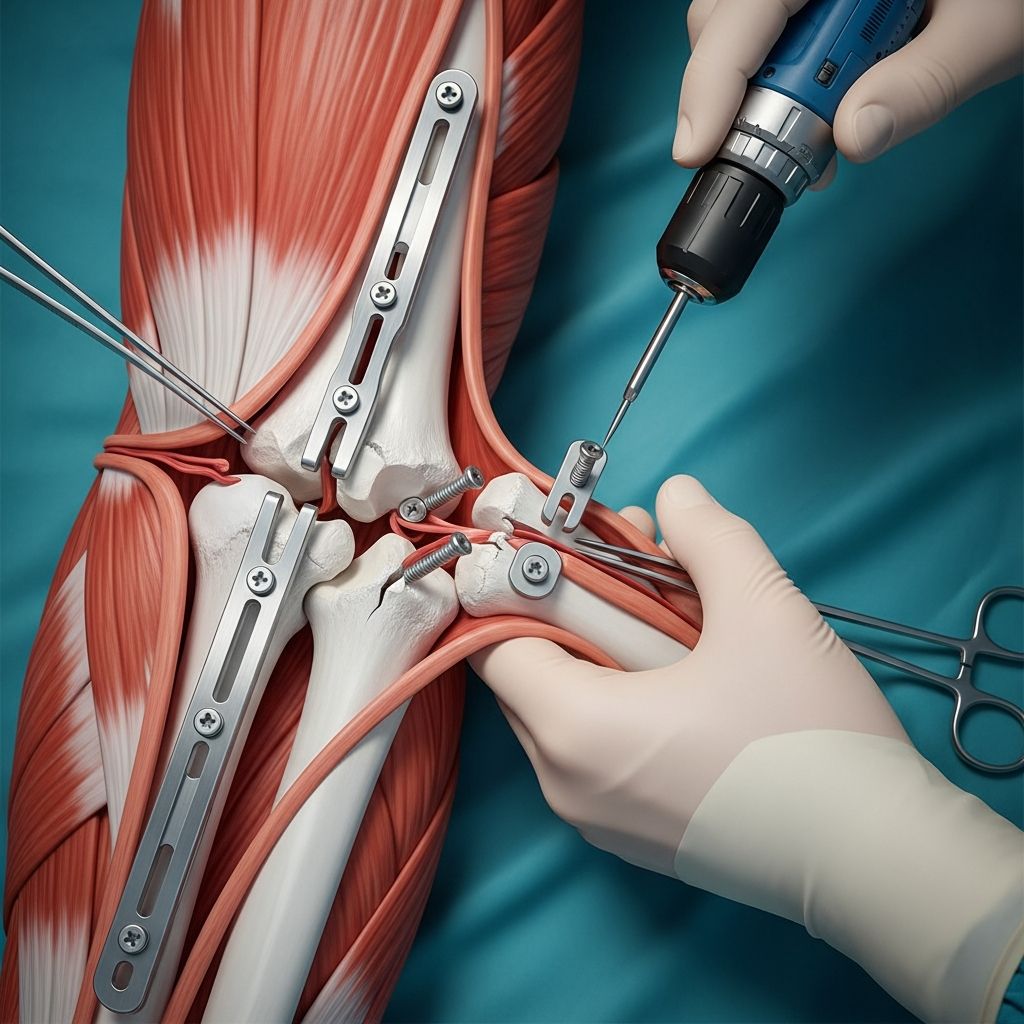
Once the fracture is exposed, the surgeon carefully cleans the fracture margins and prepares the fracture bed for optimal healing. Stay sutures are placed through rotator cuff tendons to provide manipulation handles for controlling fracture fragments. The surgeon then manipulates the bone pieces into their correct anatomic alignment, often assisted by temporary K-wires that hold fragments in position during the fixation process.
Internal Fixation Device Placement
Once proper alignment is achieved, the surgeon secures the bone fragments using one of several fixation options. These may include strong sutures, screws, specialized plate-and-screw systems, or intramedullary nails, depending on the fracture pattern and bone quality. Modern locking plate technology distributes load evenly across the plate, providing enhanced stability and reducing complications like screw pull-out.
The surgeon strategically places screws in divergent and convergent patterns through the humeral head to maximize purchase and stability. In some cases, fibular struts may be inserted to provide additional structural support, particularly in varus or valgus-impacted fractures.
Verification and Closure
Following fixation, the surgical team performs imaging studies from multiple angles to verify correct bone alignment and appropriate hardware positioning. The surgeon confirms that no screws penetrate the joint surface and that the shoulder maintains full range of motion without impingement. After final verification, the rotator cuff stay sutures may be passed through plate holes for reinforcement, and the incision is carefully closed in layers.
Benefits and Advantages of ORIF
ORIF offers several significant advantages that make it an attractive treatment option for appropriate arm fractures:
- Optimal Bone Alignment: Direct visualization and manipulation allow surgeons to achieve anatomically perfect fracture reduction, improving functional outcomes and reducing long-term complications.
- Enhanced Stability: Advanced fixation hardware provides immediate stability, allowing early mobilization and rehabilitation without fear of fracture displacement.
- Reduced Hospital Stay: Compared to prolonged immobilization, ORIF typically requires shorter hospitalization periods and faster return to functional activities.
- Earlier Rehabilitation: Immediate fixation stability enables earlier physical therapy initiation, preventing stiffness and promoting faster functional recovery.
- Lower Nonunion Risk: Proper reduction and stable fixation significantly decrease the risk of nonunion (failure to heal) and malunion (healing in incorrect position).
- Superior Functional Outcomes: Studies demonstrate that ORIF produces better long-term shoulder function, strength, and range of motion compared to conservative treatment for displaced fractures.
Potential Risks and Complications
While ORIF is generally safe and effective, like all surgical procedures, it carries certain inherent risks. Understanding these potential complications helps you make informed decisions and recognize warning signs during recovery.
Infection represents one of the most common surgical complications, though modern sterile protocols have minimized this risk. Signs include increasing redness, warmth, drainage, or fever, which require prompt medical attention.
Bleeding and Hematoma Formation may occur at the surgical site. Most minor bleeding resolves spontaneously, though significant hematomas may require drainage.
Nerve Damage can result from direct injury or stretching during surgery. The axillary nerve, which controls shoulder abduction, represents the primary nerve at risk. Nerve injuries may cause weakness or sensory changes, though most recover over time.
Avascular Necrosis (AVN) results from compromised blood supply to the bone fragments, particularly the humeral head. This devastating complication can develop months or years post-surgery and may ultimately require prosthetic replacement.
Frozen Shoulder (adhesive capsulitis) presents with progressive shoulder stiffness and pain that restricts range of motion. This complication requires aggressive physical therapy and may respond to corticosteroid injections.
Subacromial Impingement occurs when soft tissue structures become compressed between the humeral head and acromion process, causing pain and limiting shoulder movement. Hardware positioning optimization during surgery helps prevent this complication.
Hardware Complications include screw pull-out, plate loosening, or screw penetration into the joint surface. Appropriate surgical technique and modern locking technology have significantly reduced these complications.
Post-operative Care and Recovery
Successful ORIF outcomes depend heavily on proper post-operative care and patient compliance with rehabilitation protocols. Your recovery follows a structured progression from immobilization through functional strengthening.
Immediate Post-operative Period
Following surgery, your arm will be immobilized in a sling to protect the fixation while soft tissues heal. Pain management typically involves prescription medications during the immediate post-operative period. Most patients experience significant pain reduction within the first two weeks as acute inflammation subsides.
Early Mobilization Phase
Beginning the first post-operative day, you will initiate gentle arm movements as pain allows. Passive range of motion exercises, where the physical therapist moves your arm without muscle contraction, begin within days of surgery. Assisted active range of motion exercises, combining your muscle effort with therapist assistance, gradually progress over the following weeks.
Progressive Rehabilitation
After approximately two to three weeks, you transition to active range of motion exercises where you move your arm independently. Activities of daily living gradually resume, though restrictions remain regarding lifting and resistance movements for at least six weeks post-operatively.
Strengthening exercises begin around six weeks post-op, starting with gentle resistance and progressively increasing intensity. Your physical therapist guides progression through multiple rehabilitation phases, advancing based on pain levels, strength gains, and functional milestones.
Return to Function
Most patients return to sedentary activities within four to six weeks, though return to heavy labor or sports requires three to six months of rehabilitation. Your surgeon provides individualized timeline recommendations based on fracture complexity, fixation stability, and your specific functional goals.
Frequently Asked Questions
Q: How long does the ORIF surgery typically take?
A: The procedure typically requires one to two hours, though complex fractures may require additional time. The duration depends on fracture complexity, number of fragments, and any additional surgical techniques required.
Q: Will I have visible scarring after ORIF?
A: Yes, a surgical scar will remain at the incision site, typically measuring three to five inches for proximal humerus procedures. Scar appearance improves over 12 to 18 months as healing progresses, and plastic surgery revision is occasionally performed if scar prominence causes concern.
Q: When can I return to work after ORIF?
A: Return to work depends on your occupation. Desk work may resume within two to four weeks, while jobs requiring arm strength or heavy lifting require six to twelve weeks of rehabilitation. Your surgeon provides work restriction guidelines based on your specific injury.
Q: Will the hardware need to be removed after healing?
A: Most ORIF hardware remains permanently in place and requires no removal. Hardware removal is performed only if patients develop complications, experience pain from hardware prominence, or specifically request removal after complete healing.
Q: How long does bone healing typically take?
A: Initial bone healing progresses over 6 to 12 weeks, though complete remodeling continues for 12 to 24 months. Hardware stability allows earlier mobilization compared to immobilization alone, though heavy loading requires longer healing periods.
Q: What physical therapy exercises can I do at home?
A: Your physical therapist prescribes specific home exercise programs tailored to your recovery phase. Early phases emphasize gentle pendulum exercises and passive stretching, while later phases progress to resistance bands and strengthening exercises.
Comparing Treatment Options
When facing a significant arm fracture, you have multiple treatment options. Understanding how ORIF compares to alternative approaches helps you and your surgeon select the most appropriate management strategy.
| Treatment Option | Healing Time | Functional Outcomes | Hospital Stay | Rehabilitation |
|---|---|---|---|---|
| ORIF Surgery | 6-12 weeks | Excellent with optimal reduction | 1-3 days | Early mobilization, 3-6 months |
| Conservative (Immobilization) | 8-16 weeks | Variable, depends on fracture reduction | None | Delayed, risk of stiffness |
| Closed Reduction | 8-14 weeks | Good if reduction maintained | None to 1 day | Moderate, 4-8 weeks |
| Prosthetic Replacement | 6-12 weeks | Good for unreconstructable fractures | 2-3 days | Early mobilization, 3-6 months |
Conclusion
Open reduction and internal fixation represents a gold-standard surgical approach for managing complex and displaced arm fractures. By directly repositioning bone fragments and securing them with advanced hardware, ORIF enables optimal bone alignment, early mobilization, and superior functional recovery compared to conservative management alternatives.
While ORIF carries inherent surgical risks, appropriate patient selection, meticulous surgical technique, and dedicated post-operative rehabilitation combine to produce excellent long-term outcomes. If your orthopedic surgeon recommends ORIF for your arm fracture, the procedure offers the best opportunity for complete healing and return to your desired activity level.
References
- Internal Fixation for Fractures — American Academy of Orthopaedic Surgeons (AAOS). 2024. https://orthoinfo.aaos.org/en/treatment/internal-fixation-for-fractures/
- Open Reduction Internal Fixation of Proximal Humerus Fractures — National Institutes of Health (NIH/PubMed Central). PMC3702763. 2024. https://pmc.ncbi.nlm.nih.gov/articles/PMC3702763/
- Upper Arm Fracture Open Reduction and Internal Fixation — University of Rochester Medical Center (URMC). 2024. https://www.urmc.rochester.edu/encyclopedia/content?contenttypeid=135&contentid=311
- Open Reduction and Internal Fixation (ORIF) — Cleveland Clinic. 2024. https://my.clevelandclinic.org/health/procedures/open-reduction-and-internal-fixation-orif
- Upper Arm Fracture Open Reduction and Internal Fixation (ORIF) — UMM Health. 2024. https://www.ummhealth.org/health-library/upper-arm-fracture-open-reduction-and-internal-fixation-orif
- Rehabilitation Protocol for Proximal Humeral Fracture with ORIF — Massachusetts General Hospital Department of Orthopaedics. 2024. https://www.massgeneral.org/assets/MGH/pdf/orthopaedics/sports-medicine/physical-therapy/rehabilitation-protocol-for-proximal-humeral-fracture-with-ORIF.pdf
- Open Reduction & Internal Fixation of Proximal Humerus Fracture — Herrera Sports Medicine. 2024. https://www.herrerasportsmedicine.com/open-reduction-internal-fixation-of-proximal-humerus-fracture-orthopaedic-surgeon-miami-fl/
Similar Articles








Read full bio of medha deb