Arm Muscles Guide: Anatomy, Function And Movement
Explore the anatomy and functions of upper arm and forearm muscles that enable movement and precision.
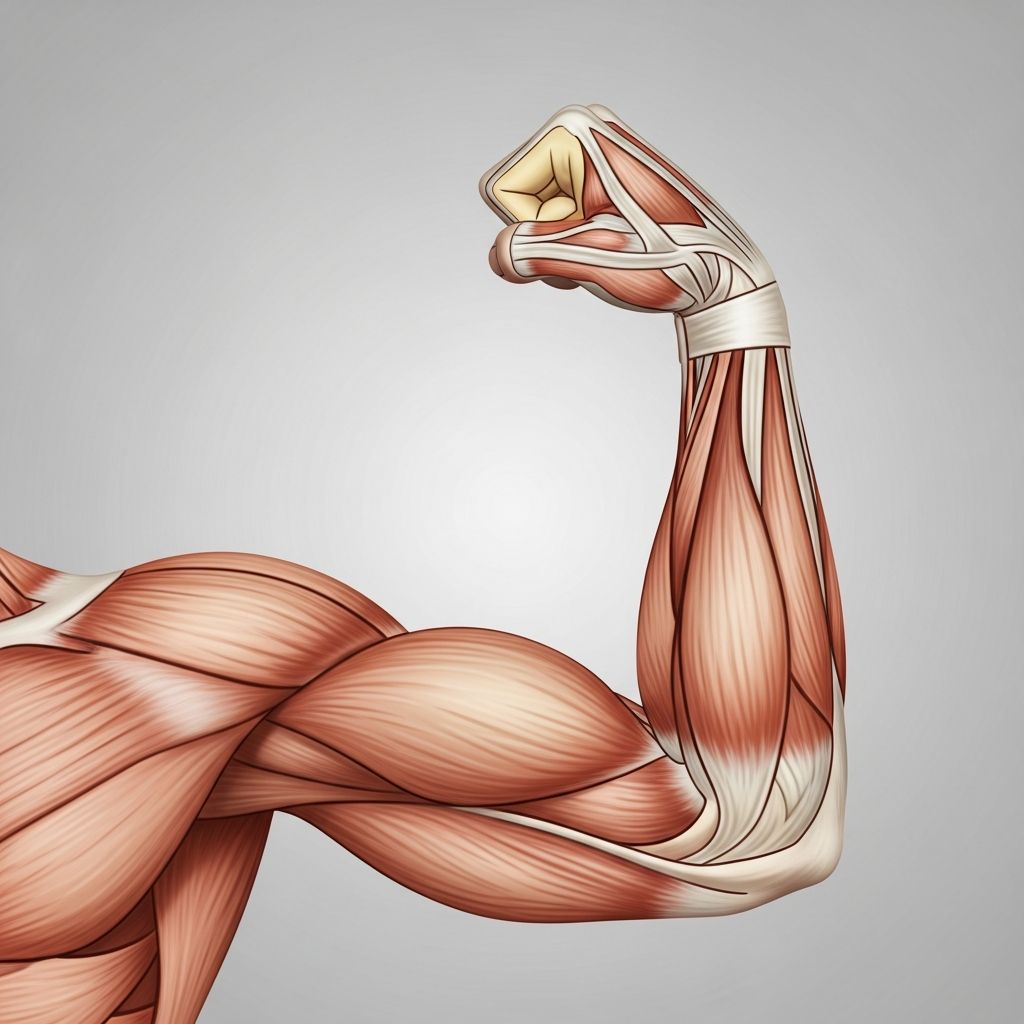
Understanding Arm Muscles: Anatomy and Function
Your arms are complex systems of more than twenty muscles that work in harmony to enable everything from delicate precision tasks to powerful movements. The arm muscles are divided into two main regions: the upper arm (the area between your shoulder and elbow) and the forearm (the area between your elbow and wrist). These muscles are part of your musculoskeletal system and are classified as skeletal muscles, made up of individual fibers bundled together to create a striated, or striped, appearance. Understanding how these muscles function is essential for appreciating the remarkable range of motion your arms can achieve.
The Structure of Arm Muscles
Arm muscles operate as a coordinated system, with some muscles located close to the surface of your skin where you can easily see their outline when contracted, while others sit deep within your arm. Tendons, which are soft tissues, attach your muscles to bones in your arm and shoulder, acting as the connection points that allow muscle contractions to translate into bone movement. This intricate network of muscles and tendons enables you to perform both large, sweeping movements and small, precise actions with remarkable control.
Upper Arm Muscles: Power and Movement
The upper arm contains four main muscles that work together to provide the primary movements of your arm. These muscles are responsible for lifting, lowering, and stabilizing your arm throughout its range of motion.
The Biceps Brachii
The biceps muscle is located on the front of your upper arm, just under your skin’s surface. This highly visible muscle is responsible for bending your arm at the elbow and rotating your forearm. When you flex your arm to show your muscle, the biceps is the primary muscle you see. It plays a crucial role in lifting objects and pulling movements, making it one of the most functionally important muscles in your upper arm.
The Triceps Brachii
Located on the back of your upper arm just above your elbow, your triceps muscle sits just under your skin’s surface, similar to the biceps. The triceps is responsible for extending your arm and straightening your elbow. While the biceps bends your arm, the triceps straightens it, and together they create a balanced system of opposing movements. The triceps is particularly important in pushing movements and activities like doing push-ups.
The Brachialis
Deep beneath the biceps lies the brachialis muscle, which assists in bending your arm at the elbow. Although less visible than the biceps, the brachialis provides significant power and stability during elbow flexion movements. This muscle works in conjunction with the biceps to provide comprehensive elbow movement capability.
The Coracobrachialis
A small muscle at the front and top of your upper arm, the coracobrachialis attaches to your shoulder joint and extends to your upper arm bone. While not one of the most prominent arm muscles, it plays a supporting role in bending your upper arm and bringing it close to your body. The coracobrachialis can become tight from certain activities and may be a hidden source of shoulder or arm pain if overused.
What Your Upper Arm Muscles Help You Do
Your upper arm muscles collectively enable several critical functions:
– Raise your arm above your head- Move your arm forward and backward- Rotate your arm inward and outward- Perform pushing and pulling movements- Stabilize your shoulder joint
Related Stories



Forearm Muscles: Precision and Control
The forearm contains numerous muscles organized into layers. These muscles are essential for controlling your fingers and thumbs, enabling everything from delicate tasks like threading a needle to gripping movements. The forearm muscles are divided into superficial and deep layers, with different muscles on both the top and underside of your forearm.
Superficial Muscles on the Underside of Your Forearm
Several muscles sit on the underside of your forearm, close to your skin’s surface. Most of these muscles start below your elbow and extend to your wrist. These superficial muscles include those responsible for flexing your wrist and fingers, allowing you to make grasping and gripping movements. They work together to enable the fine motor control necessary for precise hand positioning and movement.
Superficial Muscles on the Top of Your Forearm
The top surface of your forearm also contains superficial muscles visible when flexed. These muscles are primarily responsible for extending your wrist and fingers, straightening them out from a closed position. These muscles work in opposition to the flexor muscles on the underside, creating a balanced system of movement and control.
Deep Muscles of the Forearm
Beneath the superficial muscles lie deeper layers of muscle tissue. On the underside, deep muscles sit under the superficial muscles and perform specialized functions. Muscles located deep under your skin on the top of your forearm also contribute to the overall functionality of your arm. These deep muscles provide additional support, stability, and specialized movements that complement the actions of the superficial muscles.
Functions of Your Forearm Muscles
Muscles on both the underside and the top of your forearm work together to enable multiple essential functions:
– Bend and straighten your wrist- Rotate your forearm- Flex and extend your fingers- Grip and grasp objects- Perform fine motor tasks requiring precision- Maintain grip strength during sustained activities
Big Movements vs. Fine Motor Movements
Your arm muscles enable two distinct categories of movement. Big movements, or gross motor movements, include straightening your elbow, raising your arms above your head, and performing push-ups. These powerful movements are primarily controlled by your larger upper arm muscles like the biceps and triceps. In contrast, fine motor movements include wiggling your fingers or fastening a button, requiring the coordinated action of the many smaller muscles in your forearm and hand. This dual capability makes your arms incredibly versatile tools for interacting with your environment.
How Arm Muscles Work Together
Arm muscles function as an integrated system rather than in isolation. When you perform an arm movement, multiple muscles contract and relax in a coordinated pattern. Antagonistic muscle pairs, such as the biceps and triceps, work in opposition to create smooth, controlled movements. When one muscle contracts (the agonist), its opposite number relaxes (the antagonist), allowing for precise control and preventing jerky or uncontrolled motion. This coordination requires input from your nervous system and feedback from sensory receptors in your muscles and tendons.
The Role of Tendons in Arm Function
Tendons are crucial connective tissues that attach muscles to bones throughout your arm. These strong, flexible tissues transmit the force generated by muscle contractions to your bones, enabling movement. Without properly functioning tendons, your muscles cannot effectively move your arm, making tendon health essential for maintaining full arm function. Tendons can be strained or injured through overuse or trauma, potentially limiting your arm’s range of motion and strength.
Common Activities That Engage Arm Muscles
Understanding how your arm muscles function helps explain why certain activities can cause fatigue or soreness. Activities like doing pushups or swinging on gymnast rings place significant demands on your upper arm muscles, particularly the triceps and coracobrachialis. Carrying heavy bags at your sides engages your shoulder and upper arm muscles throughout the movement. Repetitive activities, such as typing or assembly work, constantly engage your forearm muscles. Sports like swimming and baseball require intense coordination of all arm muscles and can lead to overuse injuries if proper rest and conditioning are not maintained.
Muscle Fatigue and Recovery
When you use your arm muscles intensively, they deplete their energy stores and accumulate metabolic byproducts, leading to fatigue. This temporary weakness resolves with rest and proper nutrition. However, repeated intense use without adequate recovery can lead to chronic soreness or injury. Understanding your muscles’ limits and allowing proper recovery time between intense activities helps prevent injury and maintains long-term arm health and functionality.
Signs of Arm Muscle Strain
You might strain your arm muscles if you use them extensively to perform repetitive actions, like doing numerous pushups, swinging on gymnast rings, or carrying heavy bags at your sides. Signs of muscle strain include soreness, tightness, weakness, or instability when using your arm. While minor strains typically resolve with rest and over-the-counter pain management, severe strains may require professional medical evaluation and treatment.
Protecting Your Arm Muscles
Maintaining healthy arm muscles requires proper conditioning, adequate rest, and attention to proper form during physical activities. Warming up before exercise prepares your muscles for activity and reduces injury risk. Using proper technique during weightlifting and other strength activities protects your muscles from strain. Gradually increasing exercise intensity rather than making sudden jumps in activity level allows your muscles to adapt progressively. Incorporating rest days into your exercise routine enables muscle recovery and growth.
Arm Muscles and Age
Arm muscle function and strength change throughout your life. In youth, muscles are typically at their peak strength and flexibility. With age, muscles naturally lose mass and strength through a process called sarcopenia. However, regular exercise and proper nutrition can help maintain muscle mass and function throughout your lifetime. Staying active and incorporating strength training into your routine helps preserve arm muscle health and mobility as you age.
When to Seek Medical Attention
While many arm muscle issues resolve with rest and self-care, certain situations warrant professional medical evaluation. Severe pain, significant weakness, or loss of function lasting more than a few days should be assessed by a healthcare provider. Persistent numbness or tingling may indicate nerve involvement. Visible deformity or inability to move your arm could indicate a serious injury requiring immediate attention.
Frequently Asked Questions About Arm Muscles
Q: How many muscles are in the human arm?
A: You have more than twenty muscles in your upper arm and forearm combined, with four primary muscles in the upper arm and numerous muscles distributed throughout the forearm.
Q: What is the most visible arm muscle?
A: The biceps muscle on the front of your upper arm is the most visible arm muscle, particularly when you flex your arm. It’s the muscle that appears prominently when you show your muscle.
Q: Can you strengthen arm muscles without weights?
A: Yes, bodyweight exercises like push-ups, pull-ups, and dips can effectively strengthen arm muscles without requiring external weights. Resistance bands also provide an excellent alternative for muscle strengthening.
Q: What causes arm muscle soreness?
A: Muscle soreness typically results from intense or unfamiliar exercise, overuse from repetitive activities, or muscle strain. Delayed-onset muscle soreness (DOMS) commonly occurs 24-48 hours after intense exercise.
Q: How long does it take to build arm muscle?
A: Visible muscle growth typically takes several weeks of consistent training, usually 4-6 weeks with proper nutrition and recovery. Significant strength gains can be noticed within 2-3 weeks of regular exercise.
Q: Why do forearm muscles matter for fine motor skills?
A: Forearm muscles control your fingers and thumbs through an extensive network of tendons, enabling the precision and control necessary for tasks requiring fine motor skills like writing, sewing, or typing.
Q: What happens if arm muscles don’t get enough rest?
A: Inadequate rest prevents muscle recovery and growth, leading to persistent fatigue, increased injury risk, and potential overuse injuries that may require extended recovery periods.
References
- Coracobrachialis Muscle: What It Is, Function & Anatomy — Cleveland Clinic. 2024. https://my.clevelandclinic.org/health/body/coracobrachialis-muscle
- Arm Muscles: Anatomy & Function — Cleveland Clinic. 2024. https://my.clevelandclinic.org/health/body/22312-arm-muscles
- Deltoid Muscles: What Are They, Anatomy, Location & Function — Cleveland Clinic. 2024. https://my.clevelandclinic.org/health/body/21875-deltoid-muscles
- Humerus (Bone): Anatomy, Location & Function — Cleveland Clinic. 2024. https://my.clevelandclinic.org/health/body/24612-humerus
- Elbow Joint: Anatomy, Function & Common Conditions — Cleveland Clinic. 2024. https://my.clevelandclinic.org/health/body/elbow-joint
Similar Articles








Read full bio of Sneha Tete