Atrial Flutter Vs Atrial Fibrillation: Causes, Symptoms
Understand the key differences between atrial flutter and atrial fibrillation, including symptoms, causes, diagnosis, and treatments for these common heart arrhythmias.
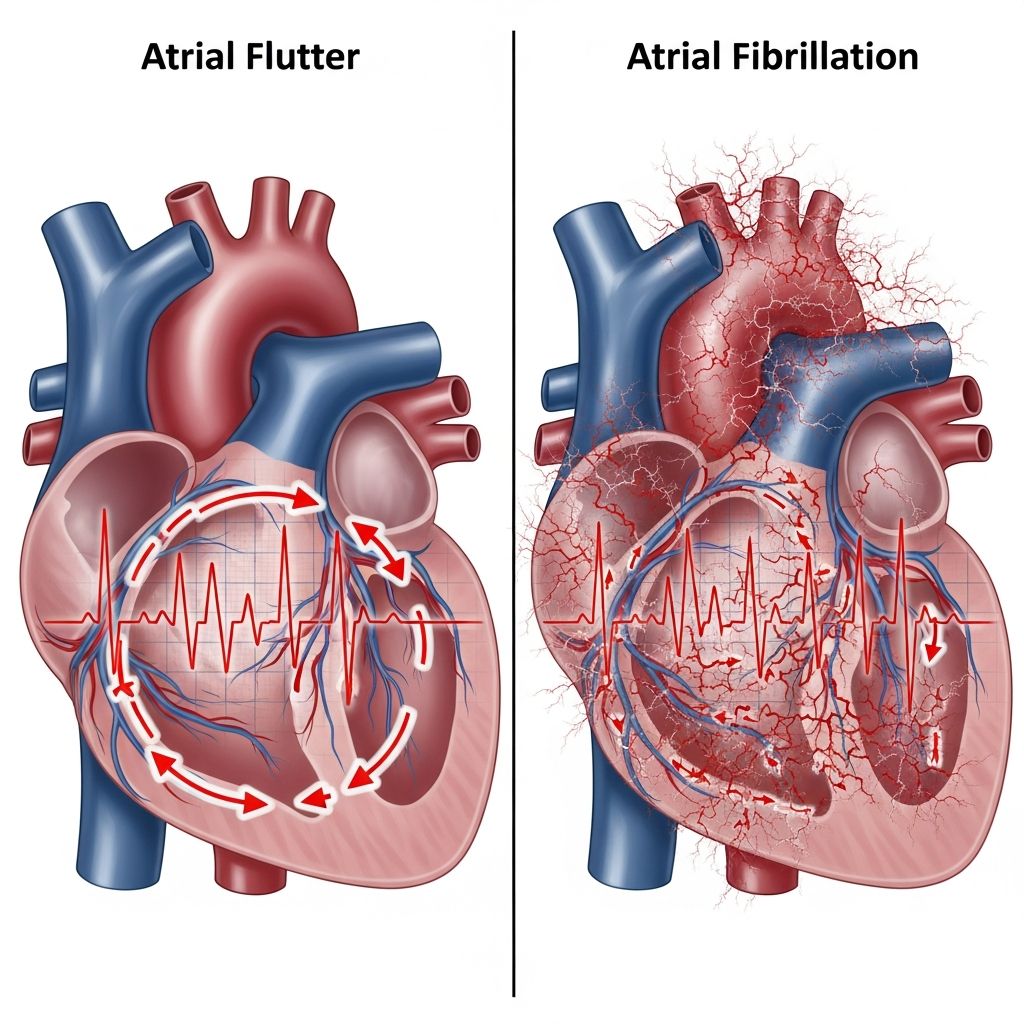
Atrial flutter and atrial fibrillation (AFib) are two prevalent supraventricular arrhythmias that disrupt the heart’s normal rhythm by causing the upper chambers (atria) to beat irregularly or too rapidly. While they share similarities in symptoms and risks like stroke, atrial flutter features a more organized, rapid atrial rhythm, whereas AFib is characterized by chaotic electrical activity. Both conditions affect millions worldwide, with AFib being more common, and early diagnosis is crucial to prevent complications such as blood clots, heart failure, and stroke.
What Are Atrial Flutter and Atrial Fibrillation?
Atrial flutter and atrial fibrillation are types of arrhythmias originating in the atria, the heart’s upper chambers responsible for receiving blood from the veins. In a healthy heart, electrical impulses travel in an organized manner from the sinoatrial (SA) node through the atria to the atrioventricular (AV) node and into the ventricles, producing a coordinated contraction at 60-100 beats per minute (bpm).
In
atrial flutter
, the atria beat rapidly—often 250-350 times per minute—but in a regular, circular pattern, typically around the tricuspid valve in the right atrium. This creates a ‘sawtooth’ pattern on an electrocardiogram (EKG). The AV node blocks some impulses, so ventricles beat at about 150 bpm or less, maintaining a more regular ventricular response.**Atrial fibrillation (AFib)**, by contrast, involves disorganized, quivering atrial contractions at 400-600 bpm due to multiple chaotic wavelets of electrical activity. This leads to an irregular and often rapid ventricular rate of 100-175 bpm, impairing efficient blood pumping. AFib is the most common arrhythmia, affecting over 5 million Americans, while atrial flutter is less prevalent but can coexist or convert to AFib in about one-third of cases.
Symptoms of Atrial Flutter and Atrial Fibrillation
Both conditions can be asymptomatic, especially in early stages, but when symptoms occur, they overlap significantly due to reduced cardiac output. Common symptoms include palpitations (sensations of fluttering or racing heart), fatigue, dizziness, shortness of breath, and chest discomfort.
However, differences exist: Atrial flutter often produces a more regular pulse, leading to less severe symptoms compared to AFib’s irregular rhythm, which can feel more chaotic and debilitating. Fainting (syncope) or near-fainting is possible in both if heart rates become extremely rapid.
| Symptom | Atrial Fibrillation | Atrial Flutter |
|---|---|---|
| Rapid pulse | Usually rapid (100-175 bpm) | Usually rapid (150 bpm or less) |
| Pulse regularity | Always irregular | Often regular |
| Palpitations | Yes | Yes |
| Dizziness/fainting | Yes | Yes |
| Shortness of breath | Yes | Yes |
| Fatigue/weakness | Yes | Yes |
| Chest pain | Yes | Yes |
Symptoms may worsen during exercise or stress, and both can lead to exercise intolerance.
Causes and Risk Factors
The precise causes involve abnormalities in the heart’s electrical conduction system.
Atrial flutter
typically arises from a single reentrant circuit in the right atrium, often triggered by scarring or stretching from prior heart surgery, inflammation, or congenital defects.**AFib** results from multiple reentrant wavelets across both atria, promoted by atrial enlargement or fibrosis. Shared risk factors include:
- Age over 65
- Hypertension
- Heart disease (e.g., coronary artery disease, heart failure, valve disorders)
- Diabetes
- Obesity
- Sleep apnea
- Thyroid disorders
- Excessive alcohol or caffeine
- Prior heart surgery
Related Stories



Atrial flutter is the second most common arrhythmia after AFib and may transition to or from it. Both elevate stroke risk 4-5 times due to blood stasis in the atria, forming clots.
Types of Atrial Flutter and Atrial Fibrillation
**Atrial flutter** is classified as:
- Typical (80-90% of cases): Counterclockwise or clockwise rotation around the tricuspid valve; sawtooth EKG pattern.
- Atypical: Involves left atrium or other circuits; less responsive to ablation.
**AFib** types include:
- Paroxysmal: Episodes <7 days, often self-terminating.
- Persistent: >7 days, requires intervention.
- Long-standing persistent: >12 months.
- Permanent: Accepted as chronic.
Diagnosis
Diagnosis begins with medical history, physical exam noting irregular pulse, and an EKG—the gold standard. Atrial flutter shows characteristic ‘F’ (flutter) waves in a sawtooth pattern, while AFib displays absent P waves and irregular R-R intervals.
Additional tests:
- Hospital telemetry or Holter monitor for intermittent episodes
- Echocardiogram to assess atrial size, valve function, clots
- Stress test, chest X-ray, blood tests (thyroid, electrolytes)
- Electrophysiology study for ablation planning
Treatment Options
Treatment aims to control rate, restore rhythm (rhythm control), and prevent clots (anticoagulation). Choices depend on duration, symptoms, and comorbidities.
Rate control: Beta-blockers (e.g., metoprolol), calcium channel blockers (diltiazem), digoxin to slow AV node conduction.
Rhythm control: Cardioversion (electrical or chemical), antiarrhythmics (amiodarone, sotalol).
Catheter ablation: Highly effective (>90%) for typical atrial flutter by creating scar tissue to block circuits; less so for AFib (60-80%) via pulmonary vein isolation.
Anticoagulation: Warfarin, DOACs (apixaban) based on CHA2DS2-VASc score.
Lifestyle: Weight loss, exercise, alcohol reduction.
Complications and Prognosis
Untreated, both risk stroke (flutter slightly lower than AFib), heart failure, tachycardia-induced cardiomyopathy. With treatment, prognosis improves; ablation often cures flutter. Regular follow-up essential.
Prevention
- Manage blood pressure, diabetes, weight
- Limit alcohol, caffeine, tobacco
- Treat sleep apnea
- Regular check-ups for at-risk individuals
Frequently Asked Questions (FAQs)
Is atrial flutter worse than AFib?
No, both are serious but atrial flutter is often more treatable with ablation.
Can you have both?
Yes, up to one-third with flutter develop AFib.
Does atrial flutter cause stroke?
Yes, similar risk to AFib due to clots.
How is atrial flutter diagnosed?
Primarily via EKG showing sawtooth waves.
Is ablation curative for flutter?
Often yes for typical flutter (>90% success).
References
- Atrial Flutter – Baylor Scott & White Health — Baylor Scott & White Health. 2023. https://www.bswhealth.com/conditions/atrial-flutter
- What’s the difference between atrial flutter and atrial fibrillation? — British Heart Foundation. 2023. https://www.bhf.org.uk/informationsupport/heart-matters-magazine/medical/ask-the-experts/atrial-flutter
- Atrial Flutter vs. Atrial Fibrillation: What’s the Difference? — Healthline. 2019-05-09. https://www.healthline.com/health/atrial-flutter-vs-atrial-fibrillation
- HealthCentral: Atrial Flutter vs. Atrial Fibrillation — Cedars-Sinai. 2023. https://www.cedars-sinai.org/newsroom/healthcentral-atrial-flutter-vs-atrial-fibrillation–whats-the-difference/
- What is Atrial Fibrillation? (AFib or AF) — American Heart Association. 2023. https://www.heart.org/en/health-topics/atrial-fibrillation/what-is-atrial-fibrillation-afib-or-af
- Atrial fibrillation vs atrial flutter — UChicago Medicine. 2017-05. https://www.uchicagomedicine.org/forefront/heart-and-vascular-articles/2017/may/atrial-fibrillation-vs-atrial-flutter-understanding
- Patient education – Atrial Fibrillation or Flutter — UF Health. 2023. https://ufhealth.org/conditions-and-treatments/atrial-fibrillation-or-flutter/patient-education
Similar Articles








Read full bio of Sneha Tete