Atrophoderma Of Pasini And Pierini: Clinical Guide
Rare dermal atrophy with cliff-drop borders: causes, symptoms, diagnosis, and management insights.
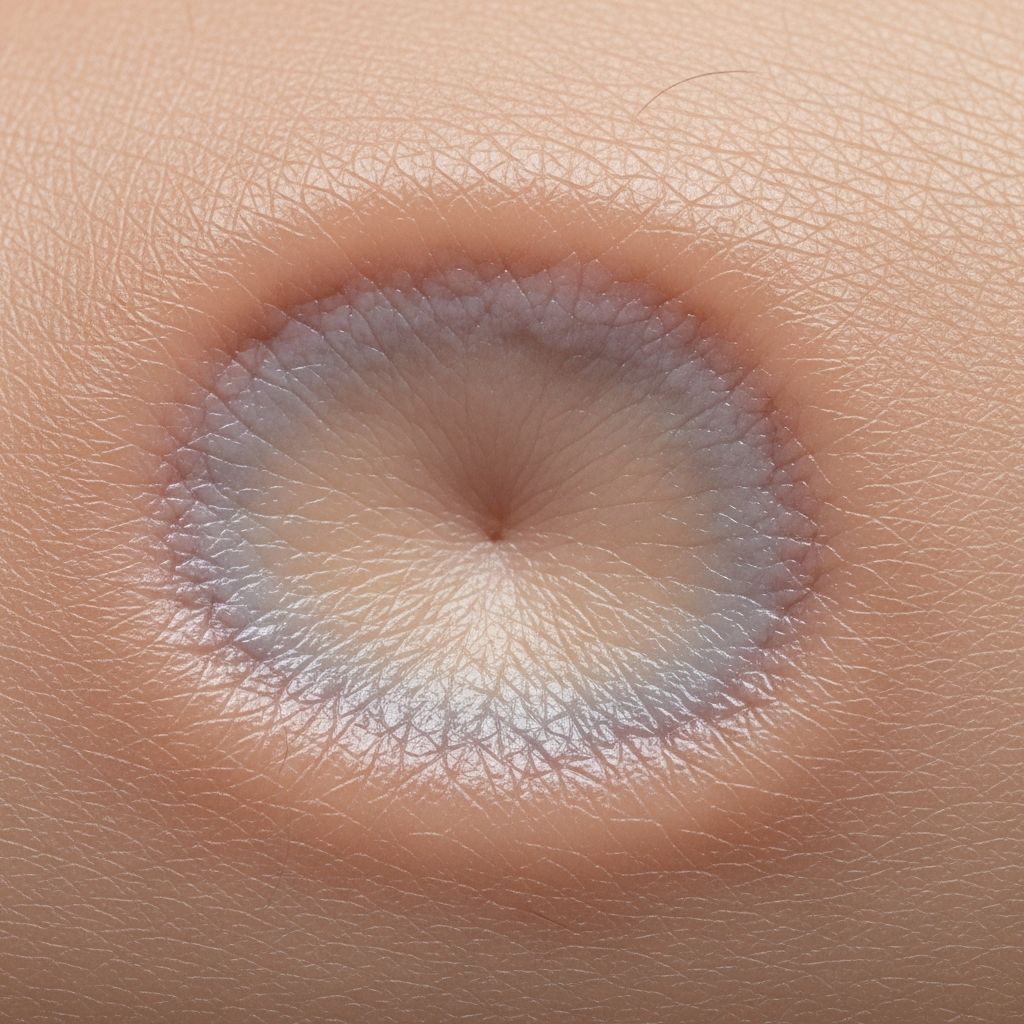
Atrophoderma of Pasini and Pierini (APP) is a rare form of dermal atrophy characterised by asymptomatic slightly depressed areas with a well-defined ‘cliff-drop’ edge.
Introduction
Atrophoderma of Pasini and Pierini represents a distinctive dermatological condition involving progressive thinning of the dermis, leading to visible skin depressions. First described by Luigi Pasini in 1923 as ‘progressive idiopathic atrophoderma,’ it was further elaborated by Pierini and Vivoli in 1936, who linked it to morphea-like changes. This disorder manifests as hyperpigmented or bluish patches with atrophic depressions, primarily on the trunk, distinguishing it from more inflammatory sclerotic conditions.
Clinically, lesions are smooth, non-indurated, and lack active inflammation, evolving slowly over years without systemic involvement in most cases. The hallmark ‘cliff-drop’ border arises from an abrupt transition between atrophic and normal skin, creating a topographic irregularity detectable by touch and sight. Histologically, it shows subtle collagen alterations confined to the upper reticular dermis, supporting its classification as superficial morphea or a burnt-out phase of localized scleroderma.
Demographics
APP predominantly affects young adults, with onset typically in the second or third decade of life, though cases in infancy, childhood, late adulthood, and even congenital presentations have been documented. There is a marked female predominance, with ratios reported from 2:1 to 6:1, and most cases occur in Caucasians.
Familial occurrences are rare but noted, suggesting possible genetic predisposition in select instances. No strong ethnic skew beyond Caucasians is evident from literature, though underreporting in other populations may exist due to diagnostic challenges in varied skin types.
Causes
The aetiology of APP remains idiopathic, with no definitive causative agent identified. Hypotheses include an association with Borrelia burgdorferi infection, particularly in European cohorts where antibodies were detected in a subset of patients; however, causality is unproven, and routine serological testing is not recommended.
Pathophysiologically, APP shares mechanisms with morphea, involving dysregulated collagen metabolism—reduced production and altered degradation—without fibrocyte proliferation. Inflammatory mononuclear infiltrates in early lesions likely drive fibrogenesis, though precise mediators are unclear. Some propose neural influences due to zosteriform or Blaschko-linear distributions in variants, but evidence is anecdotal.
Rare links to systemic sclerosis exist, with one case progressing to sclerodactyly, Raynaud phenomenon, and pulmonary fibrosis, highlighting potential overlap with autoimmune sclerodermopathies.
Clinical features
Lesions typically emerge on the trunk, especially the back, progressing to chest, abdomen, and extremities; face, hands, and feet are spared. They present as single or multiple, asymptomatic, hyperpigmented (brown to bluish) macules or patches with central atrophy, ranging from subtle indents (a few mm) to large depressions (>15 cm).
The borders exhibit a sharp ‘cliff-drop’ or gradual slope, with smooth, flat surfaces lacking scaling or telangiectasia. Patients may note mild warmth, tingling, or paraesthesia, but pruritus and pain are uncommon. Progression halts spontaneously after years, leaving permanent atrophy.
- Hyperpigmented or bluish depressed patches
- Primary site: back and trunk
- Cliff-drop or sloped margins
- Smooth, non-irregular surface
- Asymptomatic or mild sensory changes
- Unilateral or bilateral distribution
Related Stories



Variation in skin types
In lighter skin types (Fitzpatrick I-III), lesions appear as tan to brown patches with evident depression and hyperpigmentation. In darker phototypes (IV-VI), hyperpigmentation may be more pronounced, mimicking postinflammatory changes, while atrophy remains the key differentiator. The cliff-drop border persists across types, though subtle in hypopigmented variants.
Clinicians must adjust expectations: in olive or brown skin, lesions blend more with surrounding tone, potentially delaying diagnosis.
Complications
APP is primarily cosmetic, with no functional impairment. Rare sclerodermatous induration within atrophic areas may develop, histologically akin to morphea. Exceptional progression to systemic sclerosis underscores vigilance for Raynaud’s, sclerodactyly, or interstitial lung disease.
Psychosocial impact from visible truncal lesions can affect quality of life, particularly in women of childbearing age.
Diagnosis
Diagnosis relies on characteristic history and examination: non-progressive, asymptomatic atrophic patches with cliff-drop edges. Ultrasound confirms dermal atrophy (reduced echogenicity/thickness). Biopsy, if pursued, reveals stage-dependent changes—early: perivascular lymphocytic/plasmacytic infiltrate, collagen thickening; late: thinned, spaced collagen bundles without inflammation.
Serology for Borrelia in endemic regions; autoantibodies if systemic features suggest. Normal adnexa and epidermis aid differentiation.
Differential diagnoses
| Condition | Key Distinguishing Features |
|---|---|
| Anetoderma | Soft, crinkly, herniated lesions; elastic tissue loss |
| Atrophoderma of Moulin | Blaschko-linear distribution; similar atrophy |
| Morphea | Indurated plaques, lilac border, active inflammation |
| Lichen sclerosus | Porcelain-white, wrinkled; genital predilection |
| Postinflammatory hyperpigmentation | No atrophy; follows inflammation |
| Lupus profundus | Subcutaneous nodules, deeper involvement |
Treatment
No standardized therapy exists due to rarity and self-limited course; management is observational for stable lesions. For progressive or cosmetic concerns:
- Topical corticosteroids or calcineurin inhibitors (limited efficacy)
- Phototherapy (narrowband UVB, PUVA) for inflammatory phases
- Systemic immunosuppressants (methotrexate, mycophenolate) in refractory cases; one report noted response to mycophenolic acid
- Cosmetic camouflage or fillers for atrophy
- Excimer laser for hyperpigmentation
Surgical excision rarely considered for solitary lesions.
Outcome
Lesions stabilize after 2-10 years, with permanent pigmentation and atrophy. No malignant potential or systemic progression in most; monitor for scleroderma overlap. Patient education on benign nature alleviates anxiety.
Frequently Asked Questions (FAQs)
Q: Is atrophoderma of Pasini and Pierini contagious?
A: No, it is not infectious or contagious; aetiology is idiopathic or autoimmune-related.
Q: Does APP progress to systemic sclerosis?
A: Extremely rare; one case reported progression, but most remain localized.
Q: Can APP be treated effectively?
A: Treatment is limited; focuses on symptoms or cosmetics, as it self-limits.
Q: How is APP diagnosed?
A: Clinically by cliff-drop lesions; confirmed via biopsy or ultrasound if needed.
Q: Who gets APP most often?
A: Young adult females (2-6:1 ratio), primarily Caucasians.
References
- Atrophoderma of Pasini and Pierini — Dermatology Advisor. 2023. https://www.dermatologyadvisor.com/home/decision-support-in-medicine/dermatology/atrophoderma-of-pasini-and-pierini/
- Atrophoderma of Pasini and Pierini — MD Searchlight. 2024-01-15. https://mdsearchlight.com/skin-problems-and-treatments/atrophoderma-of-pasini-and-pierini/
- Atrophoderma of Pasini and Pierini — DermNet NZ. 2023-05-20. https://dermnetnz.org/topics/atrophoderma-of-pasini-and-pierini
- Atrophoderma of Pasini and Pierini — StatPearls, NCBI Bookshelf. 2023-07-17. https://www.ncbi.nlm.nih.gov/books/NBK519069/
- Atrophoderma — VisualDx. 2024. https://www.visualdx.com/visualdx/diagnosis/atrophoderma?diagnosisId=51148&moduleId=101
- Idiopathic Atrophoderma of Pasini and Pierini: Response to Mycophenolic Acid Treatment — Cureus. 2024-10-01. https://www.cureus.com/articles/317888-idiopathic-atrophoderma-of-pasini-and-pierini-response-to-mycophenolic-acid-treatment
Similar Articles








Read full bio of Sneha Tete