Auriculotemporal Syndrome: Causes, Symptoms & Treatment
Understanding auriculotemporal syndrome: comprehensive guide to causes, symptoms, diagnosis, and treatment options.
Auriculotemporal Syndrome: A Comprehensive Guide
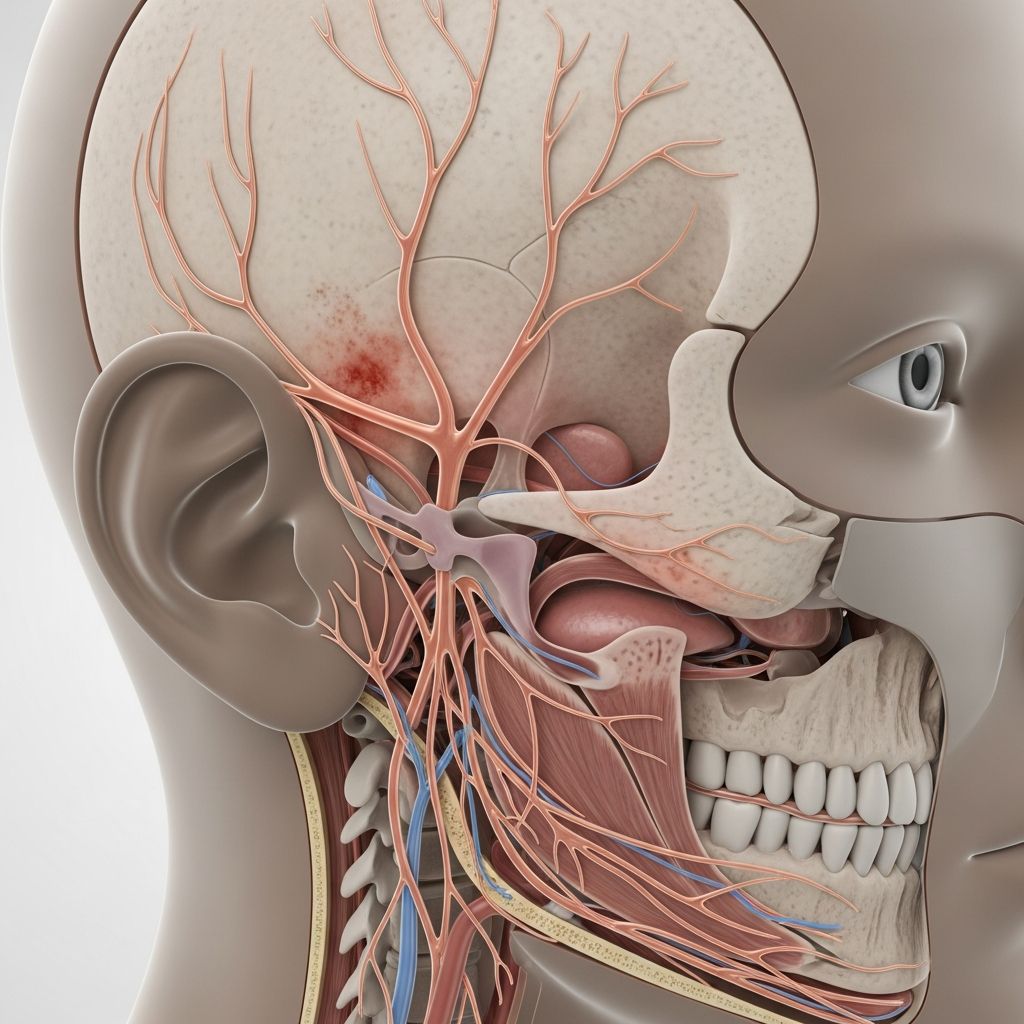
Auriculotemporal syndrome, also known as Frey syndrome or gustatory sweating syndrome, is a rare neurological condition characterized by excessive sweating, flushing, and warming in the facial region in response to gustatory (taste) or olfactory (smell) stimuli. The condition typically affects the preauricular area (in front of the ear) and temporal regions (the area behind the eyes), creating visible signs of autonomic dysreflexia that can significantly impact quality of life.
Introduction and Definition
Auriculotemporal syndrome represents a fascinating yet problematic example of aberrant nerve regeneration following injury to the auriculotemporal nerve. The condition manifests as an inappropriate autonomic response to gustatory stimuli, where the body produces sweat instead of saliva in response to eating, smelling, or even thinking about food. This misdirected parasympathetic response occurs in the facial and periauricular regions, creating a distinctive pattern of symptoms that can range from mild to severe.
The syndrome gained its alternate name, Frey syndrome, as a historical designation, though auriculotemporal syndrome remains the more accurate anatomical reference. This distinction is important for healthcare providers and patients seeking information about this condition.
Demographics
Auriculotemporal syndrome affects both pediatric and adult populations, though with notably different outcomes and incidence patterns. In adults, the condition occurs in up to 60% of patients following parotid gland surgery, making it a significant post-operative complication. The onset of symptoms can occur either in the immediate postoperative period or may be delayed for several months after surgical intervention.
In contrast, the syndrome demonstrates a much more benign course in infants, with spontaneous resolution occurring in the majority of cases without requiring intervention. This age-related difference in disease progression and prognosis is clinically significant when counseling patients about expected outcomes.
Overall, spontaneous resolution occurs in only approximately 5% of adults with auriculotemporal syndrome, indicating that most adult cases require some form of management.
Causes and Etiology
The underlying mechanism of auriculotemporal syndrome involves aberrant regeneration of the auriculotemporal nerve following injury. This injury may result from several sources:
- Surgical intervention in the parotid gland region, particularly parotidectomy (surgical removal or partial removal of the parotid gland)
- Trauma or injury to the auriculotemporal nerve or surrounding structures
- Infection in the vicinity of the parotid gland
- Damage to ganglia within the cervical sympathetic chain
The auriculotemporal nerve normally provides sympathetic innervation to the sweat glands and parasympathetic innervation to the salivary glands. The nerve consists of two anatomical roots: the superior somatosensory root, which arises from the mandibular branch of the trigeminal nerve, and provides sensation to the ear, external auditory canal, temporomandibular joint, and temporal scalp.
During the regeneration process following nerve injury, parasympathetic fibers intended to reinnervate salivary glands become misdirected. These fibers aberrantly regenerate along the pathway of the sympathetic nerve, establishing connections with sweat glands and blood vessels of the skin instead. This aberrant regeneration explains why gustatory stimuli that normally trigger salivation instead produce sweating and vasodilation.
Related Stories



Importantly, because aberrant nerve regeneration requires time to develop, the presentation of auriculotemporal syndrome is typically delayed by 6 to 18 months following the initial surgical injury.
Clinical Features
The clinical presentation of auriculotemporal syndrome is characterized by a distinctive set of symptoms triggered by gustatory or olfactory stimuli:
Primary Symptoms
- Gustatory sweating: Excessive sweating in the facial and periauricular areas, particularly triggered by foods that produce a strong salivary response
- Flushing and erythema: Visible reddening of the affected skin areas
- Warming sensation: Subjective warmth in the preauricular and temporal regions
Triggering Factors
Symptoms are most commonly triggered by:
- Sour foods
- Spicy foods
- Salty foods
- The smell of food
- The taste of food
- Thoughts about food
The severity of auriculotemporal syndrome varies considerably among patients, ranging from mild cases that cause minimal distress to severe cases that significantly impact quality of life and social functioning.
Complications
While auriculotemporal syndrome itself is benign in most cases, complications may arise from both the condition and its treatments. Severe, refractory cases can lead to significant social distress and psychological impact due to the visible symptoms during eating or when exposed to food-related stimuli. In cases requiring repeated surgical intervention or nerve transection, potential complications include facial nerve injury or altered sensation in the affected region.
Diagnosis
The diagnosis of auriculotemporal syndrome is primarily clinical, based on the characteristic presentation of sweating and flushing in response to gustatory stimuli. Diagnostic approaches include:
Clinical Assessment
- Detailed history of symptom onset, particularly temporal relationship to parotid surgery or facial trauma
- Careful observation of symptoms in response to gustatory triggers
- Examination of the distribution of sweating and flushing (typically preauricular and temporal)
- Assessment of symptom timing and severity
Diagnostic Tests
While the clinical presentation is usually sufficient for diagnosis, certain tests may support the diagnosis:
- Minor’s starch-iodine test: Uses iodine and starch to visualize areas of increased sweating
- Thermoelectric or capacitive sensors: May quantify sweat production
- Imaging studies: May be used if underlying nerve injury requires further evaluation
Differential Diagnoses
Several conditions should be considered in the differential diagnosis of auriculotemporal syndrome:
- Generalized hyperhidrosis: Excessive sweating affecting the entire body rather than localized to facial regions
- Allergic reactions: Facial flushing and sweating triggered by allergen exposure rather than gustatory stimuli
- Rosacea: Chronic facial flushing and erythema, but typically not triggered specifically by eating
- Menopausal hot flashes: Facial flushing and sweating, but with different temporal relationship and triggers
- Compensatory sweating: Other patterns of pathological sweating from different neurological causes
The specific temporal relationship to parotid surgery or trauma, combined with the localized distribution and gustatory triggers, helps distinguish auriculotemporal syndrome from these other conditions.
Treatment Options
Treatment of auriculotemporal syndrome is targeted at symptom control. The approach varies based on symptom severity and patient preferences.
Conservative Management
Patients with mild symptoms may not require active treatment. Simple measures such as awareness of triggering foods and avoidance strategies may suffice.
Pharmacological Treatments
Medical therapies represent the first-line approach for symptomatic patients:
- Topical antiperspirants: Applied directly to affected areas to reduce sweating
- Anticholinergic medications: Including atropine and scopolamine, which block cholinergic pathways innervating sweat glands
- Antihidrotic agents: Specifically designed to reduce sweating
- Glycopyrrolate: An anticholinergic agent that reduces sweating and can be applied topically or injected locally
- Botulinum toxin A (BTA): Local injections that provide extended symptom suppression lasting 9-12 months on average. Repeated injections are required every 4-6 months, or earlier if symptoms recur
Since postganglionic cholinergic pathways innervate the sweat glands, treatment has traditionally involved anticholinergic agents. Botulinum toxin A has emerged as a particularly effective and well-tolerated option over the past decade, offering the advantage of being minimally invasive with no significant side effects.
Surgical Management
Surgical intervention is reserved for severe and refractory cases where conservative and medical therapies have failed. Surgical options include:
- Transection of the auriculotemporal nerve: Cutting the affected nerve to prevent aberrant signals
- Transection of the tympanic nerve: Cutting related nerve fibers that may contribute to symptoms
- Transection of the glossopharyngeal nerve: Blocking gustatory pathways responsible for triggering symptoms
- Greater auricular nerve transection (Jacobsen’s neurectomy): Surgical approach targeting specific nerve fibers
- Chorda tympani resection: Removing a segment of nerve involved in salivary and taste function
- Barrier placement: Creating a physical barrier between affected nerves and sweat glands
- Excision with grafting: Removing affected skin and replacing it with graft material
- Muscle flap reconstruction: Using muscle tissue to provide a barrier to aberrant nerve innervation
After symptom onset, surgical management is rarely indicated and should only be considered when conservative and medical therapies have proven ineffective.
Outcome and Prognosis
The long-term outlook for auriculotemporal syndrome differs significantly based on age and case characteristics:
In infants: The condition demonstrates a benign course with spontaneous resolution occurring in the majority of cases, making observation an appropriate management strategy in pediatric patients.
In adults: Spontaneous resolution occurs in only 5% of cases, meaning that most adult patients will require some form of intervention. Pharmacological treatments, particularly botulinum toxin A, generally control symptoms effectively in the short to medium term. Repeated treatments are necessary to maintain symptom control, as the effects of BTA require re-injection every 4-6 months.
Quality of life can be substantially improved with prompt diagnosis and appropriate management. The vast majority of patients achieve adequate symptom control through medical management, with only rare cases requiring surgical intervention.
Evidence Base and Clinical Considerations
Cochrane reviews of interventions to either prevent or treat auriculotemporal syndrome have identified limited high-quality evidence regarding the effectiveness and safety of various approaches. This indicates a need for further clinical trials to establish evidence-based consensus on optimal treatment strategies. Despite this evidence gap, clinical experience has established botulinum toxin A as an effective and well-tolerated first-line pharmacological therapy.
Frequently Asked Questions
Q: What is the difference between auriculotemporal syndrome and Frey syndrome?
A: Auriculotemporal syndrome and Frey syndrome refer to the same condition. Frey syndrome is a historical name, while auriculotemporal syndrome is the more accurate anatomical reference based on the affected nerve.
Q: How long after parotid surgery can auriculotemporal syndrome develop?
A: Symptoms typically appear 6 to 18 months after surgery, though they can occasionally develop in the immediate postoperative period. This delay reflects the time required for aberrant nerve regeneration to occur.
Q: Is auriculotemporal syndrome permanent?
A: In infants, spontaneous resolution commonly occurs. In adults, only 5% experience spontaneous resolution, meaning most require ongoing management. However, symptoms can be effectively controlled with medical treatments such as botulinum toxin injections.
Q: What is the most effective treatment for auriculotemporal syndrome?
A: Botulinum toxin A has become the established therapy for symptomatic auriculotemporal syndrome, offering minimal invasiveness and significant efficacy lasting 9-12 months per injection. Anticholinergic agents and topical antiperspirants also provide symptom control for milder cases.
Q: Can auriculotemporal syndrome be prevented?
A: Prevention during parotid surgery is preferable to treatment but is not always achievable. Careful surgical technique and prompt diagnosis with management can substantially improve quality of life if the condition develops.
Q: What foods are most likely to trigger symptoms?
A: Sour, spicy, and salty foods are most likely to trigger symptoms, as these foods produce the strongest salivary response. Even the smell of food or thoughts about eating can trigger symptoms in some patients.
References
- Auriculotemporal Syndrome — DermNet NZ. 2024. https://dermnetnz.org/topics/auriculotemporal-syndrome
- Auriculotemporal Syndrome in Adult — VisualDx. 2024. https://www.visualdx.com/visualdx/diagnosis/auriculotemporal+syndrome
- Frey Syndrome — StatPearls, National Center for Biotechnology Information (NCBI). 2024. https://www.ncbi.nlm.nih.gov/books/NBK562247/
- Frey’s Syndrome: What It Is, Causes, Symptoms & Treatment — Cleveland Clinic. 2024. https://my.clevelandclinic.org/health/diseases/25185-freys-syndrome
- Frey’s Syndrome — Wikipedia. 2025. https://en.wikipedia.org/wiki/Frey%27s_syndrome
- Frey Syndrome: Symptoms, Causes, Treatment — National Organization for Rare Disorders (NORD). 2024. https://rarediseases.org/rare-diseases/frey-syndrome/
- Frey Syndrome — OncoLink, University of Pennsylvania. 2024. https://www.oncolink.org/cancers/head-and-neck/side-effect-management-support-resources/frey-syndrome
Similar Articles








Read full bio of Sneha Tete