Autosomal Dominant and Recessive Inheritance Explained
Understanding how genes pass from parents to children through autosomal inheritance patterns.
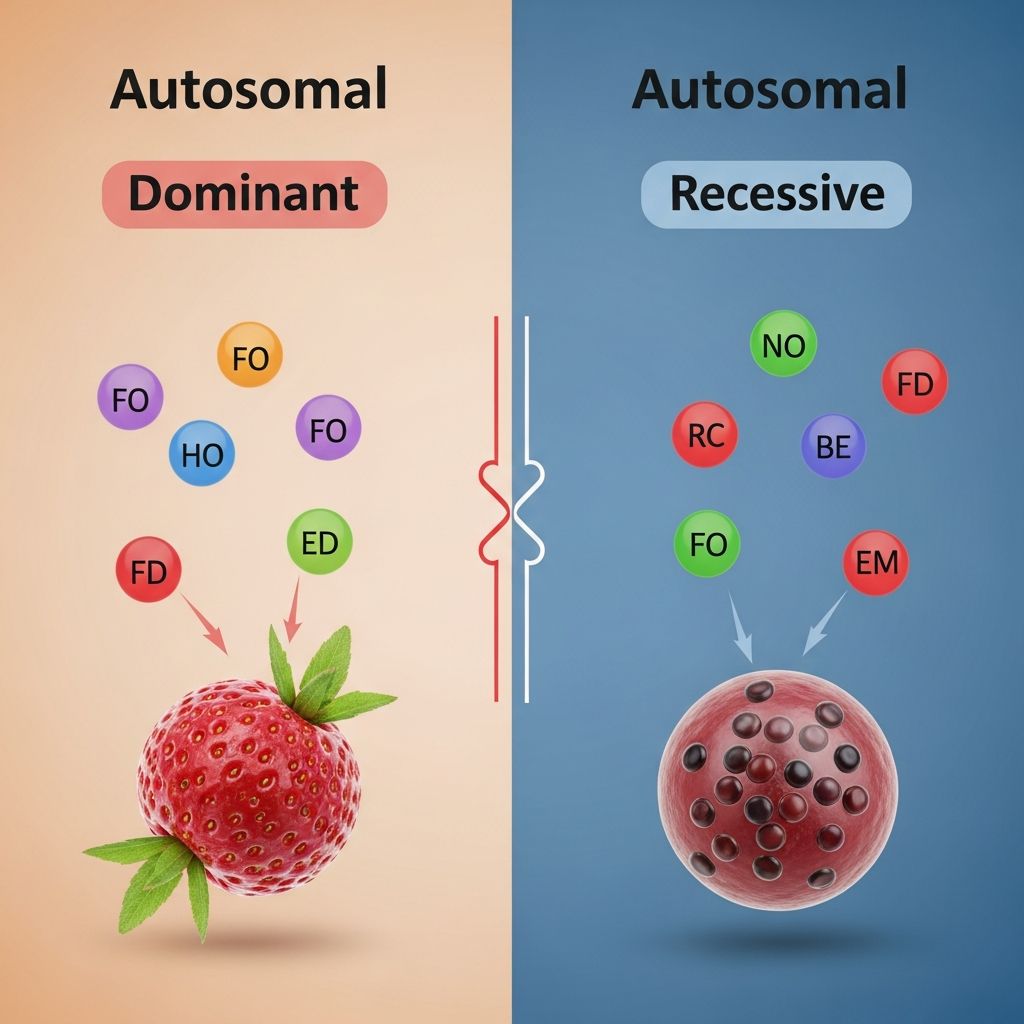
Autosomal Dominant and Autosomal Recessive Inheritance
Genetic inheritance is the process by which traits and conditions pass from parents to their children through genes. Understanding how these inheritance patterns work is crucial for comprehending genetic health conditions and predicting risk within families. Among the various inheritance patterns, autosomal dominant and autosomal recessive inheritance are two of the most common ways genetic conditions are transmitted across generations.
What Are Autosomes?
To understand autosomal inheritance, it’s important to first understand what autosomes are. Humans have 23 pairs of chromosomes, totaling 46 chromosomes. Out of these 23 pairs, 22 pairs are autosomes—non-sex chromosomes that are present in both males and females. The 23rd pair consists of sex chromosomes: XX for females and XY for males. Autosomal inheritance refers to the transmission of genetic traits located on these 22 pairs of non-sex chromosomes, meaning these conditions affect both males and females equally.
Understanding Autosomal Dominant Inheritance
In autosomal dominant inheritance, a person needs to inherit only one copy of a gene variant to develop the associated condition. This means that if one parent carries a dominant gene for a specific trait or disorder, there is a 50% chance that each child will inherit that gene and express the condition. The dominant allele (gene variant) will be expressed even in the presence of a normal recessive allele because the dominant gene produces a functional protein that overrides the recessive gene.
Key Characteristics of Autosomal Dominant Inheritance
Autosomal dominant conditions typically display several recognizable patterns in families:
- Affected individuals usually have at least one affected parent
- The condition appears in every generation of an affected family
- Both males and females are equally likely to be affected
- Both males and females can pass the condition to their children
- An affected parent with one dominant gene has a 50% chance of passing it to each child
Examples of Autosomal Dominant Conditions
Several well-known genetic conditions follow autosomal dominant inheritance patterns. Huntington’s disease is a progressive neurological disorder that typically manifests in mid-to-late adulthood. Familial hypercholesterolemia causes elevated cholesterol levels and increased heart disease risk. Neurofibromatosis involves the growth of tumors along nerves. Achondroplasia is the most common form of dwarfism. Each of these conditions requires only one copy of the mutated gene from one parent for the condition to develop.
Understanding Autosomal Recessive Inheritance
In contrast to autosomal dominant inheritance, autosomal recessive inheritance requires a person to inherit two copies of a recessive gene variant—one from each parent—to develop the associated condition. This means both parents must be carriers or affected for a child to inherit the condition. A recessive allele is only expressed when the person is homozygous recessive, meaning they have two identical copies of the recessive gene.
Key Characteristics of Autosomal Recessive Inheritance
Autosomal recessive conditions have distinct family patterns:
- Both parents of an affected child are typically carriers or affected individuals
- The condition may skip generations, appearing to come out of nowhere
- Both males and females are equally likely to be affected
- Two carrier parents have a 25% chance of having an affected child, a 50% chance of having a carrier child, and a 25% chance of having an unaffected, non-carrier child
- The condition is typically not seen in every generation
Related Stories



Examples of Autosomal Recessive Conditions
Multiple genetic disorders follow autosomal recessive inheritance patterns. Cystic fibrosis affects the lungs and pancreas, causing thick mucus buildup and respiratory problems. Sickle cell anemia alters the shape of red blood cells, causing pain and organ damage. Tay-Sachs disease affects the nervous system and is typically fatal in early childhood. Phenylketonuria (PKU) impairs the body’s ability to metabolize the amino acid phenylalanine. Each of these conditions requires two copies of the recessive gene for the condition to manifest.
Comparing Inheritance Patterns
| Feature | Autosomal Dominant | Autosomal Recessive |
|---|---|---|
| Gene Copies Needed | One copy | Two copies |
| Inheritance Pattern | Appears in every generation | May skip generations |
| Affected Parent Inheritance Risk | 50% chance per child | Depends on other parent’s status |
| Two Carrier Parents Risk | N/A (carriers are affected) | 25% affected, 50% carriers, 25% unaffected |
| Gender Distribution | Equal in males and females | Equal in males and females |
How Inheritance Works: Punnett Squares
Geneticists use Punnett squares to visualize how genes are inherited. In these diagrams, capital letters represent dominant alleles and lowercase letters represent recessive alleles. For autosomal dominant conditions, if one parent is heterozygous (Aa) and the other is homozygous recessive (aa), each child has a 50% chance of inheriting the dominant allele and expressing the condition. For autosomal recessive conditions, if both parents are heterozygous carriers (Aa), there is a 25% chance their child will be homozygous recessive (aa) and affected, a 50% chance of being a carrier (Aa), and a 25% chance of being homozygous dominant (AA) and unaffected.
Carriers and Genetic Risk
A key distinction between autosomal dominant and recessive inheritance involves the concept of carriers. In autosomal dominant conditions, a person either has the condition or does not—there is no carrier state because one copy of the dominant gene is sufficient to cause the condition. However, in autosomal recessive conditions, individuals can be carriers, meaning they have one copy of the recessive gene but do not express the condition. Carriers of autosomal recessive conditions can pass the gene to their children, potentially leading to affected offspring if the other parent is also a carrier or affected.
De Novo Mutations
Not all genetic conditions are inherited from a parent. Sometimes a mutation occurs spontaneously in a parent’s egg or sperm cell, creating a new genetic variant that was not present in either parent. These are called de novo mutations. De novo mutations can cause autosomal dominant conditions even when neither parent is affected. This explains how some autosomal dominant conditions appear in families with no prior history of the disorder.
Other Inheritance Patterns
While autosomal dominant and autosomal recessive inheritance are the most common patterns, other inheritance modes exist. X-linked inheritance involves genes on the X chromosome and affects males and females differently. Y-linked inheritance affects only males since only males possess a Y chromosome. Mitochondrial inheritance involves mutations in mitochondrial DNA and is transmitted exclusively from mothers to their children. Codominant inheritance occurs when both alleles are equally expressed, producing a blended phenotype.
Genetic Testing and Counseling
If you have a family history of genetic conditions or are concerned about autosomal inheritance patterns in your family, genetic testing and counseling can provide valuable information. Genetic counselors help families understand inheritance patterns, assess risk, and make informed decisions about testing and family planning. Tests can identify carrier status, confirm diagnoses, and predict disease risk in individuals who may inherit genetic conditions.
Frequently Asked Questions
Q: Can two unaffected parents have a child with an autosomal dominant condition?
A: Yes, if one parent carries a de novo mutation or if the condition shows reduced penetrance (not all gene carriers express the condition). However, this is uncommon. More commonly, an affected parent would have a child with an autosomal dominant condition.
Q: What does it mean to be a carrier of an autosomal recessive condition?
A: Being a carrier means you have one copy of a recessive gene mutation but do not have the condition because you also have a normal dominant gene. Carriers typically show no symptoms but can pass the recessive gene to their children.
Q: If both parents are carriers of a recessive condition, will all their children be affected?
A: No. If both parents are carriers (heterozygous), there is a 25% chance each child will be affected (homozygous recessive), a 50% chance they will be a carrier, and a 25% chance they will be unaffected and non-carrying.
Q: Are autosomal conditions more common in certain ethnic groups?
A: Some autosomal genetic conditions show higher prevalence in specific populations due to founder effects or geographic isolation. For example, sickle cell disease is more common in people of African descent, while Tay-Sachs is more prevalent in Ashkenazi Jewish populations.
Q: Can genetic counseling help me understand my family’s inheritance pattern?
A: Yes. Genetic counselors are healthcare professionals trained to interpret family histories, explain inheritance patterns, discuss genetic testing options, and help families make informed decisions about their genetic health.
References
- Autosomal Inheritance: Dominant vs. Recessive Disorders — Medical News Today. 2025. https://www.medicalnewstoday.com/articles/autosomal-inheritance
- Autosomal Recessive and Autosomal Dominant Inheritance — Lecturio. 2025. https://www.lecturio.com/concepts/autosomal-recessive-and-autosomal-dominant-inheritance/
- Understanding Autosomal Dominant and Autosomal Recessive Inheritance — National Institutes of Health. https://medlineplus.gov/genetics/understanding/inheritance/inheritancepatterns/
- Inheritance Patterns — NCBI Bookshelf, National Center for Biotechnology Information. https://www.ncbi.nlm.nih.gov/books/NBK115561/
- Dominance (Genetics) — National Institutes of Health, MedlinePlus. https://medlineplus.gov/genetics/understanding/basics/howgeneswork/
Similar Articles








Read full bio of Sneha Tete