Axial Skeleton: Anatomy, Function & Structure
Discover the axial skeleton: the 80 bones forming your body's central framework that protects vital organs.
Understanding the Axial Skeleton
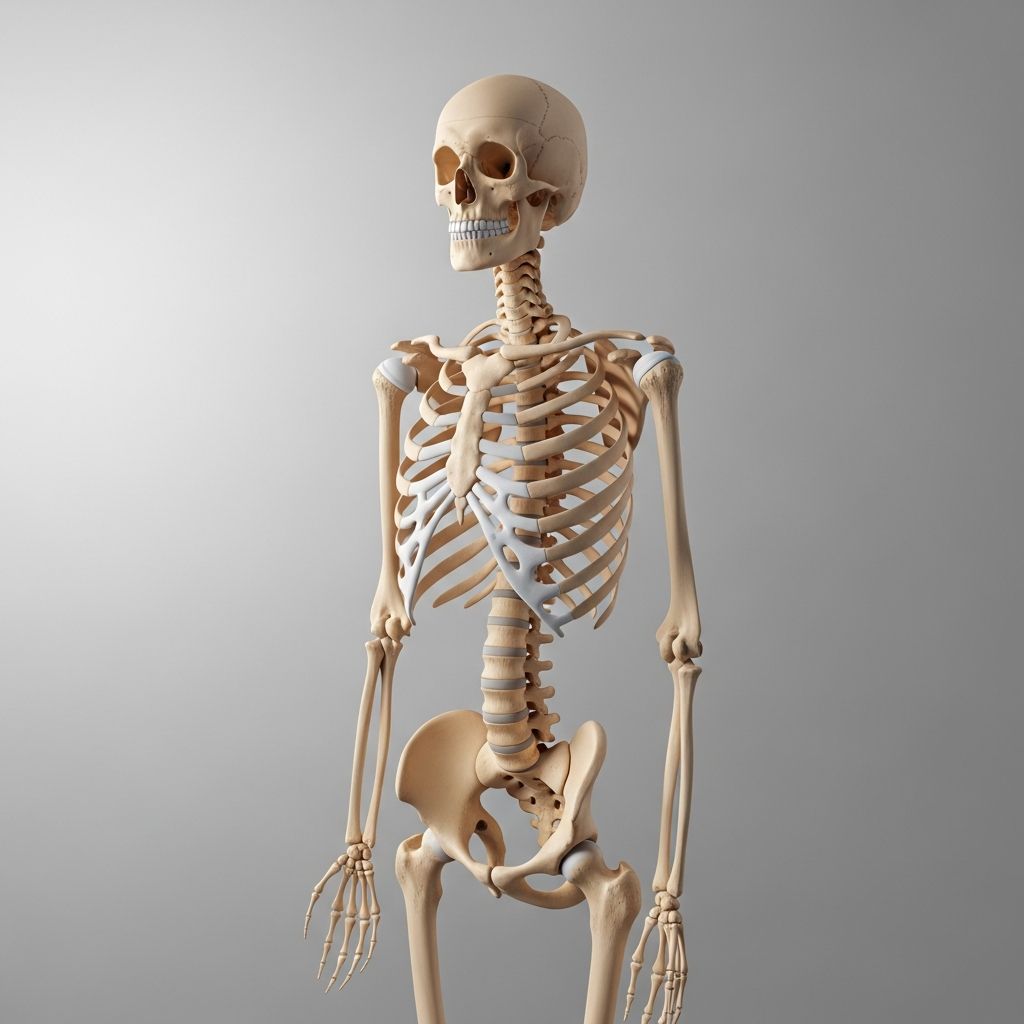
The axial skeleton is the central framework of your body, consisting of 80 individual bones that form a vertical axis from your head to your pelvis. This essential component of your skeletal system includes the bones of the skull, vertebral column, and rib cage. The axial skeleton serves as the protective core of your body, safeguarding vital organs such as your brain, spinal cord, heart, and lungs while providing structural support for proper posture and movement.
Unlike the appendicular skeleton, which comprises 126 bones in your arms, legs, and the girdles that attach them to your body, the axial skeleton forms the rigid central support system around which the rest of your skeleton operates. Understanding the structure and function of the axial skeleton is crucial for appreciating how your body maintains its shape, protects delicate organs, and facilitates movement.
Composition of the Axial Skeleton
The 80 bones of the axial skeleton are distributed across three main regions: the skull, the vertebral column, and the rib cage. Each region contains a specific number of bones that work together to provide both protection and structural support.
Skull Bones
Your skull is composed of 22 bones that can be categorized into two distinct groups: cranial bones and facial bones. The eight cranial bones form the bulk of your skull and create a protective vault for your brain. These bones fit together like pieces of a puzzle, with immovable joints called sutures that allow for minimal movement while maintaining structural integrity.
The 14 facial bones are located on the front of the skull and form the structure of your face, including your nose, cheeks, jaw, and eye sockets. Additionally, the skull contains six auditory ossicles—three tiny bones on each side of your head known as the malleus (hammer), incus (anvil), and stapes (stirrup). These delicate bones work together to transmit sound waves from the outer ear to the inner ear, playing a critical role in hearing.
Vertebral Column
The vertebral column, also called the spine or backbone, consists of 24 individual vertebrae arranged in a flexible stack. This remarkable structure provides the main support for your trunk while protecting the spinal cord, which runs through a canal at the center of each vertebra. The vertebrae are classified into three regions: cervical (neck), thoracic (mid-back), and lumbar (lower back).
Below the 24 vertebrae are two additional structures formed from fused vertebrae: the sacrum and the coccyx. The sacrum is a triangular bone composed of five fused vertebrae that connects the vertebral column to the pelvis. The coccyx, commonly called the tailbone, is composed of four fused vertebrae and serves as an attachment point for various ligaments and muscles. Together, the sacrum and coccyx help support the weight of your body while sitting and provide attachment points for essential ligaments.
Hyoid Bone
The hyoid bone is a unique U-shaped bone located in your neck, below your jaw and above your larynx (voice box). This bone is distinctive because it is the only bone in your body that does not articulate directly with any other bone; instead, it is suspended by muscles and ligaments. The hyoid bone plays an important role in swallowing and speech.
Related Stories



Rib Cage
The rib cage consists of 24 ribs (12 pairs) and the sternum, along with the cartilage and connective tissues that join them together. This protective cage surrounds your heart, lungs, and other vital organs in your chest cavity. The ribs are classified into three types based on their attachment to the sternum: true ribs (which attach directly to the sternum), false ribs (which attach to the sternum indirectly through cartilage), and floating ribs (which have no attachment to the sternum).
The flexibility of the rib cage is crucial for respiration. The costal cartilages—the pliable cartilaginous connections between the ribs and the sternum—allow the rib cage to expand during inhalation and contract during exhalation. Additionally, small joints between the ribs and the vertebrae permit a gliding motion that facilitates breathing and other activities.
Primary Functions of the Axial Skeleton
The axial skeleton performs several critical functions that are essential to your survival and well-being. These functions work in concert to maintain your body’s integrity and enable normal physiological processes.
Protection
The foremost function of the axial skeleton is to protect your body’s most vital and delicate structures. Your cranium (skull) encases your brain, providing a rigid protective shell against external trauma. The 33 bones of the vertebral column (including the cervical, thoracic, and lumbar vertebrae, sacrum, and coccyx) form a protective tunnel for your spinal cord, with bony neural arches creating an encircling structure that shields this vital nerve center.
The rib cage creates a flexible protective barrier around your heart, lungs, and other thoracic organs. Unlike the rigid protection offered by the skull and vertebral column, the rib cage must maintain some flexibility to allow for the expansion of your lungs during breathing. This is accomplished through the elastic costal cartilages and the articulations between the ribs and vertebrae.
Support
The axial skeleton provides the structural framework that maintains your body’s shape and posture. The vertebral column serves as the primary support structure for your trunk, distributing your body weight vertically and maintaining alignment against gravity. The sacrum and coccyx continue this support function in your lower back and pelvis, helping to support the weight of your body when you sit.
Attachment Points
The bones, cartilages, and ligaments of the axial skeleton serve as crucial attachment points for numerous muscles. The sternum and ribs provide attachment points for intercostal muscles (between the ribs), which assist with breathing. The vertebral column offers attachment sites for deep abdominal and back muscles that maintain posture and enable trunk movement. These muscular attachments are essential for maintaining core stability and enabling movement.
Axial Skeleton vs. Appendicular Skeleton
| Feature | Axial Skeleton | Appendicular Skeleton |
|---|---|---|
| Number of Bones | 80 bones | 126 bones |
| Location | Head, neck, chest, spine, pelvis | Arms, legs, shoulders, hip girdles |
| Primary Function | Protection and support | Movement and manipulation |
| Key Structures | Skull, vertebral column, rib cage | Bones of limbs, pectoral girdle, pelvic girdle |
| Role | Forms central framework | Enables interaction with environment |
The Role of Bone in Axial Skeleton Development
The bones of the axial skeleton develop through a complex process that begins before birth and continues throughout childhood and adolescence. In infants and young children, the skeleton contains more bones than in adults because many bones have not yet fused together. For example, the skull bones gradually fuse as a person grows, reducing the number of individual skull bones over time.
The vertebral column also undergoes significant development, with some vertebrae fusing to form the sacrum and coccyx. This fusion process continues until early adulthood, at which point the skeleton reaches its mature configuration of 206 total bones—80 in the axial skeleton and 126 in the appendicular skeleton.
Variations in the Axial Skeleton
While the basic structure of the axial skeleton is consistent across humans, there are some important variations that occur between individuals and between males and females. The male skeleton is typically longer and has greater bone mass, contributing to a larger overall frame. The female skeleton, by contrast, often has specific anatomical adaptations, most notably a broader pelvis to accommodate pregnancy and childbirth.
Additionally, variations in vertebral structure, rib number, and skull shape exist among individuals, contributing to the natural diversity of human anatomy. These variations are generally minor and do not affect the primary functions of the axial skeleton.
Common Conditions Affecting the Axial Skeleton
The bones and structures of the axial skeleton can be affected by various conditions and injuries. Understanding these conditions is important for recognizing symptoms and seeking appropriate medical care.
Vertebral compression fractures, herniated discs, and degenerative disc disease can affect the vertebral column and cause back pain. Osteoporosis can weaken the bones of the axial skeleton, increasing the risk of fractures. Scoliosis involves abnormal curvature of the spine, while kyphosis and lordosis represent excessive curvature in specific regions. Rib fractures can result from trauma and may affect breathing. The sternum can also be injured in accidents or during medical procedures. Any persistent pain or structural concerns should be evaluated by a healthcare provider.
Frequently Asked Questions
Q: How many bones are in the axial skeleton?
A: The axial skeleton contains 80 individual bones. These include the 22 skull bones (8 cranial and 14 facial), 6 auditory ossicles, 1 hyoid bone, 24 vertebrae in the vertebral column, the sacrum, the coccyx, 24 rib cage bones, and the sternum.
Q: What is the main difference between the axial and appendicular skeleton?
A: The axial skeleton comprises 80 bones that form the central framework of your body (skull, spine, and rib cage) and primarily protects vital organs and provides support. The appendicular skeleton consists of 126 bones in the limbs and their connecting girdles, primarily enabling movement and interaction with the environment.
Q: Why is the rib cage flexible?
A: The rib cage is flexible because it must expand and contract during breathing. This flexibility is provided by costal cartilages that connect the ribs to the sternum and by small joints between the ribs and vertebrae that allow gliding motion.
Q: What organs does the axial skeleton protect?
A: The axial skeleton protects several vital organs including the brain (protected by the skull), the spinal cord (protected by the vertebral column), the heart and lungs (protected by the rib cage), and other organs in the thoracic cavity.
Q: Do children have the same number of bones as adults in their axial skeleton?
A: No, children have more bones than adults because many of their bones have not yet fused together. As children grow, bones fuse together, resulting in the adult count of 206 total bones, with 80 in the axial skeleton.
Q: What is the hyoid bone and why is it unique?
A: The hyoid bone is a U-shaped bone located in the neck below the jaw. It is unique because it is the only bone in the body that does not directly articulate with any other bone; instead, it is suspended by muscles and ligaments. It plays an important role in swallowing and speech.
Q: How does the axial skeleton differ between males and females?
A: The male skeleton is typically longer and has greater bone mass, while the female skeleton often has a broader pelvis to accommodate pregnancy and childbirth. These differences are adaptations to biological functions and do not affect the basic protective and supportive functions of the axial skeleton.
References
- Axial skeleton — Britannica. 2025-11-21. https://www.britannica.com/science/axial-skeleton
- Skeletal System: Anatomy and Function, Diagram, Diseases, and More — Healthline. 2024. https://www.healthline.com/health/skeletal-system
- The Skeletal System — MedReport Foundation. https://www.medreport.foundation/post/the-skeletal-system
- Bones: How Many Do Humans Have, Types, Anatomy & Function — Cleveland Clinic. https://my.clevelandclinic.org/health/body/25176-bones
- Skeletal System: What It Is, Function, Care & Anatomy — Cleveland Clinic. https://my.clevelandclinic.org/health/body/21048-skeletal-system
- Rib Cage — Cleveland Clinic. https://my.clevelandclinic.org/health/body/rib-cage
Similar Articles








Read full bio of medha deb