Axilla (Armpit): Anatomy, Function & Health
Understanding your armpit: anatomy, structures, and clinical significance explained.
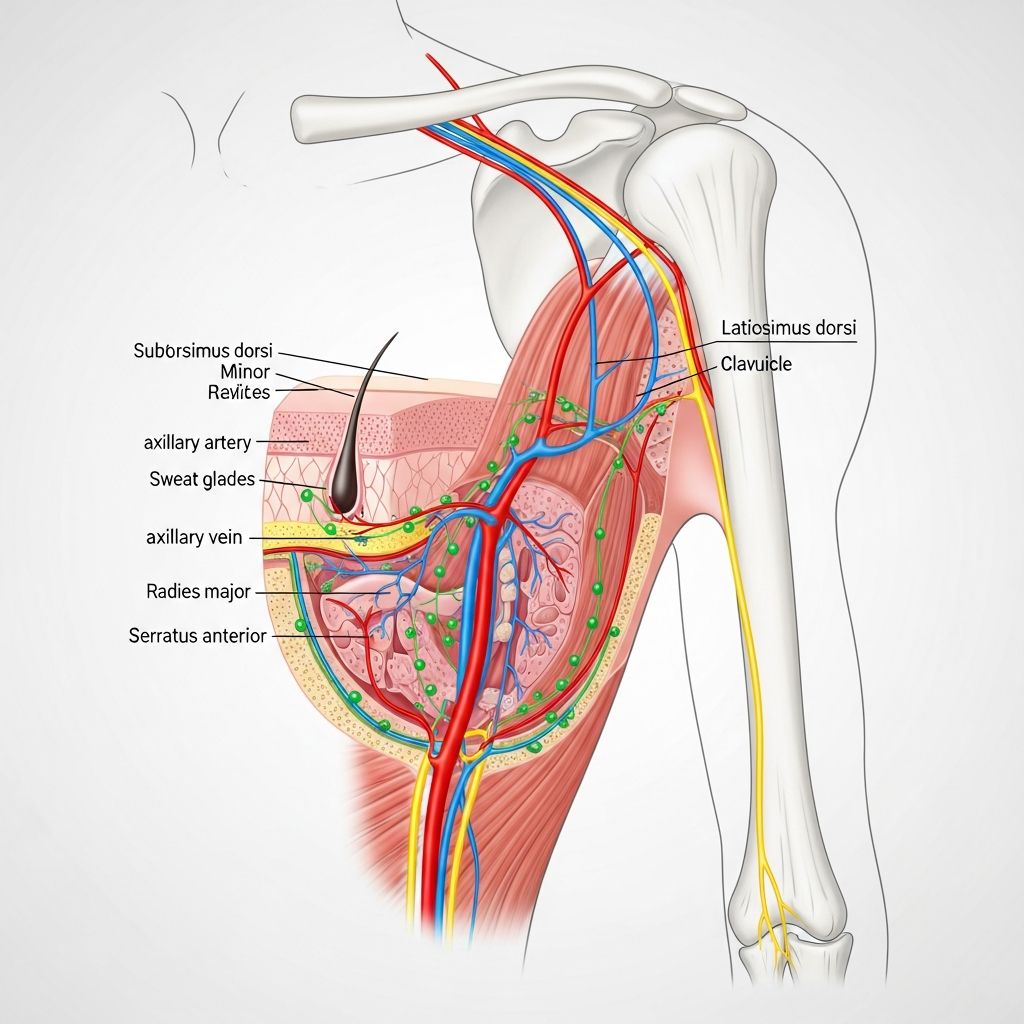
Understanding the Axilla: Anatomy and Function
The axilla, commonly known as the armpit, is far more than just a hollow space under your arm. It is a sophisticated anatomical region that serves as a critical gateway for important neurovascular structures connecting your arm, shoulder, chest, and neck. The axilla is pyramid-shaped and acts as a crucial junction point where numerous blood vessels, nerves, and lymphatic vessels pass through to supply and innervate the upper limb and surrounding regions. Understanding the anatomy of the axilla is essential for healthcare professionals and anyone interested in learning about how their body functions.
What Is the Axilla?
The axilla is an anatomical region located under the shoulder joint where the arm connects to the shoulder and thorax. This triangular or pyramid-shaped space lies between the thorax and the arm, serving as a connection point between the arm, neck, thorax, and pectoral regions. The axilla contains a variety of critical neurovascular structures, including the axillary artery, axillary vein, brachial plexus, and numerous lymph nodes. Beyond its role as a conduit for these vital structures, the axilla is also known for being notoriously ticklish due to the high concentration of nerve endings present in this region.
Anatomical Boundaries and Structure
The axilla is bounded by five distinct anatomical walls, each composed of specific muscles and tissues that define its borders and structure. Understanding these boundaries is essential for surgical procedures, clinical examinations, and comprehending how the axilla functions as a cohesive anatomical unit.
The Five Walls of the Axilla
The axilla has a pyramid-like configuration with an apex, a base, and four walls. Each wall is formed by different anatomical structures:
| Wall | Primary Structures | Function |
|---|---|---|
| Anterior Wall | Pectoralis major and pectoralis minor muscles; anterior axillary fold formed by pectoralis major | Flex, adduct, and medially rotate the arm at the glenohumeral joint |
| Posterior Wall | Subscapularis muscle, teres major, latissimus dorsi; posterior axillary fold | Internally rotate and adduct the arm; extend the arm |
| Medial Wall | Serratus anterior muscle | Protraction and anteversion of the scapula |
| Lateral Wall | Coracobrachialis and short head of biceps muscles | Flex and adduct the elbow; flex and supinate the elbow |
| Superior Border | Apex connecting to the neck region | Serves as transition zone to cervical structures |
The base of the axilla forms what we commonly refer to as the axillary fossa or armpit, where the skin and superficial tissues create the visible depression under the arm.
Neurovascular Structures of the Axilla
The axilla houses some of the most important blood vessels and nerves of the upper limb. These structures are organized within the axillary sheath, a connective tissue layer that provides protection and organization to the neurovascular bundle.
Arterial Supply
The primary blood supply to the axilla is the axillary artery, which branches directly from the subclavian artery and serves as a major blood supplier to the shoulder and upper arm. The axillary artery progresses through three parts and gives off multiple branches:
First Part: Gives off the superior thoracic artery, which supplies the subclavius muscle and the muscles of the first and second intercostal spaces, as well as the superior aspect of the serratus anterior.
Related Stories



Second Part: Typically has two branches, including the thoracoacromial artery and other branches that supply the pectoral region and surrounding structures.
Third Part: Contains the subscapular artery (the largest branch of the axillary artery), which supplies the intercostal muscles, latissimus dorsi, and serratus anterior muscles. This part also gives off the circumflex scapular artery, which passes posteriorly between muscles to reach the dorsal surface of the scapula and forms an important anastomosis with the suprascapular artery. Additionally, the thoracodorsal artery travels with the thoracodorsal nerve to supply the latissimus dorsi muscle.
The final major branches are the anterior and posterior circumflex humeral arteries, which emerge from the axillary artery and encircle the surgical neck of the humerus in what is described as an “arterial hug.” The anterior circumflex humeral artery supplies the shoulder joint, while the posterior circumflex humeral artery supplies the glenohumeral joint, deltoid muscle, and surrounding structures.
Venous Drainage
The axillary vein is the most superficial of the neurovascular structures within the axillary sheath and corresponds to the axillary artery as it carries deoxygenated blood from the upper limb back toward the heart. The axillary vein runs alongside the axillary artery and receives tributaries that correspond to the arterial branches.
The Brachial Plexus and Nerve Supply
The brachial plexus is a network of nerves originating from the C5-T1 spinal roots and represents the principal nervous structure in the axillary area. This complex network undergoes a sophisticated organization process within the axilla:
The five nerve roots merge into three trunks (superior, middle, and inferior), which then form six divisions. These divisions subsequently merge into three cords (lateral, posterior, and medial cords), which are named according to their relationship to the axillary artery. Finally, the three cords divide into five terminal branches: the musculocutaneous, axillary, radial, median, and ulnar nerves.
Each of these nerves supplies specific muscles and provides sensory innervation to various regions of the upper limb. For example, the musculocutaneous nerve originates from the C5-C6 nerve roots and innervates the coracobrachialis and biceps muscles. The long thoracic nerve branches directly from the C6, C7, and C8 nerve roots to innervate the serratus anterior muscle.
Lymphatic System of the Axilla
The axilla contains an extensive network of lymph nodes and lymphatic vessels that play a crucial role in immune function and drainage of the upper limb and chest wall. Lymph nodes are bean-shaped areas of tissue that filter fluid in your body for harmful substances or cells. The axillary lymph nodes are organized into several groups that receive and process lymphatic fluid from different regions:
Anterior Nodes: Located along the medial wall of the axilla, these nodes receive lymphatic drainage from the anterior thoracic wall and most of the breast.
Central Nodes: Positioned in the center of the pyramid, these nodes process lymph from various sources.
Apical Nodes: Located at the apex of the axilla, these nodes receive lymph from the central nodes and also receive lymphatic vessels accompanying the cephalic vein.
The lymphatic drainage system of the axilla is clinically significant, particularly in breast cancer assessment, as cancer from the breast often spreads to axillary lymph nodes. Surgical oncologists perform axillary lymph node dissection to determine if cancer has spread to lymph nodes in the armpit.
Muscles of the Axilla
The muscles forming the boundaries of the axilla work together to enable a wide range of arm and shoulder movements. Each muscle receives specific nerve innervation and performs distinct functions:
Pectoralis Major and Minor: These muscles form the anterior wall and receive innervation from the medial and lateral pectoral nerves. They function to flex, adduct, and medially rotate the arm at the glenohumeral joint.
Subscapularis: Located on the posterior wall, this muscle receives its nerve supply from the upper subscapular nerve and functions to internally rotate the arm.
Teres Major and Latissimus Dorsi: These posterior muscles function to internally rotate and adduct the arm, with the latissimus dorsi also extending the arm.
Serratus Anterior: Forming the medial wall, this muscle functions in anteversion and protraction of the scapula, enabling forward movement of the shoulder blade.
Coracobrachialis and Biceps: Comprising the lateral wall, the coracobrachialis functions in flexion and adduction of the elbow joint, while the short head of the biceps assists in flexion and supination of the elbow joint.
Clinical Significance and Anatomical Variations
The axilla has significant clinical importance due to the concentration of vital structures within a relatively small space. Healthcare professionals must understand axillary anatomy for various procedures, including physical examinations, injections, and surgical interventions.
There are anatomical variances in the points of entry and exit, paths, and locations of veins, arteries, and nerves in the axilla. These variations are particularly important during surgical procedures in the axillary region, such as axillary lymph node biopsies. The medial cutaneous nerve is the smallest branch of the brachial plexus that passes through the axilla and runs alongside the axillary vein. In some individuals, this nerve may deviate from its typical path or even split into multiple branches during its passage through the axilla.
Understanding these anatomical variations is crucial for surgical planning and reducing the risk of nerve injury during procedures involving the axillary region.
Frequently Asked Questions
Q: Why is the armpit so ticklish?
A: The axilla contains a high concentration of nerve endings, particularly from branches of the brachial plexus, which makes it extremely sensitive to light touch and pressure, resulting in the ticklish sensation.
Q: Why is the axilla clinically important in breast cancer?
A: The axillary lymph nodes receive lymphatic drainage from the breast tissue, so cancer cells often spread to these nodes first. Examining and potentially removing axillary lymph nodes helps determine cancer stage and prognosis.
Q: What happens if the axillary nerve is injured?
A: Injury to the axillary nerve can affect your ability to rotate your arm or lift it, as this nerve provides motor innervation to the deltoid muscle and sensory innervation to the shoulder region.
Q: What structures pass through the axilla?
A: The axilla contains the axillary artery and vein, the brachial plexus (and its five terminal nerves), lymph nodes and lymphatic vessels, and various muscles that form its boundaries.
Q: Are there variations in axillary anatomy between individuals?
A: Yes, there are anatomical variances in the paths and locations of veins, arteries, and nerves in the axilla that vary between individuals, which is important to consider during surgical procedures.
References
- Anatomy of the axilla — YouTube Video Transcript. 2024. https://www.youtube.com/watch?v=MorKbtoXGmk
- Anatomy, Shoulder and Upper Limb, Axilla — StatPearls, National Center for Biotechnology Information (NCBI), National Institutes of Health (NIH). 2024. https://www.ncbi.nlm.nih.gov/books/NBK547723/
- Axillary Nerve: Overview, Function & Anatomy — Cleveland Clinic. 2024. https://my.clevelandclinic.org/health/body/22264-axillary-nerve
- Lymph Node Locations & Function — Cleveland Clinic. 2024. https://my.clevelandclinic.org/health/body/23131-lymph-nodes
- Axillary Lymph Nodes: Dissection & Recovery — Cleveland Clinic. 2024. https://my.clevelandclinic.org/health/procedures/axillary-lymph-node
Similar Articles








Read full bio of Sneha Tete