Azathioprine And Mercaptopurine: Expert Guide For Dermatology
Immunosuppressant drugs for severe skin conditions: uses, dosing, monitoring, and safety in dermatology practice.
Authoritative fact sheet on azathioprine and mercaptopurine — what are they, uses and risks in dermatology practice.
What are azathioprine and mercaptopurine?
Azathioprine and mercaptopurine (also known as 6-mercaptopurine) are synthetic purine analogues with immunosuppressive properties. Azathioprine is a prodrug that is metabolized into mercaptopurine in the body, which then exerts its therapeutic effects primarily by interfering with nucleic acid synthesis and T-cell activation pathways. These drugs have been utilized in dermatology for decades to manage severe inflammatory and autoimmune skin conditions as steroid-sparing agents.
Originally developed for antileukemic therapy, azathioprine gained prominence in organ transplantation in the 1960s and has since become a cornerstone in treating autoimmune blistering diseases, eczematous disorders, and photodermatoses. Mercaptopurine, its active metabolite, is less commonly used directly in dermatology but shares the same pharmacological profile. Their mechanism involves conversion to active thioguanine nucleotides that disrupt DNA and RNA synthesis, particularly in rapidly dividing immune cells.
Who gets them prescribed?
Azathioprine and mercaptopurine are indicated for patients with severe, refractory dermatological conditions unresponsive to topical therapies or corticosteroids. Common indications include:
- Immunobullous diseases such as pemphigus vulgaris and bullous pemphigoid.
- Generalized eczematous disorders like severe atopic dermatitis and chronic actinic dermatitis.
- Photodermatoses and lupus erythematosus.
- Other autoimmune conditions including dermatomyositis, psoriasis (refractory cases), and sarcoidosis.
These medications are particularly valuable in pediatric and pregnant patients under careful supervision, serving as alternatives to more toxic agents like cyclophosphamide.
What does it look like?
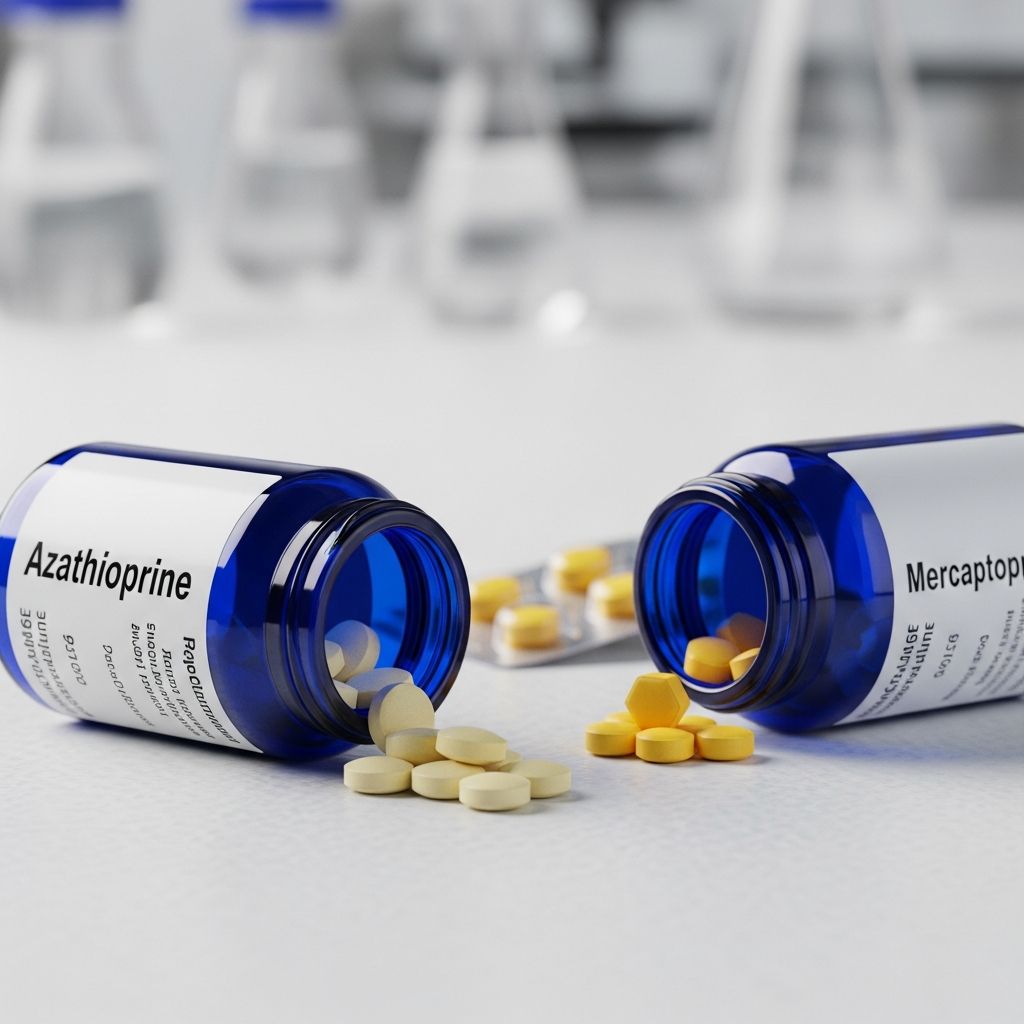
Azathioprine is available as 50 mg yellow tablets, often imprinted with a score line for easy division. Mercaptopurine comes in 50 mg tablets, typically pale yellow. Both are oral formulations dispensed in blister packs or bottles, with azathioprine also available as an injectable form for specific cases, though rarely used in dermatology.
How do they work?
Azathioprine is rapidly cleaved by glutathione in red blood cells to mercaptopurine, which is further metabolized via three main pathways:
- HPRT pathway: Forms active 6-thioguanine nucleotides (6-TGN) that incorporate into DNA/RNA, inhibiting cell proliferation.
- TPMT pathway: Methylates metabolites to inactive forms; genetic deficiency increases toxicity risk.
- XO pathway: Oxidizes to inactive thiouric acid.
Recent insights highlight azathioprine’s unique inhibition of CD28 costimulation in T-cells, independent of mercaptopurine metabolites, enhancing its immunosuppressive efficacy. Mercaptopurine directly enters these pathways, amplifying effects in sensitive patients.
Genetic testing prior to treatment
Thiopurine S-methyltransferase (TPMT) genotyping or phenotyping is essential before initiating therapy to predict myelotoxicity risk. TPMT enzyme methylates thiopurines; low activity (6-11% population) requires dose reduction, while deficient activity (<0.3%) contraindicates use.
| TPMT Status | Prevalence | Recommended Dose Adjustment |
|---|---|---|
| Normal (high activity) | 89-90% | Full dose (2-3 mg/kg/day) |
| Intermediate | 10% | 30-70% dose reduction |
| Deficient | 0.3% | Contraindicated or very low dose |
Interethnic variations exist; screening is routine in Caucasians and Africans for TPMT, and Japanese for ITPA. Hypoxanthine-guanine phosphoribosyltransferase (HGPRT) deficiency, as in Lesch-Nyhan syndrome, reduces efficacy.
Related Stories



Dose and scheduling
Standard azathioprine dose is 2-3 mg/kg/day orally, adjusted for TPMT status and response. Mercaptopurine dosing mirrors this at 1-1.5 mg/kg/day. Start low (1 mg/kg) to assess tolerance, titrating over weeks. Weight-based calculation ensures precision:
- 50 kg patient: 100-150 mg azathioprine daily.
- Allopurinol co-therapy halves dose to avoid toxicity.
In photodermatoses, lower doses (1-2 mg/kg) suffice. Pulse regimens (e.g., 500 mg/day for 3 days monthly) show promise in psoriasis.
Monitoring
Regular blood monitoring is mandatory due to myelosuppression risk:
- Weeks 1-4: CBC weekly (WBC >3.5 x10^9/L, neutrophils >2.0 x10^9/L).
- Weeks 5-8: Biweekly.
- Month 3+: Monthly.
- LFTs and renal function every 3 months.
Therapeutic 6-TGN levels (235-400 pmol/8×10^8 RBCs) guide dosing in refractory cases. Discontinue if WBC drops below thresholds.
Drug interactions
- Allopurinol/Febuxostat: Inhibit XO; reduce azathioprine to 25-33% dose.
- Sulfamethoxazole/Trimethoprim: Increases myelotoxicity.
- Warfarin: Enhances anticoagulation; monitor INR.
- HLA testing: Avoid in HLA-B*58:01 carriers due to severe hypersensitivity risk.
Adverse effects and complications
Myelosuppression (leukopenia, thrombocytopenia) is most common (10-30%), reversible with dose adjustment. GI upset, hepatotoxicity (5-10%), and infections occur. Long-term risks include lymphoproliferative disorders (0.8-2.3/1000 patient-years) and non-melanoma skin cancers, prompting rigorous sun protection. Sweet syndrome and hypersensitivity (fever, rash) necessitate immediate cessation.
Response to treatment
Onset varies: 4-8 weeks for pemphigus remission, up to 3 months for eczema. Complete response rates: 60-80% in bullous diseases when combined with steroids. Maintenance dosing sustains remission; relapse common on cessation.
Clinical uses in dermatology
Pemphigus vulgaris
First-line steroid-sparing; superior to MMF, comparable to cyclophosphamide long-term. Combined with prednisone, achieves higher remission rates.
Bullous pemphigoid
Effective in elderly; 50-150 mg/day prevents psoriasis reactivation.
Atopic dermatitis
Reduces SCORAD by 26-37%; third-line for severe cases.
Chronic actinic dermatitis
57-92% improvement at 1-2.5 mg/kg.
Psoriasis
Refractory or with biologics; pulse therapy yields >5-year remission.
Dermatomyositis
Equivalent to methotrexate; combination for refractory disease.
Other uses
Sarcoidosis, morphea, eosinophilic fasciitis; steroid-sparing in lupus and vasculitis.
Special situations
Pregnancy
Category D; use if benefits outweigh risks (e.g., severe pemphigus). No increased malformation risk in first trimester, but monitor for IUGR and immunosuppression in neonate. Breastfeeding contraindicated.
Breastfeeding
Infant exposure low but risky; avoid.
Children
Safe at 2-3 mg/kg; TPMT testing crucial.
Prevention and prognosis
TPMT screening, monitoring, and sun avoidance optimize outcomes. Prognosis excellent in responsive diseases; 70-90% achieve control.
Frequently asked questions
What is the main difference between azathioprine and mercaptopurine?
Azathioprine is a prodrug converted to mercaptopurine, offering better bioavailability and tolerability.
Is TPMT testing mandatory?
Yes, to prevent severe myelotoxicity in deficient patients.
How long until azathioprine works?
Typically 4-12 weeks; patience required.
Can it be used in pregnancy?
Only if essential; consult specialist.
What if blood counts drop?
Reduce or stop dose; monitor closely.
References
- Azathioprine in dermatology: the past, the present, and the future — Tan E, et al. Journal of the American Academy of Dermatology. 2006-08-01. https://pubmed.ncbi.nlm.nih.gov/16908341/
- Azathioprine: its uses in dermatology — Mesa MA, et al. An Bras Dermatol. 2020-11-13. https://pmc.ncbi.nlm.nih.gov/articles/PMC7672387/
- Azathioprine in the Treatment of Autoimmune Blistering Diseases — Plasticsurgerykey.com (summarizing peer-reviewed data). 2017. https://plasticsurgerykey.com/azathioprine-in-the-treatment-of-autoimmune-blistering-diseases/
- Azathioprine — National Center for Biotechnology Information. Updated 2023. https://en.wikipedia.org/wiki/Azathioprine
- Azathioprine: a guide for the management of dermatology patients — Warren RB, et al. Dermatologic Therapy. 2007. https://onlinelibrary.wiley.com/doi/abs/10.1111/j.1529-8019.2007.00134.x
Similar Articles








Read full bio of medha deb