B Cells: Types, Function & Immune Protection
Learn how B cells protect you by producing antibodies and fighting infections.
What Are B Cells?
B cells are a type of white blood cell that plays a crucial role in protecting your body from infection and disease. Also known as B lymphocytes, these cells are classified as lymphocytes—specialized white blood cells that fight harmful invaders and abnormal cells like cancer cells. Your B cells are part of your adaptive immune system, which is specialized to recognize and fight particular types of threats such as specific viruses or bacteria.
The primary function of B cells is to produce infection-fighting proteins called antibodies in response to antigens, which are markers that allow your immune system to identify harmful substances in your body, including viruses and bacteria. Unlike your innate immune system, which provides general protection against any threat, your adaptive immune system—with B cells at its core—develops specific defenses against particular pathogens.
B cells work in coordination with other immune cells, particularly T cells, to create a comprehensive defense network. While T cells coordinate immune responses and destroy pathogens directly, B cells manufacture antibodies that neutralize threats. This division of labor makes your immune system remarkably effective at protecting your health.
How B Cells Protect You
When your immune system detects antigens—markers indicating that a bacteria, virus, or other harmful pathogen has entered your body—your B cells spring into action. These cells recognize the specific threat and produce customized antibodies designed to fight that particular invader. The antibodies don’t destroy the pathogen directly; rather, they mark it for destruction by other immune cells or neutralize its harmful effects.
B cells are key regulatory cells in the immune system that produce antibodies and serve as antigen-presenting cells, supporting other mononuclear cells and directly contributing to inflammatory pathways. They mediate the production of antigen-specific immunoglobulin directed against invasive pathogens. When a B cell encounters an antigen, it recognizes it through a membrane-bound B-cell receptor (BCR) and accessory cell-surface receptors.
One remarkable feature of B cells is their ability to remember specific antigens. This immunological memory allows your immune system to launch a faster and more effective defense if the same pathogen ever enters your body again. This memory response is why vaccinations work so effectively—they train your B cells to recognize and respond to specific threats before you ever encounter them naturally.
Types of B Cells
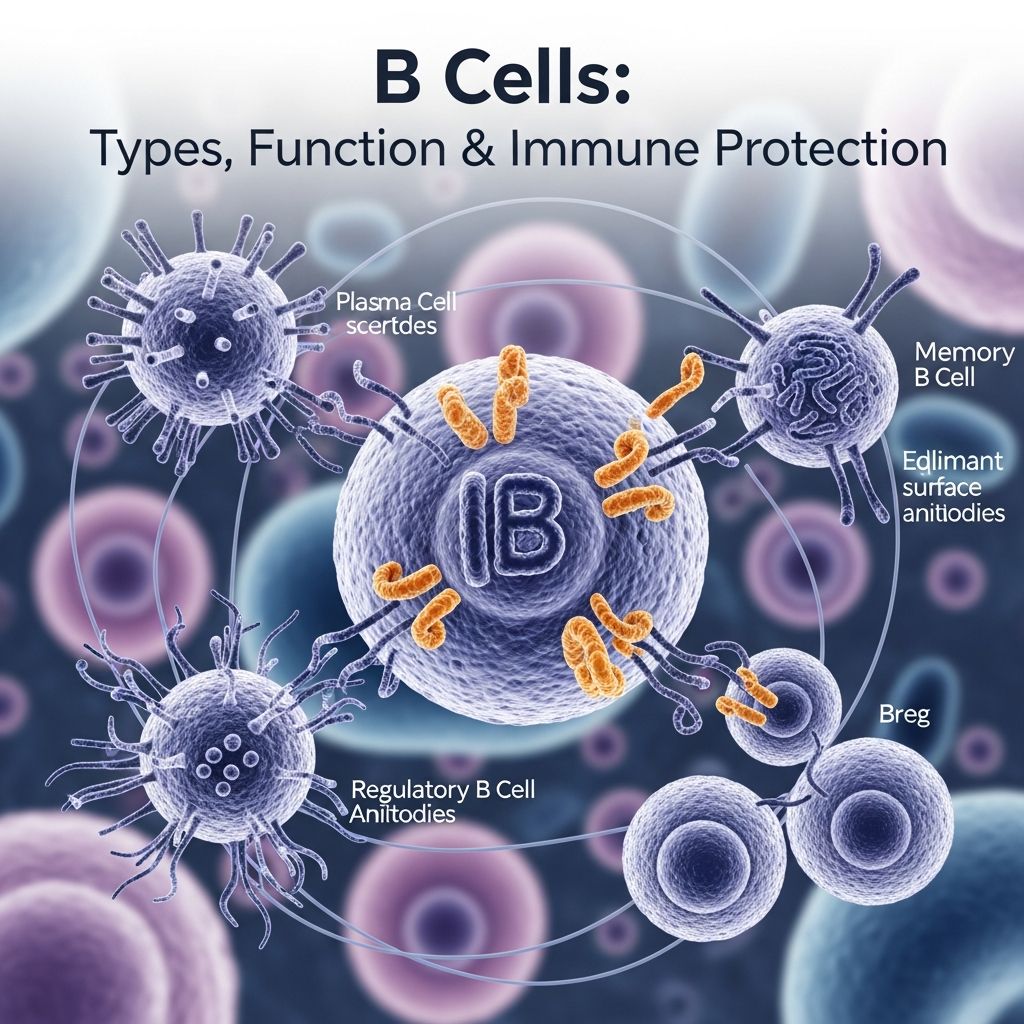
There are two main types of B cells that work together to provide both immediate and long-lasting protection:
Plasma Cells
Plasma cells are B cells that have been activated by exposure to an antigen. Once activated, B cells transform into plasma cells that actively produce and secrete large numbers of antibodies in response to the specific antigen that triggered them. These cells provide immediate protection during an active infection. Plasmablasts, which are early forms of plasma cells, produce initial antibodies mostly of the IgM class, which offer early but relatively weak immunity. The long-lived plasma cells that develop later produce high-affinity antibodies that circulate throughout your body, providing more effective defense.
Related Stories



Memory B Cells
Memory B cells are dormant B cells that circulate through your body and remain alert for any sign of a previously encountered antigen. If they detect their target antigen again, they initiate a stronger and more rapid antibody response—known as the anamnestic secondary antibody response. This enhanced response is what gives you lasting immunity and is the reason why you typically don’t catch the same infection twice.
Beyond these two primary types, researchers have identified additional specialized B cell populations. Marginal-zone B cells are found mainly in the spleen and serve as a first line of defense against blood-borne pathogens. Regulatory B cells (Breg cells) are immunosuppressive B cells that stop the expansion of pathogenic, pro-inflammatory lymphocytes through the secretion of specific molecules, and they promote the generation of regulatory T cells.
B Cells and Your Adaptive Immune System
Your immune system consists of two main components: your innate immune system and your adaptive immune system. While your innate immune system is your first defense against any threat, providing general protection against all pathogens, your adaptive immune system is specialized to recognize and fight particular types of threats.
B cells are central to your adaptive immune system. When a pathogen enters your body, your immune system must first identify what it is. This recognition process triggers B cell activation through interaction with T cells and other immune cells. Following T cell receptor-MHC-II-peptide binding, T helper cells express surface proteins and cytokines such as IL-4 and IL-21 that activate B cells.
Once activated, B cells participate in a sophisticated two-step differentiation process. In the first step, called the extrafollicular response, activated B cells proliferate outside lymphoid follicles and differentiate into plasmablasts that produce early antibodies. In the second step, B cells enter a lymphoid follicle and form a germinal center, a specialized microenvironment where B cells undergo extensive proliferation, immunoglobulin class switching, and affinity maturation. This process generates both high-affinity memory B cells and long-lived plasma cells.
B Cells vs. T Cells
While both B cells and T cells are lymphocytes that protect you from infection-causing pathogens and diseases, they play distinct and complementary roles in your immune system:
| Feature | B Cells | T Cells |
|---|---|---|
| Primary Function | Produce antibodies in response to antigens | Send signals controlling immune response or kill pathogens directly |
| Maturation Location | Bone marrow | Thymus gland |
| Immunity Type | Humoral (antibody-mediated) | Cell-mediated |
| Main Action | Antibodies neutralize or mark invaders | Helper T cells coordinate; cytotoxic T cells destroy infected cells |
| Response Type | Indirect—antibodies fight the threat | Direct—cells themselves fight the threat |
T cells send signals that control your immune response (helper T cells) or kill pathogens or infected cells directly (cytotoxic T cells). B cells make proteins called antibodies in response to antigens. It’s the antibodies and not the B cell directly that stops the invader. Together, B cells and T cells create a comprehensive immune defense system that addresses threats from multiple angles.
The Importance of B Cells in Your Immune System
B cells are essential for maintaining immune system health and function. They are responsible for generating the majority of high-affinity antibodies during an infection, providing targeted and effective defense against specific pathogens. Beyond producing antibodies, B cells serve multiple other critical functions.
B cells are necessary for immune system maintenance and support overall immune homeostasis. They release immunomodulatory cytokines that influence immune cell functions of T cells and dendritic cells, and they regulate lymphoid tissue organogenesis, wound healing, and transplanted tissue rejection. Research has shown that depletion of B cells during development leads to severe consequences and congenital abnormalities within the immune system, including a generalized decrease in the number and diversity of T cells, defects within dendritic cells, and absence of certain lymphoid structures.
Regulatory B cells play a particularly important role in maintaining immune balance. They regulate T-cell-mediated inflammatory responses by producing IL-10 and help prevent excessive immune activation that could damage your own tissues.
How to Keep Your B Cells and Immune System Healthy
Maintaining a strong immune system requires attention to several key lifestyle factors:
Get Regular Exercise: Physical activity boosts immune function and helps your B cells and other immune cells work more effectively.
Eat a Balanced Diet: Nutrients like vitamins C and D, zinc, and antioxidants support immune cell development and function.
Stay Hydrated: Proper hydration helps lymph circulation and supports immune cell movement throughout your body.
Get Adequate Sleep: During sleep, your immune system strengthens, allowing B cells and other immune cells to function optimally.
Manage Stress: Chronic stress can suppress immune function, including B cell activity.
Practice Good Hygiene: Regular handwashing and other hygiene measures reduce pathogen exposure and give your immune system less to fight.
Stay Current with Vaccinations: Vaccines train your B cells to recognize specific pathogens, providing protection before you encounter them naturally.
Frequently Asked Questions
Q: What is the difference between an antigen and an antibody?
A: An antigen is a foreign substance, such as a virus or bacterium protein, that triggers an immune response. An antibody is a protein produced by B cells in response to an antigen. The term “antibody” literally means “anti-body generator”—antibodies are generated in response to antigens.
Q: Can B cells attack your own body?
A: Under normal circumstances, no. B cells have the ability to distinguish between self and non-self—they recognize foreign antigens rather than self-antigens. However, when this system malfunctions, autoimmune diseases can develop where B cells produce antibodies against the body’s own tissues.
Q: How long do antibodies produced by B cells last?
A: The lifespan of antibodies varies. Some antibodies may last weeks to months in circulation, while long-lived plasma cells in the bone marrow can produce antibodies for years or even a lifetime, providing long-term immunity.
Q: Do vaccinations work with B cells?
A: Yes, vaccinations work by training your B cells and memory B cells to recognize specific pathogens. When you receive a vaccine, your B cells learn to produce antibodies against that particular threat, so if you encounter it naturally later, your immune system can respond quickly and effectively.
Q: What happens if you don’t have enough B cells?
A: Without sufficient B cells, your immune system cannot produce adequate antibodies, leaving you vulnerable to infections. Conditions like X-linked agammaglobulinemia result in very few or no B cells, requiring patients to receive regular infusions of antibodies to stay healthy.
References
- B Cells: Types and Function — Cleveland Clinic. 2024. https://my.clevelandclinic.org/health/body/24669-b-cells
- B cell — National Center for Biotechnology Information. https://www.ncbi.nlm.nih.gov/books/NBK560905/
- Histology, B-Cell Lymphocyte — StatPearls, National Center for Biotechnology Information. https://www.ncbi.nlm.nih.gov/books/NBK560905/
- Introduction to T and B lymphocytes — National Center for Biotechnology Information. https://www.ncbi.nlm.nih.gov/books/NBK459471/
- Overview of B- and T-Cell Function — Merck Manuals. https://www.merckmanuals.com/home/multimedia/video/overview-of-b-and-t-cell-function
- B Cells — British Society for Immunology. https://www.immunology.org/public-information/bitesized-immunology/cells/b-cells
- Definition of B cell — National Cancer Institute Dictionary of Cancer Terms. https://www.cancer.gov/publications/dictionaries/cancer-terms/def/b-cell
Similar Articles








Read full bio of Sneha Tete