Barrier Function In Atopic Dermatitis: What You Need To Know
Understanding how impaired skin barrier drives atopic dermatitis pathogenesis and effective restoration strategies.
Barrier Function in Atopic Dermatitis
The
skin barrier
serves as the body’s primary defense against external threats including pathogens, chemicals, irritants, and allergens that could trigger immune responses if they penetrate deeper skin layers. This protective function also prevents excessive water loss from the epidermis, with barrier integrity measurable throughtransepidermal water loss (TEWL)
rates—elevated TEWL indicates heightened permeability. Additional metrics include surface pH, tracer compound penetration, stratum corneum hydration, and cohesion.Who gets atopic dermatitis (epidemiology)?
Atopic dermatitis (AD), commonly known as eczema, affects approximately 15-20% of children worldwide and 2-10% of adults, with higher prevalence in industrialized nations. Genetic predisposition, particularly
filaggrin (FLG) mutations
, combined with environmental factors like urban living and pollution, drives susceptibility. Lesional and non-lesional skin in AD patients exhibits disrupted stratum corneum homeostasis, leading to increased allergen penetration and water loss even before visible flares.What is the skin barrier?
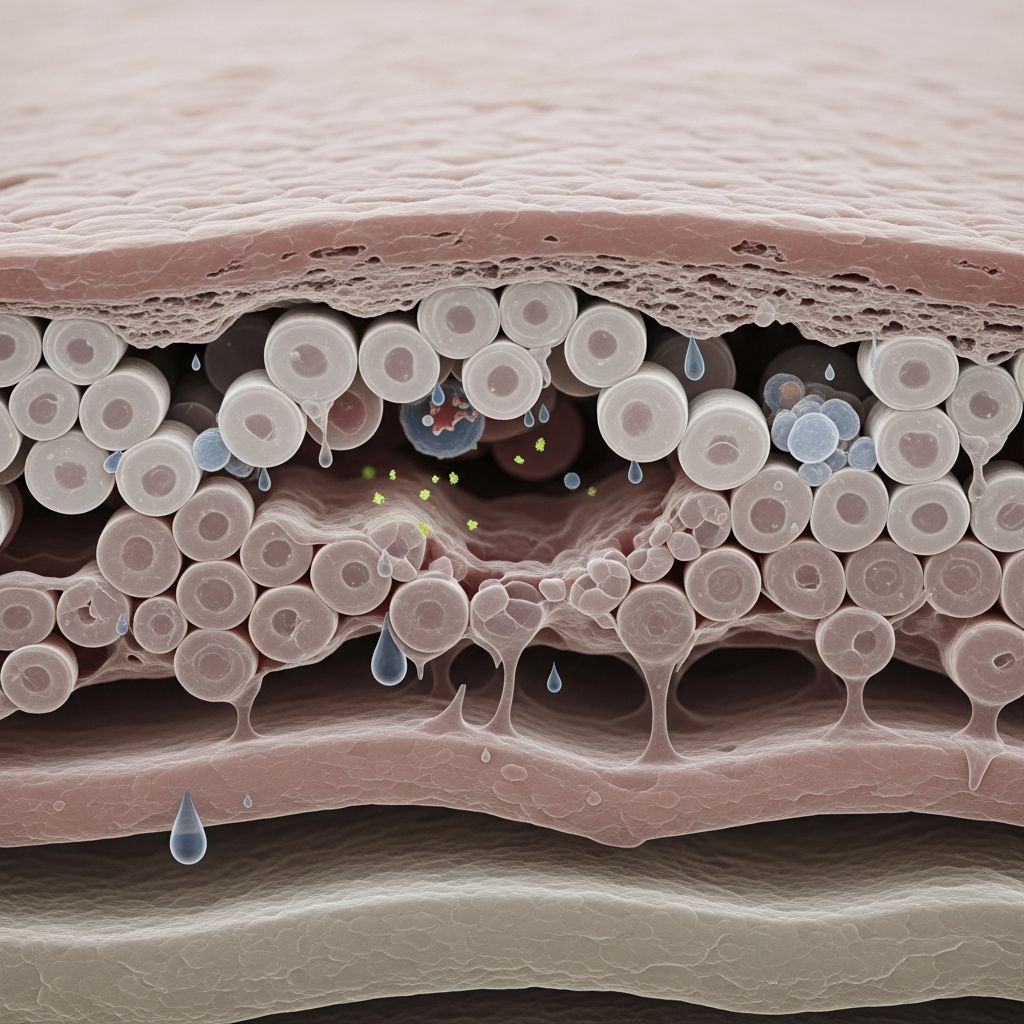
The skin barrier resides primarily in the
stratum corneum (SC)
, the outermost epidermal layer composed of dead, flattenedcorneocytes
embedded in a lipid matrix. This ‘brick-and-mortar’ structure blocks external agents while retaining moisture. Key components include:- Corneocytes: Protein-rich cells providing mechanical strength.
- Intercellular lipids: Ceramides (50%), cholesterol (25%), and free fatty acids (10-20%) forming lamellar bilayers.
- Acidic mantle: pH ~4.5-5.5 regulating enzyme activity and microbial balance.
Disruption in any element compromises barrier function, as seen in AD.
Skin barrier defects in atopic dermatitis
In AD, both lesional and non-lesional skin display
altered SC homeostasis
, manifesting as:- Increased TEWL and permeability.
- Elevated SC pH.
- Reduced lipid content and abnormal organization.
- Impaired corneocyte integrity.
Filaggrin mutations
**Filaggrin (FLG)** is pivotal for SC integrity: it aggregates keratin filaments, forms the cornified envelope, and degrades into hygroscopic amino acids that maintain hydration and acidic pH. FLG mutations, present in 20-30% of AD patients, reduce these functions, elevating pH and promoting:
- Hyperactive serine proteases (KLK5, KLK7) that degrade corneodesmosomes, causing flaking and weakened cohesion.
- Inflammation via unchecked enzyme activity.
Th2 cytokines (IL-4, IL-13, IL-22) further suppress FLG expression, perpetuating the cycle.
Lipid abnormalities
The SC lipid matrix enables selective permeability. In AD:
| Lipid Component | Normal Proportion | AD Changes |
|---|---|---|
| Ceramides | ~50% | Reduced levels (especially long-chain), abnormal species; disrupts lamellar structure. |
| Cholesterol | ~25% | Decreased, impairing fluidity. |
| Free Fatty Acids | 10-20% | Lowered, increasing pH and permeability. |
These deficits create ‘gaps’ in the lipid mortar, facilitating allergen/hapten ingress and TEWL.
Protease activity and pH
Normal acidic pH inhibits proteases; AD’s alkaline SC (~6-7) activates KLK5/7, accelerating desquamation and barrier breakdown. This also amplifies cytokine release and Th2 skewing.
How does skin barrier dysfunction cause atopic dermatitis?
Impaired barrier enables ‘outside-in’ pathogenesis:
- Allergens/haptens penetrate, triggering proinflammatory cytokines (IL-1, TNF-α).
- Th2 cytokines (IL-4/13) suppress FLG/lipid genes, worsening defects.
- Scratching induces ‘inside-out’ inflammation via nerve growth factor and protease activation.
Severity correlates with barrier impairment degree; dry skin precedes flares.
Microbiome and barrier function
The cutaneous microbiome maintains homeostasis. In AD, >90% of patients are colonized by
Staphylococcus aureus (S. aureus)
, which:- Produces exotoxins (superantigens) stimulating IgE and itch.
- Inhibits epidermal fatty acid production, increasing permeability.
- Thrives in alkaline, disrupted SC.
Competent barriers (acidic pH, intact lipids) resist S. aureus; dysfunction fosters overgrowth and infection.
Clinical features of barrier dysfunction
Manifestations include xerosis, erythema, pruritus, and lichenification. TEWL elevation precedes lesions; pH rise correlates with severity. Non-lesional skin defects predict flares.
Treatment of barrier dysfunction
Barrier repair is foundational:
- Moisturizers: Daily application reduces flares by 50%+; ceramide-dominant formulas mimic SC lipids, lowering TEWL and restoring lamellae.
- Helpful ingredients: Ceramides, cholesterol, free fatty acids, natural moisturizing factor (NMF) components (urea, amino acids), humectants (glycerin), occlusives (petrolatum).
- Proactive use: RCTs show daily emollients in high-risk neonates delay/prevent AD onset.
Avoid irritants (soaps, fragrances); gentle cleansing preserves lipids.
Prevention of atopic dermatitis by skin barrier repair
Early intervention trials:
- Neonates at risk (FLG mutation carriers, atopic family history) applying ceramide moisturizers daily reduced AD incidence by 50% at 1 year.
- Continued use halves cumulative incidence.
Mechanism: Prevents initial barrier breach, averting sensitization.
Future directions
Emerging therapies target genetics (FLG enhancers), lipids (nanocarrier delivery), microbiome (targeted antibacterials), and pH (acidifying agents). Combination with biologics (dupilumab) synergizes repair.
Frequently Asked Questions (FAQs)
Can moisturizers prevent atopic dermatitis?
Yes, daily ceramide-based moisturizers in high-risk infants significantly reduce AD development, per RCTs.
Why is the skin pH higher in atopic dermatitis?
FLG deficiency reduces NMF, elevating pH; this activates proteases, worsening barrier function.
Does Staphylococcus aureus cause atopic dermatitis?
No, but colonizes disrupted barriers in >90% cases, exacerbating inflammation and permeability via toxins.
Are ceramide moisturizers better than regular ones?
Yes; they replenish deficient SC lipids, improving TEWL and hydration comparably to mild steroids with fewer side effects.
How often should AD patients apply moisturizer?
At least twice daily, plus post-bath; proactive use prevents flares.
References
- Barrier function in atopic dermatitis — DermNet NZ. 2023-06-15. https://dermnetnz.org/topics/barrier-function-in-atopic-dermatitis
- Skin barrier function, epidermal proliferation and differentiation in eczema — PubMed (J Invest Dermatol). 2006-08-01. https://pubmed.ncbi.nlm.nih.gov/16887338/
- Epidermal Barrier Function in Atopic Dermatitis: Lipid Replacement Therapy — Skin Therapy Letter. 2009-01-01. https://www.skintherapyletter.com/atopic-dermatitis/epidermal-barrier-function/
- Understanding the Fundamentals of Skin Barrier Physiology — Journal of Clinical and Aesthetic Dermatology. 2021-10-01. https://jcadonline.com/fundamentals-of-skin-barrier-physiology/
- Atopic dermatitis: Role of the skin barrier and novel therapeutic strategies — National Institutes of Health (PubMed Central). 2022-05-15. https://www.ncbi.nlm.nih.gov/pmc/articles/PMC9175395/
Similar Articles



Read full bio of medha deb